
A mandatory reconsideration (MR) is the formal process of asking the Department for Work and Pensions (DWP) to look again at your PIP Personal Independence Payment (PIP) decision. You must request it within one month of the date on your decision letter. Write to the DWP using the CRMR1 form or a detailed letter, explain which PIP Descriptors you believe were scored incorrectly, and include any supporting evidence. If the MR is refused, you can appeal to an independent tribunal.
What Is a Mandatory Reconsideration and Do I Have to Do It?
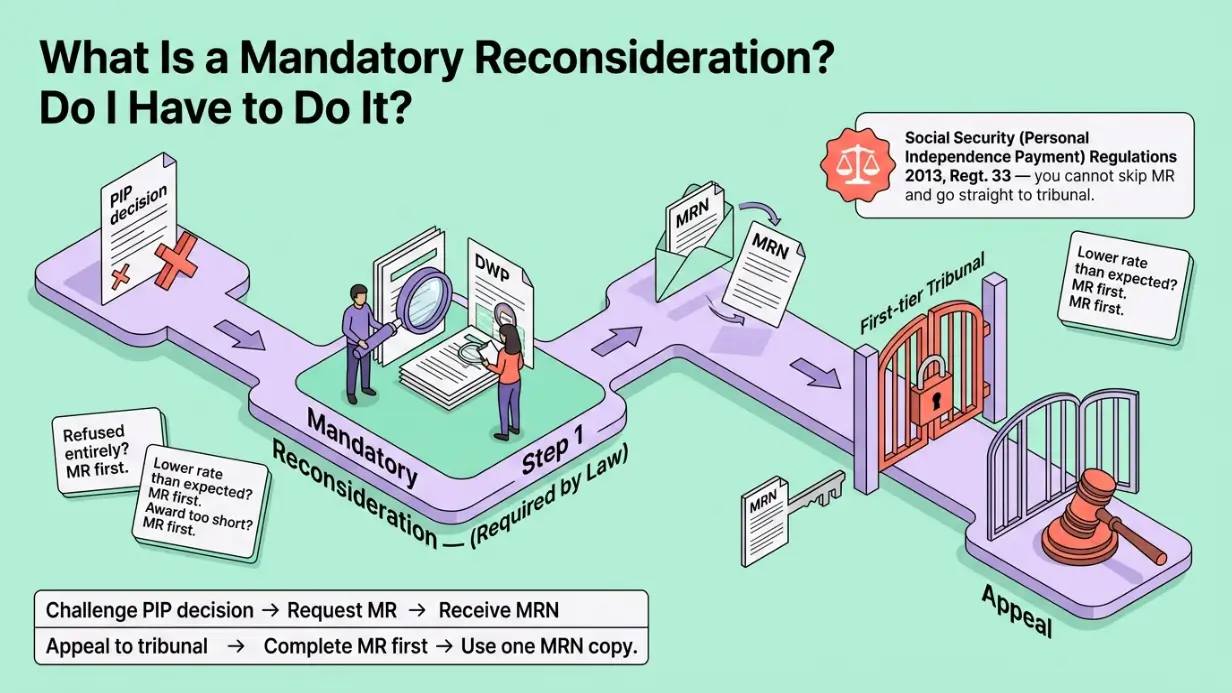
A mandatory reconsideration is the first step you must take to challenge a PIP decision you disagree with. You cannot skip it and go straight to an appeal tribunal. The law requires the DWP to review their own decision before an independent judge can hear your case.
The requirement is set out in the Social Security (Personal Independence Payment) Regulations 2013, Regulation 33 (https://www.legislation.gov.uk/uksi/2013/377/regulation/33/made). It applies whether the DWP refused your claim entirely, gave you a lower rate than you expected, or awarded PIP for a shorter period than you believe is correct.
When the DWP finishes its review, it sends you a Mandatory Reconsideration Notice (MRN). You will receive two copies. The MRN tells you whether the decision has been changed. If the decision stays the same, or changes but not by enough, you need one copy of the MRN to appeal to the First-tier Tribunal.
| If you want to… | You need to… |
|---|---|
| Challenge a PIP decision you disagree with | Request a mandatory reconsideration first |
| Appeal to an independent tribunal | Complete the MR stage and receive an MRN |
What Is the Deadline for a PIP Mandatory Reconsideration?
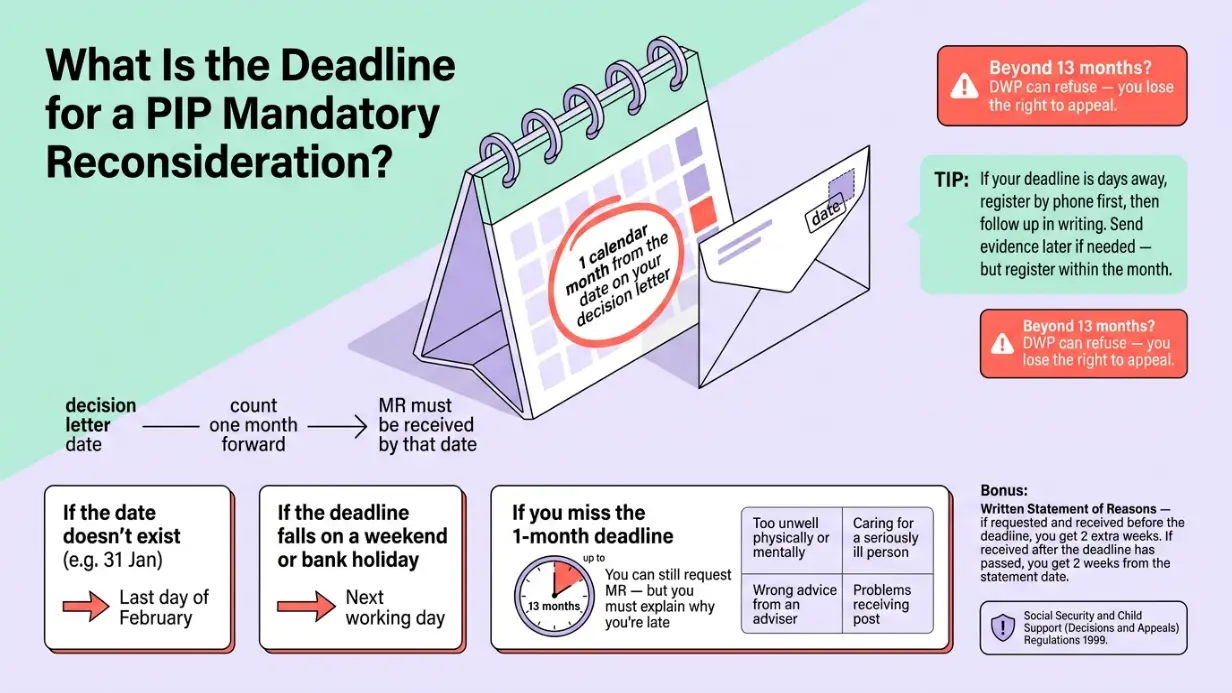
You have one calendar month from the date on your decision letter to request a mandatory reconsideration. The DWP must receive your request by that date — posting it on the deadline day is not enough if it arrives late.
How to count your deadline:
-
Find the date printed on your decision letter from the DWP.
-
Count one calendar month forward from that date.
-
Your MR request must be received by the DWP by that date.
-
If the date does not exist in the following month — for example, a letter dated 31 January — the deadline is the last day of February.
-
If the deadline falls on a Saturday, Sunday, or bank holiday, it moves to the next working day.
If you have missed the one-month deadline, you can still request an MR up to 13 months from the date of the decision letter. You must explain why you are late. The longer the delay, the stronger your reason needs to be. The legal basis for this is the Social Security and Child Support (Decisions and Appeals) Regulations 1999 (https://www.legislation.gov.uk/uksi/1999/991/regulation/4/made).
Examples of reasons the DWP may accept for a late request:
-
You were too unwell — physically or mentally — to make the request in time.
-
You were caring for a partner or relative who was seriously ill.
-
An adviser gave you wrong information about the deadline.
-
You had problems receiving post at your address.
If you are beyond 13 months from the decision date, the DWP can refuse your request and you lose the right to appeal. If you are close to the deadline, register the MR by phone first, then follow up in writing. Do not wait for new medical evidence if your deadline is days away — you can send evidence after registering the MR, but you must register within the month.
If you request a written statement of reasons from the DWP and receive it before the one-month deadline, you get an extra two weeks to submit your MR from the date you receive the statement. If the statement arrives after the one-month deadline has already passed, you get two weeks from the date of the statement to request your MR.
How Do I Start a Mandatory Reconsideration?
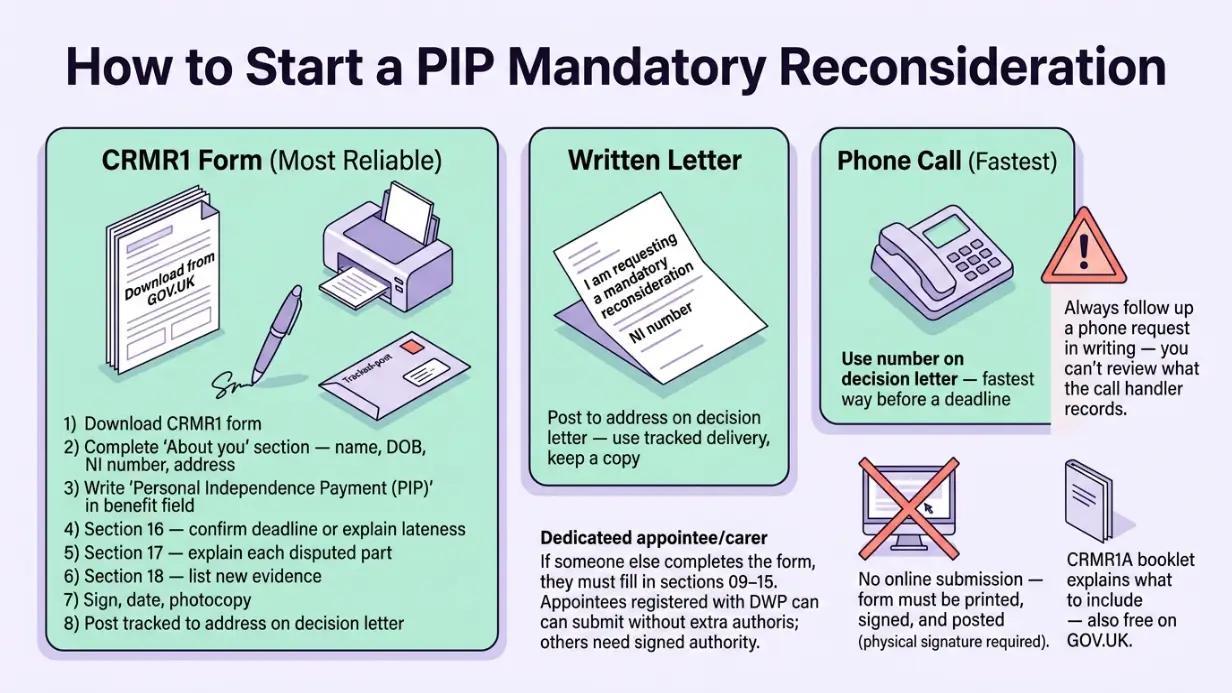
You can request a mandatory reconsideration by phone, by letter, or by using the CRMR1 form. Writing gives you the most control — you decide exactly what goes into your request, and you keep a copy of everything you submit. Phone requests rely on a DWP call handler accurately recording your reasons, and you cannot review what they write before a decision is made. If you phone, always follow up with a letter or form confirming what you said.
| Method | How to do it | Risk or benefit |
|---|---|---|
| CRMR1 form | Download from GOV.UK, print, sign, and post to the address on your decision letter | Most reliable — the DWP’s scanning system recognises this form and routes it correctly |
| Written letter | Send to the address on your decision letter; include your National Insurance number and state clearly that you are requesting a mandatory reconsideration | You control the content; keep a copy and send it by tracked post |
| Phone call | Use the number at the top of your decision letter | Fastest way to register before a deadline; always confirm in writing afterwards |
How to complete and submit the CRMR1 form:
The CRMR1 form (version 01/26) is the official DWP mandatory reconsideration request form, available at www.gov.uk/mandatory-reconsideration. The companion CRMR1A booklet explains what information to include and gives examples of evidence the DWP can consider. Both are free to download.
-
Download the CRMR1 form from www.gov.uk/mandatory-reconsideration.
-
Complete the “About you” section — your title, full name, date of birth, National Insurance number, and current address.
-
In the “Which benefit” field, write “Personal Independence Payment (PIP).”
-
Complete section 16 — confirm whether you are within the one-month deadline. If not, explain why in the space provided.
-
In section 17, explain each part of the decision you disagree with and why (see the guidance in the next section of this guide).
-
In section 18, list all new evidence you are sending with the form.
-
Sign and date the declaration.
-
Photocopy or photograph the completed form and all evidence before posting.
-
Post everything to the address printed on your decision letter. Use tracked delivery.
If someone else is completing the form on your behalf — a carer, family member, or appointee — they must complete section 09-15. An appointee already registered with the DWP can submit the MR request for you without additional authorisation. Anyone else acting on your behalf needs to include signed authority for them to represent you.
You cannot submit the CRMR1 form online. It must be printed, signed, and posted. This is a security requirement — the DWP requires a physical signature on the declaration.
What Should I Write in My Mandatory Reconsideration to Change the Decision?
The DWP decision maker does not need to understand your medical condition in detail. They need to understand why you cannot perform specific PIP activities safely, repeatedly, to an acceptable standard, and in a reasonable time. A letter describing how your condition feels will not change the decision. A letter that addresses specific PIP descriptors, states why the assessor was mistaken on each one, and links each point to evidence has a much better chance.
Before you write:
-
Get your decision letter, your statement of reasons, and your assessment report. Phone the DWP to request the report if you do not have it. The Reddit r/DWPhelp community refers to this as the PA3 or PA4 report.
-
Identify every PIP activity where you believe the points awarded were wrong.
-
Note the descriptor you believe you should have scored for each activity and how many points it carries.
-
Gather evidence that supports each disputed activity.
PIP assesses 12 activities — 10 for the daily living component and 2 for the mobility component. Each activity has descriptors that score between 0 and 12 points. You need 8 points for the standard daily living rate, 12 for the enhanced daily living rate, 8 for the standard mobility rate, and 12 for the enhanced mobility rate. The full descriptor list and points system is published on GOV.UK.
Letter structure:
Open with: “I am writing to request a mandatory reconsideration of the PIP decision dated [date on your decision letter]. My National Insurance number is [your NI number].”
For each disputed activity, write a paragraph following this structure: “For [activity name], the assessor stated [what the report says]. This is incorrect because [your specific difficulty]. I should have scored [X] points under the descriptor ‘[descriptor text]’ because [explain how you meet that descriptor’s criteria]. Please see [specific evidence reference].”
Close with: “Please find enclosed [list of all evidence]. I request that you do not make a decision until I have had the opportunity to respond to any further evidence the DWP intends to rely on.”
Example 1: Daily living activity
“The report from my medical assessment states I do not need any aids or help to prepare my meals. This is incorrect. I cannot safely stand at a hob because my balance is unreliable, and I have fallen in my kitchen twice in the past three months. I can only heat food in a microwave, and even then I need to sit on a stool while I wait. I should have scored 2 points under the descriptor ‘Needs to use an aid or appliance to be able to prepare or cook a simple meal.’ Please see the occupational therapy report from Ms J. Davies dated 12 March 2026, page 4, which confirms my balance difficulties and recommends a perching stool for kitchen use.”
Example 2: Mobility activity
“I do not believe you have adequately assessed the extent of my mobility problems. The assessor states I can walk 50 metres unaided. In reality, walking 50 metres causes significant pain in my hips and lower back, and I cannot walk again for several hours afterwards. On a typical day, I can walk approximately 20 metres before I need to stop. The pain is not occasional — it occurs every time I walk beyond a short distance. I should have scored 10 points under the descriptor ‘Can stand and then move more than 20 metres but no more than 50 metres.’ Please see the letter from my physiotherapist dated 8 February 2026 and my symptom diary for January-February 2026.”
How to challenge each PIP descriptor:
| PIP activity | What the DWP assesses | What to say if you disagree |
|---|---|---|
| Preparing food | Can you prepare a simple meal safely, with or without aids? | Describe a specific incident: what you tried to cook, what went wrong, what help you needed |
| Taking nutrition | Can you eat and drink without assistance or prompting? | If you need prompting to eat, describe who prompts you, how often, and what happens without prompting |
| Managing therapy or monitoring a health condition | Can you manage medication, treatments, and monitor your condition without help? | List each treatment, how many hours per week it takes, and exactly what help you need from another person |
| Washing and bathing | Can you wash your full body without help or aids? | State which body parts you cannot reach or wash safely, and why |
| Managing toilet needs or incontinence | Can you use the toilet without help? | If you need physical help or prompting, describe the specific assistance required |
| Dressing and undressing | Can you dress your upper and lower body without help? | State which items you cannot put on or take off, and what help you need |
| Communicating verbally | Can you speak and understand others without help? | If you need communication support, state what type and why |
| Reading and understanding signs, symbols, and words | Can you read basic written information? | If you need aids or help to read, state what you use and why |
| Engaging with other people face to face | Can you mix with people you do not know without help? | Describe what happens when you try — Anxiety symptoms, panic, avoidance behaviour, need for someone with you |
| Making budgeting decisions | Can you manage your money without help? | State what goes wrong without support — missed payments, debt, needing someone to handle your finances |
| Planning and following journeys | Can you plan and follow a route of a familiar journey without help? | Describe what prevents you — getting lost, anxiety, needing someone with you, inability to use public transport |
| Moving around | Can you stand and then move a specific distance without help? | State the exact distance you can walk before pain, breathlessness, or fatigue stops you, and what happens afterwards |
If you have a mental health condition:
The DWP sometimes dismisses mental health difficulties because your medication has not changed or you are not under secondary mental health services. This reasoning is flawed. NICE guideline NG222 states that many people continue to experience significant symptoms while on long-term medication, and a lack of dosage change is not proof of recovery or stability (https://www.nice.org.uk/guidance/ng222). If you are on an NHS waiting list for mental health support, state this clearly. The fact that you are waiting for treatment does not mean your condition is mild — it reflects NHS capacity, not the severity of your illness.
Important:
Do not call the assessor a liar, even if their report contains statements you believe are false. Use words like “mistaken,” “misunderstood,” “omitted,” or “did not adequately consider.” A direct accusation of dishonesty weakens your credibility with the decision maker. Stick to the evidence and the descriptors.
What Evidence Should I Send with My Mandatory Reconsideration?
You do not need new evidence to request a mandatory reconsideration. The DWP is legally required to review its decision based on the information it already holds. But new, relevant evidence that directly supports the PIP descriptors you are disputing makes a stronger case.
| Evidence type | What it proves | How to get it |
|---|---|---|
| GP or consultant letter | Diagnosis, symptoms, and how they affect daily function | Write to your GP or consultant; state clearly that you need the letter for a PIP mandatory reconsideration; GPs may charge a fee |
| Occupational therapy report | Specific functional difficulties with daily living activities | Request through NHS community OT services or commission a private assessment |
| Carer or family member letter | Observed daily difficulties and assistance required | Ask them to write one side of A4, sticking to what they see you struggle with and what they do to help |
| Symptom diary | Frequency and impact of fluctuating conditions | Keep for 2-4 weeks; note the date, the activity you attempted, the problem you experienced, and any help you needed |
| Your assessment report (PA3/PA4) | What the assessor said — so you can dispute it point by point | Phone the DWP and ask for a copy |
Write your National Insurance number on every piece of evidence you send. For every document, state in your covering letter or CRMR1 form which PIP activity it supports and which part of the assessment report it contradicts. Do not send a bundle of medical letters and expect the decision maker to work out the relevance. A 100-page evidence pack with no annotation is less effective than five pages of evidence with clear explanations linking each document to a specific descriptor.
If you are waiting for evidence and your one-month deadline is approaching, register the MR first by phone or with a brief written request. Then send the evidence separately with a cover note including your National Insurance number. State that this is additional evidence for your pending mandatory reconsideration.
How Long Does a PIP Mandatory Reconsideration Take?
The DWP is not subject to a statutory deadline for completing mandatory reconsiderations. This differs from new PIP claims, which have published clearance targets. Based on available advice service reporting, most PIP MRs take between 8 and 12 weeks, though some take several months. I cannot provide a precise current average because the DWP does not publish MR processing time data in the same format as new claim clearance statistics.
Your wait time may be longer if you submitted new evidence that the decision maker needs to review, if your case involves multiple conditions and disputed activities, or if the DWP needs to contact your healthcare providers for clarification.
What happens while you wait:
The DWP may phone you during the MR process. A call from a decision maker is not necessarily good or bad news. Possible reasons include:
-
Routine clarification. The decision maker needs to confirm a detail in your request.
-
Request for more information. They may ask about your condition, your evidence, or your circumstances.
-
Outcome indication. Some claimants report being asked whether they would be able to manage a larger sum of money responsibly. Based on shared claimant experiences in online forums, this question often precedes a positive decision, but it is not a guarantee.
If you receive a call, ask the caller to confirm anything discussed in writing. Do not assume the online PIP status system will update immediately — claimant reports indicate that the online status can lag behind the actual decision. The Mandatory Reconsideration Notice that arrives by post is the definitive record of the outcome. If your online status shows “not entitled” but you have had a call suggesting otherwise, wait for the letter before drawing conclusions.
If you need an update during the wait, phone the DWP using the number on your decision letter.
What Happens After a Mandatory Reconsideration?
When the DWP finishes reviewing your case, it sends you a Mandatory Reconsideration Notice (MRN). You receive two copies. The MRN tells you whether the decision has been changed and, if so, what your new award is. Keep both copies safe — you will need one if you proceed to appeal.
There are three possible outcomes:
Path 1: The DWP changes the decision in your favour. Your PIP is awarded or increased. Any backpay owed is paid into your account. You do not need to do anything else. Your PIP will be backdated to the date of your original claim if this was a new claim, or to the date your award was reduced or stopped if this was a review or change-of-circumstances decision.
Path 2: The DWP changes the decision but not by enough. You have been awarded more points, but still not enough for the PIP rate you believe you should receive. You can appeal to the First-tier Tribunal.
Path 3: The DWP does not change the decision. Your award stays as it was. You can appeal to the First-tier Tribunal.
Success rates:
I cannot source a current, verified PIP MR success rate from publicly available DWP data without direct access to Stat-Xplore. The most recently cited figure in the advice sector — reported by Benefits and Work from January 2025 DWP data — stated that approximately 22% of PIP MRs resulted in a changed decision. By comparison, MoJ tribunal statistics have consistently shown that over 60% of PIP appeals to the First-tier Tribunal are decided in the claimant’s favour.
An MR refusal is not a final judgment on the merits of your claim. Many claimants who are refused at the MR stage go on to win at tribunal. The MR is a procedural step the law requires — it is not a reason to give up.
If you need to appeal:
You must appeal within one month of the date on your Mandatory Reconsideration Notice. The appeal is made to HM Courts and Tribunals Service using form SSCS1, available at www.gov.uk/appeal-benefit-decision. You will need one copy of your MRN.
Backdating after a successful MR:
| Your situation | Backdating rule |
|---|---|
| New claim, MR successful | Backdated to the date you originally made the PIP claim |
| Existing award reduced at review, MR successful | Backdated to the date your award was reduced or stopped |
| Change of Circumstances logged by phone, MR successful | Backdated to the date you reported the change |
Can I Get Help with My Mandatory Reconsideration?
Yes. Free, qualified help is available. Most successful MRs are completed by claimants themselves with support from free advice services. You do not need to pay anyone.
| Organisation | What they offer | How to access |
|---|---|---|
| Citizens Advice | Face-to-face and phone advice, help understanding the MR process, form-checking | citizensadvice.org.uk or find your local office |
| Advicenow | Free online tool that helps you write your MR letter, structured around PIP descriptors | advicenow.org.uk |
| Local welfare rights services | Specialist benefits advice and representation, often based in local authorities | advicelocal.uk to find your nearest |
| Turn2us | Benefits calculator to check your full entitlement, adviser finder tool | turn2us.org.uk |
| r/DWPhelp and r/BenefitsAdviceUK (Reddit) | Peer support and experience-sharing from others who have been through the process | reddit.com/r/DWPhelp and reddit.com/r/BenefitsAdviceUK |
Some companies charge substantial fees to write MR letters or provide representation. Welfare rights organisations, including Citizens Advice, do not recommend paid services. They are expensive, and many claimants report poor experiences. Free advice from qualified advisers exists in every region of the UK. A paid service does not guarantee a better outcome than a well-prepared request you make yourself with free support.
Online communities like r/DWPhelp and r/BenefitsAdviceUK on Reddit offer free peer support. While these forums are not a substitute for professional advice, they can help you understand what to expect. Search for “MR” or “mandatory reconsideration” within these subreddits to find relevant discussions.
What Are the Risks of Challenging a PIP Decision?
Yes, challenging a PIP decision carries a risk. The DWP can look at your whole claim again, not just the parts you dispute. The CRMR1 form itself states: “It is important you understand that the amount you are awarded could go up, down or stay the same. Your benefit could also be stopped.”
This does not mean you should not challenge. It means you should assess your position before you act.
Risk assessment questions to ask yourself:
-
Do you have strong evidence for the points you already scored? If an occupational therapy report or consultant letter confirms a specific difficulty, those points are generally “safe” and unlikely to be removed.
-
Are there any points in your current award that the assessor’s report questioned or that you think were a borderline judgment? These could be vulnerable in a full review.
-
If your existing award were reduced to zero, would the challenge still be worth it? If the answer is yes — because you believe the original decision was fundamentally wrong — proceed.
When there is no risk:
If you received 0 points and no award, you have nothing to lose. A mandatory reconsideration cannot result in less than zero.
Example of safe-points thinking:
A claimant scores 8 points for daily living based on needing aids for cooking, washing, and dressing. An occupational therapy report confirms the aids are necessary. These points are backed by professional evidence and are unlikely to be removed. The claimant wants to challenge 0 points for “engaging with others” related to their mental health condition. The risk of losing the 8 daily living points is low, so the claimant decides to proceed.
If you are unsure whether your existing points are safe, speak to an adviser before submitting your MR. Free advice services can help you assess the risk.
Common Questions About PIP Mandatory Reconsiderations
Is it worth doing a mandatory reconsideration if I got 0 points?
Yes. You have nothing to lose — your award cannot go lower. Even if the MR does not change the decision, it is a required step before you can appeal to a tribunal. Tribunal success rates are significantly higher than MR success rates, so an MR refusal should not discourage you from continuing your challenge.
Can I submit a mandatory reconsideration online?
No. You cannot submit the CRMR1 form online. You must print, sign, and post it to the DWP address on your decision letter. You can register an MR by phone using the number on your decision letter, but you should confirm any phone request in writing. Some claimants report that DWP text message services can acknowledge an MR, but a written submission remains the recommended method.
What happens to my PIP payments during a mandatory reconsideration?
If you are challenging a new claim refusal, you receive no PIP payments during the MR. Payments only start if the decision is changed in your favour. If you are challenging a reduction to an existing award, your payments continue at the reduced rate until the MR is decided. If the MR succeeds, any underpayment is backdated.
How long does a PIP mandatory reconsideration take in 2026?
The DWP does not publish MR processing time targets in the same way as new claim data. Based on advice service reporting, most PIP MRs take between 8 and 12 weeks. Some take several months. Cases involving new evidence or complex conditions may take longer. Contact the DWP using the number on your decision letter if you need an update.
Can I add more evidence after submitting my mandatory reconsideration?
Yes. You can send additional evidence to the DWP at any point before the MR decision is made. Include your National Insurance number and a brief cover note stating that this is additional evidence for your pending mandatory reconsideration. Send it to the address on your decision letter. If you registered the MR by phone, you can also send the evidence with a covering letter to the same address.
Do I need a solicitor for a PIP mandatory reconsideration?
No. A solicitor is not required for a mandatory reconsideration. Free advice is available from Citizens Advice, local welfare rights services, and online tools like Advicenow’s PIP MR letter tool. Most successful MRs are completed by claimants themselves with support from free services. Paid representation at this stage does not guarantee a better outcome.