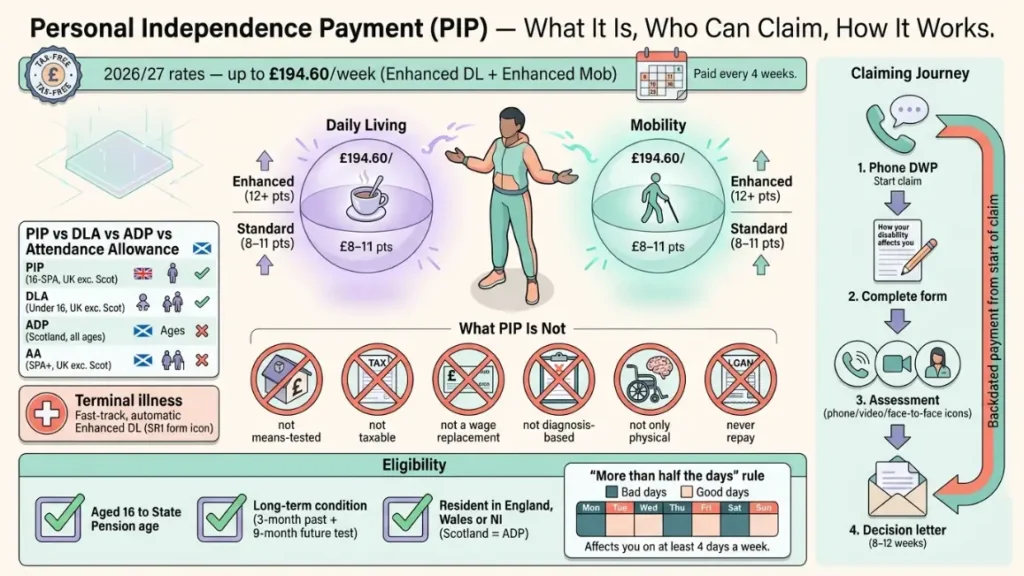
Personal Independence Payment (PIP) is a tax-free benefit from the Department for Work and Pensions (DWP) that helps with the extra costs of a long-term physical or mental health condition or disability. It is not means-tested, not based on your National Insurance record, and not linked to whether you work — it is awarded on how your condition affects your daily living and mobility, not on the condition itself. You can spend it on anything that helps you, it is paid every 4 weeks, and you do not have to repay it.
PIP has two parts: a
daily living component for help with everyday tasks, and a
mobility component for help with getting around. You may receive one part or both, each paid at a standard or enhanced rate.
What is PIP not?
There are common misconceptions about Personal Independence Payment. To be clear, PIP is:
- Not means-tested — your income and savings do not affect it.
- Not taxable — it does not count as income for tax.
- Not a wage replacement — it covers extra disability costs, not lost earnings (unlike Universal Credit or ESA).
- Not awarded on diagnosis alone — what matters is how your condition affects you.
- Not only for physical disabilities — mental health conditions can qualify.
- Not a loan — you never repay it.
Who can claim PIP?
You can
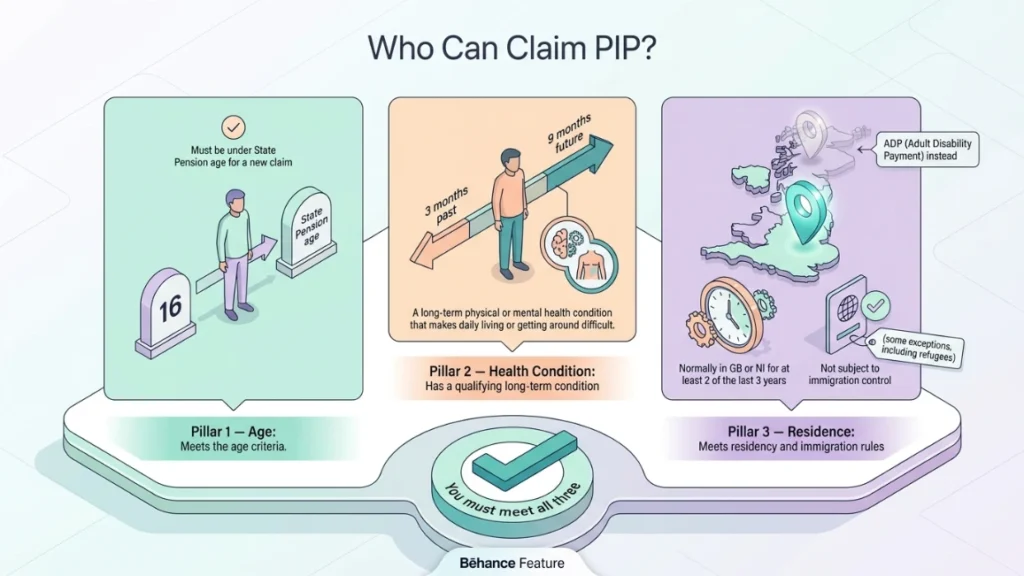
claim PIP if you are aged 16 or over, under State Pension age when you first claim, and you have a long-term physical or mental health condition that makes daily living or getting around difficult. You must also meet the residence rules and a qualifying period (below).
Age and residence rules
- You are 16 or over and under State Pension age for a new claim.
- You live in England, Wales or Northern Ireland. If you live in Scotland, you apply for Adult Disability Payment (ADP) instead.
- You have normally been in Great Britain (or Northern Ireland) for at least 2 of the last 3 years and are present in the UK when you claim.
- You are not subject to immigration control (some exceptions apply, including refugees).
How long must your condition have affected you?
You must have had difficulty with daily living or mobility for at least
3 months before you can be paid, and you must expect that difficulty to continue for at least
9 more months. This backward-and-forward test is why people sometimes describe PIP as needing around a year of difficulty overall. You can claim before the 3 months are up, but payment only starts once the qualifying period is met.
Special rules for terminal illness
If you are nearing the end of life, special rules apply: the 3-month and 9-month qualifying periods do not apply, you automatically receive the enhanced daily living component, and you do not need to complete the full form or attend an assessment. A doctor provides an SR1 form to support the fast-tracked claim. You may also receive the mobility component depending on your needs.
What are the two PIP components?
PIP has two separate components, each paid at a standard or enhanced rate. You can get one or both.
The daily living component
The daily living component is for help with everyday tasks such as preparing and eating food, managing medication or treatment, washing and dressing, communicating, reading, managing money, and engaging with other people. You do not need help with every task — the award depends on how your condition affects the specific activities.
The mobility component
The mobility component is for help with getting around — planning and following journeys, and physically moving around. You do not need a physical disability to qualify: a mental health condition such as severe anxiety that stops you planning or following a journey can also count.
How much is PIP?
For 2026/27, the daily living component is £76.70 (standard) or £114.60 (enhanced) a week, and the mobility component is £30.30 (standard) or £80.00 (enhanced) a week. The maximum award — enhanced on both components — is £194.60 a week. For every award combination as weekly, 4-weekly, monthly and yearly figures, see our full
PIP rates guide.
How is PIP assessed?
PIP is assessed using a
points system across
12 activities — 10 for daily living and 2 for mobility. You need
8 points in a component for the standard rate and
12 points for the enhanced rate. Points are awarded on whether you can do each activity safely, to an acceptable standard, repeatedly, and in a reasonable time. The 10 daily living activities cover preparing food, taking nutrition, managing therapy, washing and bathing, managing toilet needs, dressing, communicating, reading, engaging with others, and budgeting; the 2 mobility activities are planning and following journeys, and moving around.
You can estimate your likely score with our
calculators/pip-points-calculator/”>
PIP points calculator, and see what the assessment itself involves in our PIP assessment guide.
The “more than half the days” rule
You must have difficulty with an activity on
more than half of the days over the relevant period for it to count. This is why fluctuating conditions — arthritis, mental health problems, fatigue conditions — still qualify if they affect you more than 50% of the time. Many people underestimate themselves here: they dismiss bad days as one-offs instead of counting how many days each month they genuinely struggle. If you are not sure how a specific condition is scored, our condition-specific PIP calculators walk through the descriptors.
How do you claim PIP?
You start a claim by contacting the DWP PIP new claims line (or by post). The DWP checks your basic details and sends you a form, “How your disability affects you,” which you complete and return within one month. You may then have a health assessment by phone, video or in person, after which the DWP sends a decision letter. Most decisions take roughly 8–12 weeks, with the wait for an assessment appointment usually the longest stage. If your claim succeeds, payment is backdated to the date you started the claim — you can estimate any arrears with our
PIP back pay calculator. For what the assessment is like and the questions asked, see our PIP assessment guide.
Can you get PIP while working or on other benefits?
Yes. You can receive PIP whether you work full-time, part-time, or not at all, because it is not means-tested and has no hours or earnings limit — your salary, savings and National Insurance record do not affect it. For how work interacts with PIP, the assessment, and what you need to report, see our guide to working while claiming PIP.
You can usually receive PIP alongside Universal Credit, Employment and Support Allowance, Housing Benefit, Carer’s Allowance and Child Benefit. A few benefits interact differently: Armed Forces Independence Payment stops you receiving PIP, Constant Attendance Allowance reduces the daily living component, and War Pensioners’ Mobility Supplement stops the mobility component. Being awarded PIP can also
increase means-tested benefits and unlock extra help — so it is worth a full benefits check.
PIP vs DLA, ADP and Attendance Allowance
PIP, Disability Living Allowance (DLA), Adult Disability Payment (ADP) and Attendance Allowance are four separate UK disability benefits with different age ranges and geography. None of them is means-tested.
| Feature |
PIP |
DLA |
ADP |
Attendance Allowance |
| Who it’s for |
16 to State Pension age (England, Wales, NI) |
Under 16 (England, Wales, NI) |
16 to State Pension age (Scotland) |
State Pension age and over |
| What it covers |
Daily living and mobility |
Care and mobility |
Daily living and mobility |
Care needs only |
| Means-tested |
No |
No |
No |
No |
DLA: PIP replaced DLA for working-age adults; DLA continues only for children under 16. If you got DLA as an adult, the DWP will invite you to claim PIP — you do not need to act until you receive that letter.
ADP: Adult Disability Payment is the Scottish equivalent of PIP, run by Social Security Scotland; you cannot receive both. If you move between Scotland and England or Wales, you generally need to claim the relevant benefit within 13 weeks of moving.
Attendance Allowance: if you are over State Pension age and have not previously had PIP, you claim Attendance Allowance instead — you cannot make a
new PIP claim after State Pension age. If you were already getting PIP before State Pension age, you keep it.
How long does a PIP award last?
A PIP award is given for a fixed period (commonly up to 2 years, or longer for more stable conditions) or as an ongoing award for conditions not expected to change — though ongoing awards are still reviewed periodically. Before an award ends, the DWP sends a review form; your payments continue while the review is underway, and the outcome can keep, increase, reduce or extend your award. Award lengths and how often you are reviewed changed in 2026 — see our PIP review changes guide for the current rules and what to do at a review. If a decision goes against you, you can challenge it through
Mandatory Reconsideration and appeal.
What is changing for PIP in 2026?
Several operational changes have arrived in 2026, but the rules on
who qualifies have not yet changed:
- Longer award periods. From mid-2026, new awards for claimants aged 25 and over are reviewed less often (a minimum of 3 years, rising to 5 at the next review). See our review changes guide.
- Right to try work. The government has signalled that starting work should not, on its own, trigger a reassessment — covered in our guide to working while claiming PIP.
- Eligibility reform delayed. A proposed rule requiring new claimants to score at least 4 points in a single daily living activity was originally floated for November 2026, but it has been delayed and is not in force, pending the independent Timms Review expected to report later in 2026. Nothing has changed yet to how PIP Eligibility is scored.
Frequently asked questions about PIP
Is PIP paid weekly or monthly?
PIP is paid every 4 weeks, not monthly, directly into your bank account. Your award letter states a weekly rate, but the actual payment is a single 4-weekly sum — so you receive 13 payments a year rather than 52. For monthly-equivalent figures, see our PIP rates guide.
Is PIP taxable?
No. PIP is entirely tax-free, does not count as income for tax, and is disregarded as income for most means-tested benefits and tax credits.
Yes. PIP is awarded on how your condition affects your daily living and mobility, not on the diagnosis. Conditions such as anxiety, Depression, PTSD or schizophrenia can qualify if their functional impact matches the assessed descriptors.
What happens to PIP at State Pension age?
If you were awarded PIP before reaching State Pension age, you keep it and often move to a less frequent, light-touch review. You cannot usually make a
new PIP claim after State Pension age — Attendance Allowance is the alternative.
How many points do you need for PIP?
You need 8 points for the standard rate and 12 points for the enhanced rate, scored separately for the daily living and mobility components. Points reflect how your condition affects specific tasks, not the condition itself. Try our PIP points calculator to estimate your score.
Can you get PIP and Attendance Allowance at the same time?
No. You cannot receive both. If you are over State Pension age and have not previously claimed PIP, apply for Attendance Allowance instead. Existing PIP claimants continue to receive PIP after State Pension age.
Related PIP guides