
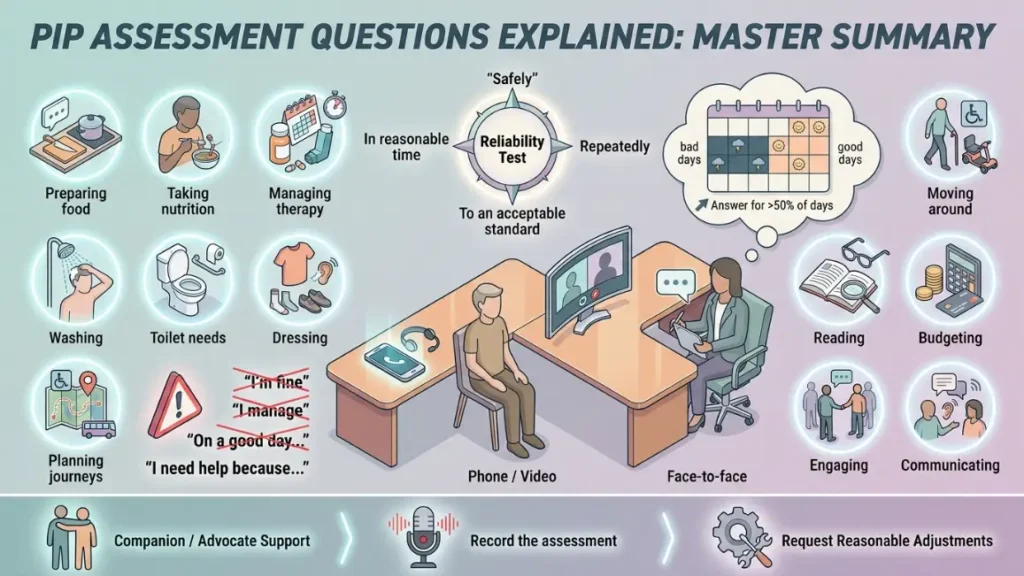
A PIP assessment is a DWP functional health assessment where an assessor asks how your long-term condition affects 12 daily living and mobility activities on the majority of days. You are asked about preparing food, washing, dressing, communicating, engaging with others, planning journeys and moving around, and whether you can do each task safely, repeatedly, and in a reasonable time.
What questions do PIP ask in an assessment?
A PIP assessor asks about 12 activities: 10 daily living – Preparing food, Taking nutrition, Managing therapy or monitoring a health condition, Washing and bathing, Managing toilet needs, Dressing and undressing, Communicating verbally, Reading and understanding, Engaging with other people face-to-face, Making budgeting decisions – and 2 mobility – Planning and following journeys, Moving around.
The assessor scores how you manage each activity on more than 50% of days.
How does the assessor start the PIP assessment?
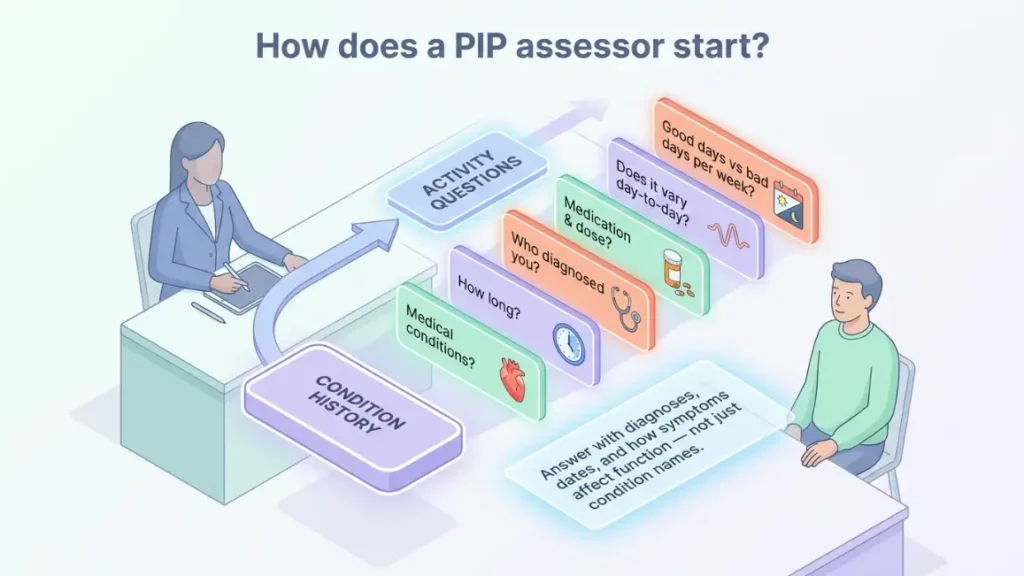
The assessor starts with your medical condition history before the activity questions. Expect these questions:
- What medical conditions do you have?
- How long have you had this condition?
- Who diagnosed you?
- What medication do you take, and what dose?
- Does your condition vary from day to day?
- How many good days and bad days do you have in a typical week?
Answer with your diagnoses, dates, and how symptoms affect function, not just condition names.
Daily living questions – Activities 1–10
The tables below show real assessor questions for each daily living activity, what is being tested, and how to answer accurately.
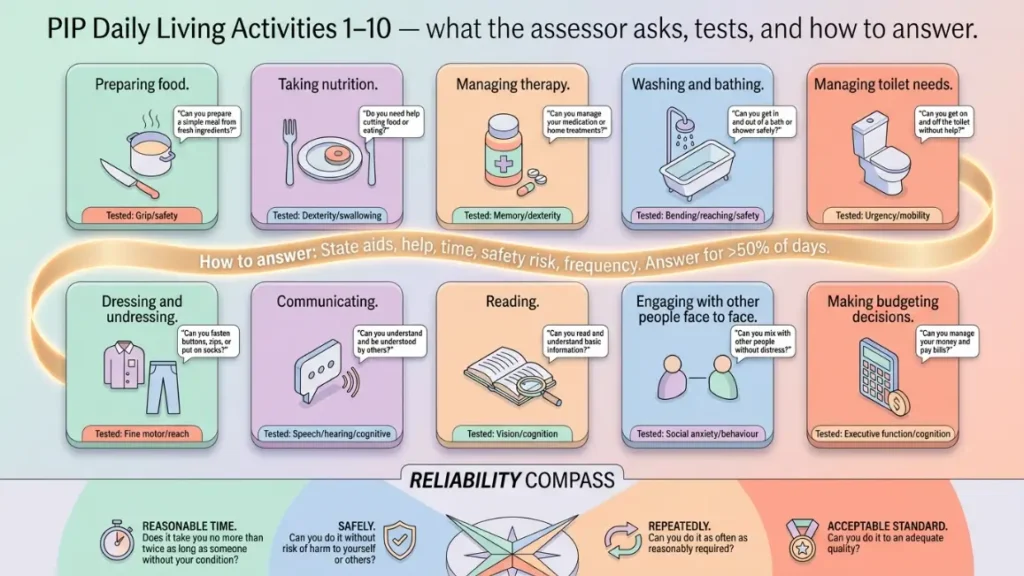
Activity 1: Preparing food
| Sample assessor question | What they’re testing | How to answer |
|---|---|---|
| Can you prepare a simple meal from fresh ingredients? | Grip, standing tolerance, safety with heat/knives | State if you need an aid, help, or cannot do it safely. Give time taken. |
| Do you need someone to prompt you to cook? | Cognitive / motivation needs | Say if you forget to eat, or need reminding to start/finish |
| Have you had accidents in the kitchen? | Safety risk | Describe burns, cuts, or leaving gas on, with frequency |
Activity 2: Taking nutrition
| Sample assessor question | What they’re testing | How to answer |
|---|---|---|
| Can you cut up food and convey it to your mouth? | Manual dexterity, swallowing | Report if you need adapted cutlery, help cutting, or supervision for choking |
| Do you need prompting to eat or drink? | Cognitive/mental health needs | Explain if Depression or memory issues mean you skip meals without prompting |
Activity 3: Managing therapy or monitoring a health condition
| Sample assessor question | What they’re testing | How to answer |
|---|---|---|
| Can you remember to take your medication? | Memory / cognitive ability | Say if you need a dosette box, alarms, or another person prompts you |
| Can you open medication packaging? | Manual dexterity | Report if blister packs are impossible without help |
| Do you manage injections or therapy equipment yourself? | Physical help/supervision need | State if someone supervises for safety |
Activity 4: Washing and bathing
| Sample assessor question | What they’re testing | How to answer |
|---|---|---|
| Can you wash your hair and body below the waist? | Bending, reaching, balance | Explain if you need a shower seat, grab rails, or help |
| Does washing leave you exhausted or in pain? | Reliability – repeatedly / afterwards | Say how long it takes, and if you cannot do anything else that day |
| Do you need prompting to wash? | Mental health / cognitive need | Report if low mood means you go days without washing |
Activity 5: Managing toilet needs
| Sample assessor question | What they’re testing | How to answer |
|---|---|---|
| Can you get to the toilet in time? | Incontinence/urgency | Give the frequency of accidents per week |
| Can you clean yourself after using the toilet? | Dexterity / reaching | State if you need wipes, aids, or help |
| Do you use incontinence pads or a catheter? | Aid/appliance use | Report if you need help managing them |
Activity 6: Dressing and undressing
| Sample assessor question | What they’re testing | How to answer |
|---|---|---|
| Can you put on shoes and socks? | Bending, grip | Say if you need elastic laces, a shoe horn, or help |
| Can you manage buttons, zips, or laces? | Fine motor skills | Report if you only wear pull-on clothes to cope |
| Does someone need to choose appropriate clothes for you? | Cognitive/mental health prompting | Explain if you need prompting for weather-appropriate clothing |
Activity 7: Communicating verbally
| Sample assessor question | What they’re testing | How to answer |
|---|---|---|
| Can people understand you when you speak? | Speech / hearing / Anxiety | Report if anxiety, stammer, or hearing loss means you need help |
| Do you need someone to explain things to you? | Comprehension need | State if you need simple sentences repeated |
Activity 8: Reading and understanding
| Sample assessor question | What they’re testing | How to answer |
|---|---|---|
| Can you read standard print in a newspaper? | Vision / cognitive processing | Say if you need large print, aids, or someone to read to you |
| Can you understand signs and symbols? | Cognitive / learning disability | Report if you cannot follow written instructions alone |
Activity 9: Engaging with other people face-to-face
| Sample assessor question | What they’re testing | How to answer |
|---|---|---|
| Do you find meeting people distressing? | Anxiety / social interaction | Describe panic attacks, the need for a support person, and frequency |
| Can you engage with someone you do not know? | Social engagement ability | Explain if you avoid all unfamiliar contact, and how often |
| Do you need prompting to engage? | Mental health support need | Report if someone must encourage you to interact |
Activity 10: Making budgeting decisions
| Sample assessor question | What they’re testing | How to answer |
|---|---|---|
| Can you manage a household budget and pay bills on time? | Cognitive/executive function | Say if you need help calculating change, avoiding scams, or paying bills |
| Do you need prompting to manage money? | Support need | Report if someone else manages your money to prevent harm |
Answer each question for how you are on the majority of days, with safety, time, repetition, and help needed.
Mobility questions – Activities 11–12
Activity 11: Planning and following journeys, and Activity 12: Moving around. Sample questions:
| Activity | Sample assessor question | What they’re testing |
|---|---|---|
| Planning and following journeys | Can you plan a route to an unfamiliar place? Can you follow it alone? Do you get overwhelming distress travelling? | Cognitive navigation, anxiety, need for a companion |
| Moving around | How far can you walk, repeatedly and reliably, on a flat surface? Do you stop due to pain, breathlessness, or fatigue? What aids do you use? | Walking distance, reliability, speed, safety |
Report distance in metres, time taken, pain levels, stops needed, and whether you can repeat the walk the same day.
What questions do PIP ask on a phone assessment / video assessment?
PIP telephone assessment questions are the same 12-activity questions as face-to-face, but the assessor cannot see you. Expect these phone-specific opening questions:
- Are you in a quiet place where you can talk freely?
- Is anyone with you on the call today?
- Can you hear me clearly?
- What did you do this morning before the call?
- How did you sleep last night?
Video assessments follow the telephone script, with visual observation added. Have your medication list, PIP2 form copy, and ID ready. Ask for a three-way call if your companion is joining by phone.
Mental health PIP assessment questions – what changes?
Mental health PIP assessment questions focus on Activities 7, 8 and 9: Communicating verbally, Reading and understanding, Engaging with other people face-to-face, plus prompting needs in Activities 1–3 and 10.
Expect:
- Do you need prompting to take medication, eat, wash, or dress?
- Do you avoid leaving the house alone due to anxiety or panic?
- Can you engage with someone you do not know without distress?
- Do you need a support person to help you in social situations?
- Can you concentrate long enough to read or follow a conversation?
Report overwhelming psychological distress, frequency of panic attacks, need for prompting, and if someone must stay with you. A memory/concentration check is observational – the assessor notes if you lose track, need questions repeated, or cannot recall dates/medication – there is no formal PIP memory test.
How does a PIP assessment work? Phone, video and face-to-face
A PIP assessment is a functional conversation with an assessor, not a medical diagnosis. It covers how your condition affects daily living and mobility.
The assessment can take place by telephone, video call, face-to-face at an Assessment Centre, or by home visit with medical evidence. The assessor writes a report for DWP. DWP decides entitlement, not the assessor.
What happens during a PIP assessment, step by step?
A PIP assessment follows 7 steps:
- Initial review and invitation letter from your assessment provider – Maximus, Capita, Serco or Ingeus
- Check-in / ID verification – photo ID at face-to-face, verbal consent by phone
- Conditions history – diagnoses, medication, variability
- Functional history / typical day – good days and bad days, from waking to bed
- Activity questions – all 12 PIP activities, with reliability probing
- Closing summary – assessor reads back findings, you can add anything missed
- Report to DWP – the assessor completes the report, DWP writes to you with the decision
How long does a PIP assessment take – phone vs face-to-face?
| Assessment channel | Typical length |
|---|---|
| Telephone assessment | 45 to 90 minutes |
| Face-to-face assessment | 20 to 60 minutes |
| Video assessment | 45 to 90 minutes, similar to telephone |
Allow extra time. Do not schedule anything immediately afterwards.
What do I need to bring/have ready for a telephone, video, or face-to-face PIP assessment?
Use this channel-specific checklist.
| Telephone | Video | Face-to-face |
|---|---|---|
| Quiet room, phone fully charged, medication list, copy of your PIP2 form, water, pen and paper, companion on three-way call | Quiet room, charged device, stable internet, camera and microphone working, same documents as telephone, private space | Appointment letter, photo ID, medication list, recent evidence, aids you use daily, companion aged 16+ |
| Test the signal. Ask for a call-back number if disconnected. | Join 10 minutes early. Check lighting so the assessor can see you. | Arrive 10 minutes early. Ask at reception for a travel expenses form. |
How do I answer PIP assessment questions correctly?
PIP is not pass/fail. Answer accurately. Do not exaggerate. This guide helps you report your true functional limitations on the majority of days.
Answer for how you are on more than 50% of days. Always report difficulty, safety risk, time taken, aids needed, and help needed.
What is the PIP reliability test – and how do I use it when answering?
You count as unable to do an activity if you cannot do it reliably. Reliably means:
- Safely – without risk of harm to you or others
- To an acceptable standard – properly, not partially
- Repeatedly – as often as reasonably required
- In a reasonable time period – no more than twice as long as a person without a physical or mental health condition
Assessors open with broad open questions – ‘Tell me about a typical day’ – then move to closed clarification – ‘Can you… How often…’. Claimants who answer only yes/no lose detail that scores points.
Use the test in every answer: “Yes, but it takes 40 minutes, causes severe pain, I cannot repeat it the same day, and I need my partner to prompt me.”
How do I talk about good days and bad days?
Talk about bad days first. State how many good days and bad days you have in a typical week.
If you can do a task on Monday but not Tuesday through Friday, your answer must reflect Tuesday through Friday. Four days out of seven is the majority. The assessor scores what applies on more than 50% of days.
Describe what happens on a bad day, how often bad days occur, and what help you need then.
What not to say during a PIP assessment?
Avoid these phrases. They are recorded as evidence you cope independently.
| Do not say | Why it hurts | Say this instead |
|---|---|---|
| “I’m fine” | Recorded as no functional limitation | “I manage with difficulty / pain / help” |
| “I manage” | Recorded as independent, no aids needed | “I manage only with [aid/person], and it takes [X] minutes, with pain” |
| “On a good day I can…” | Assessor scores best-day ability | Start with: “On most days / 4 days a week, I cannot…” |
| “Sometimes / often” | Vague – assessor defaults to less frequent | Give exact days per week: “4 days out of 7” |
| “I push through” | Recorded as able, no safety risk | “I can do it once, but then I cannot repeat it, and I am in pain for hours” |
Always explain difficulty, safety, time, repetition, and help.
Can I get sample answers to PIP questions? Downloadable Q&A
Yes. A “PIP Assessment Questions & Answers – 12 Activities – PDF” with sample assessor questions, answer prompts, and the reliability checklist is available for download. Use it to prepare your own answers in your own words before your assessment call. Do not read scripts in the assessment – speak naturally about your real bad days.
How does PIP scoring work during the assessment?
PIP scoring uses 12 activities across two components: daily living and mobility.
You need 8 points for the standard rate, and 12 points for the enhanced rate, per component. The assessor selects the highest-scoring descriptor that applies for each activity on the majority of days.
For the full descriptor points list and a self-test calculator, see our separate PIP points and descriptors guide. That page covers points in full – this page covers assessment questions only.
What are my rights at a PIP assessment? Can I bring someone? Can I record it?
You have three core rights at a PIP assessment: a companion, audio recording, and reasonable adjustments.
Can I take someone with me to a PIP assessment?
Yes. You can take anyone aged 16 or over. This can be a friend, family member, carer, or support worker.
Your companion can prompt you if stress makes you forget details, add information you miss, and take notes. For telephone assessments, ask for a three-way call so they can join from the start.
In telephone assessments, assessors note background noise, response latency, and prompting – have your companion on a three-way call from the start.
Can I record my PIP assessment?
Yes. Audio recording is allowed. You must request a recording at least 1 working day before the assessment.
Covert audio recording is acknowledged by DWP. Video recording of PIP consultations is not permitted
For telephone assessments, both you and the assessor can record. The assessor’s copy is sent to you afterwards.
What reasonable adjustments can I ask for?
You can ask for:
- Interpreter or BSL signer – request at least 2 working days before
- Same-gender assessor – on request
- Ground-floor room, wheelchair-accessible toilet, extra time
- Quiet room / reduced waiting time if you have anxiety in enclosed spaces
- Home visit – with medical evidence you cannot attend otherwise
Phone your assessment provider using the number on your appointment letter to request adjustments.
What are PIP assessment trick questions, and how should I answer them?
PIP assessment trick questions are not tricks. They are informal observation questions used to gather functional evidence. Answer honestly, with full context.
Assessors evaluate consistency across activities – e.g., toothbrush grip vs kitchen cutlery – explain why seemingly similar tasks differ, otherwise inconsistency is recorded.
Why does the assessor ask casual questions like “Do you have pets?”
These questions test real-world function. Always add difficulty, help, safety, and time.
| Casual question | What they’re testing | How to answer with full context |
|---|---|---|
| How did you get here today? | Planning journeys, moving around, using public transport alone | “My sister drove me. I cannot use buses alone due to anxiety / I cannot walk from the car park without stopping twice” |
| Do you have pets? | Daily routine, bending, feeding, motivation | “Yes, my partner feeds the dog. I cannot bend to fill the bowl on bad days” |
| What did you do this morning? | Morning routine, washing, dressing, preparing food | Describe help needed, time taken, pain, prompting |
| Do you cook? | Preparing food ability | “Only microwave meals, seated, with adapted aids – chopping is unsafe” |
| Do you drive? | See below | – |
| How did you sleep? | Fatigue, pain, mental health impact on function | Link poor sleep to next-day function loss |
Never give a one-word answer. Always explain the difficulty, risk, time, aids, and help.
Should I admit to driving at a PIP assessment?
Yes. Driving does not disqualify PIP. Answer truthfully.
Explain adaptations: automatic car, hand controls, only short familiar routes, never alone, someone helps you in/out, you cannot plan unfamiliar journeys due to anxiety / cognitive overload, you do not drive on bad days.
Hiding driving and being found out damages credibility more than disclosing with context.
How do I describe mental health conditions and fluctuating conditions at a PIP assessment?
Describe how you function on the majority of days, with specific examples of bad days, prompting needs, and safety risks.
How do I explain fluctuating conditions – good days vs bad days?
State: how many good days and bad days per week, what a bad day looks like, what you cannot do on a bad day, and why good days are not representative.
Example: “Four days a week I cannot wash or dress without prompting. I stay in bed until midday. On three better days I can wash with a shower seat, taking 35 minutes. My answer reflects the four bad days, because that is the majority.”
If you can do something on Monday but not Tuesday through Friday, your answer must reflect Tuesday through Friday.
How do I answer PIP mental health questions – engaging with others, communicating, reading?
For Communicating verbally, Reading and understanding, and Engaging with other people face-to-face:
- Report overwhelming psychological distress – panic attacks, dissociation, inability to leave home alone
- State if you need prompting to engage, to take medication, to eat, to wash
- Explain if you need a support person present for all social contact
- Describe what happens if you try alone – e.g., panic attack, shutdown, self-harm risk
- Give frequency: “This happens 5 days out of 7”
Bring evidence: care plan, CPN letter, medication list, therapist reports.
What is the PIP memory test?
There is no formal PIP memory test. The assessor observes cognitive function during conversation: can you follow questions, remember dates and medication names, stay on topic, concentrate long enough to complete the call.
If memory / concentration problems affect you, say so early: “I have memory problems, I may need questions repeated, my companion has my medication list.” This prevents poor recall being misread as lack of difficulty.
What if I need to reschedule my PIP assessment?
Contact your assessment provider immediately. Use the number on your appointment letter.
You can usually reschedule once. Contact at least two working days before your appointment.
A flare-up of your condition is a valid good reason to reschedule. If you miss without good reason, your claim may be refused.
You must have been given at least 7 days’ written notice of the assessment date, unless you agreed to shorter notice.
After the assessment, the assessor sends a report to DWP. DWP makes the decision and writes to you. For decision wait times, payment dates, and challenging decisions, see our separate PIP decision after assessment guide – this page covers assessment questions only.
PIP Assessment Questions – FAQs
What questions are asked in a PIP assessment?
Assessors ask about 12 activities: preparing food, taking nutrition, managing therapy, washing and bathing, managing toilet needs, dressing and undressing, communicating verbally, reading and understanding, engaging with other people face-to-face, making budgeting decisions, planning journeys, and moving around, plus your conditions and medication.
What not to say during a PIP assessment?
Avoid “I’m fine”, “I manage”, “on a good day I can…”, and vague words like “sometimes”. Always describe how you function on the majority of days, with difficulty, safety risk, time taken, and help needed. Do not minimise pain or push through tasks you would not normally do.
How do I pass the PIP assessment?
PIP is not pass/fail. Answer accurately for how your condition affects you on more than 50% of days. Explain if tasks are unsafe, take more than twice as long, cause pain, or need prompting or physical help. Bring a companion and take your time answering.
How long does a PIP assessment take?
Telephone assessments last 45 to 90 minutes. Face-to-face assessments last 20 to 60 minutes. Video assessments are similar to telephone. Allow extra time afterwards. Do not schedule anything immediately after your assessment slot.
Can I record my PIP assessment?
Yes. Request audio recording at least 1 working day before. Covert audio recording is acknowledged by DWP. Video recording is not permitted. For telephone assessments, ask for a three-way call so your companion can join and take notes.
What are the 12 points for PIP assessment?
You need 8 points for the PIP standard rate and 12 points for the enhanced rate, per component – daily living and mobility. Points come from descriptors across 12 activities. See our separate PIP points guide for the full descriptor list and a calculators/pip-points-calculator/”>points calculator.