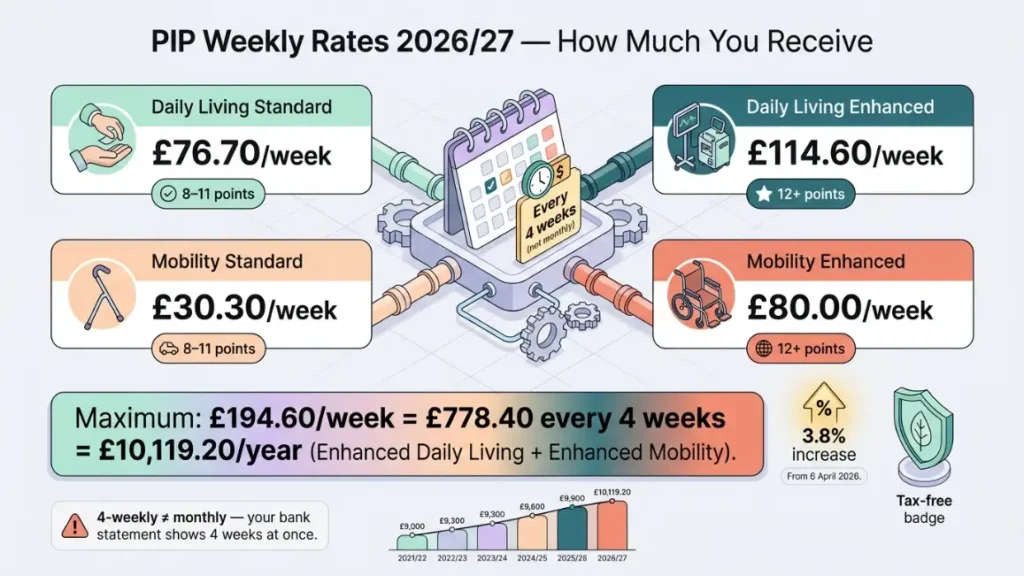
PIP Personal Independence Payment (PIP) is for adults aged 16 to State Pension age (for new claims; you can keep PIP past State Pension age once awarded). It pays £76.70 or £114.60 per week for the Daily Living component and £30.30 or £80.00 per week for the Mobility component in 2026/27. You receive the Standard rate if you score 8–11 points in a component, or the Enhanced rate if you score 12 or more. Payments are made every 4 weeks and are tax-free.
What are the current PIP weekly rates for 2026/27?
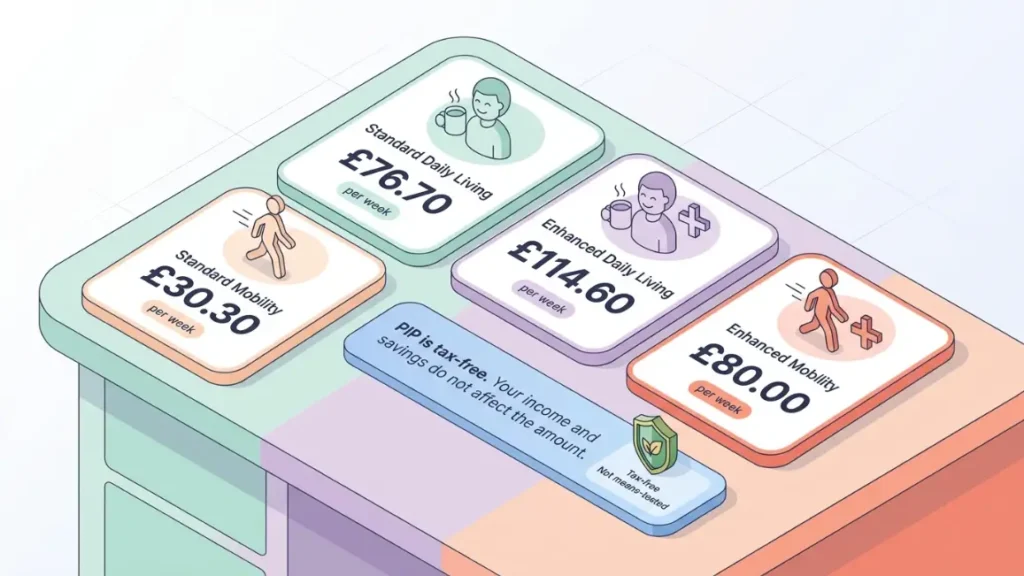 The 2026/27 weekly PIP rates are £76.70 for Standard Daily Living, £114.60 for Enhanced Daily Living, £30.30 for Standard Mobility, and £80.00 for Enhanced Mobility.
| Component | Standard rate | Enhanced rate |
|---|---|---|
| Daily Living | £76.70 per week | £114.60 per week |
| Mobility | £30.30 per week | £80.00 per week |
PIP is tax-free. Your income and savings do not affect the amount you receive.
What is the Daily Living component rate?
 The Daily Living component pays £76.70 per week at the Standard rate and £114.60 per week at the Enhanced rate in 2026/27. (PIP does not use the old DLA terms “care component” or “middle rate”; these now refer to the Daily Living component.) This part of PIP is for the extra help you need with everyday tasks.
What is the Mobility component rate?
The Mobility component pays £30.30 per week at the Standard rate and £80.00 per week at the Enhanced rate in 2026/27. This part is for the extra help you need getting around.
What is the difference between Standard and Enhanced rate?
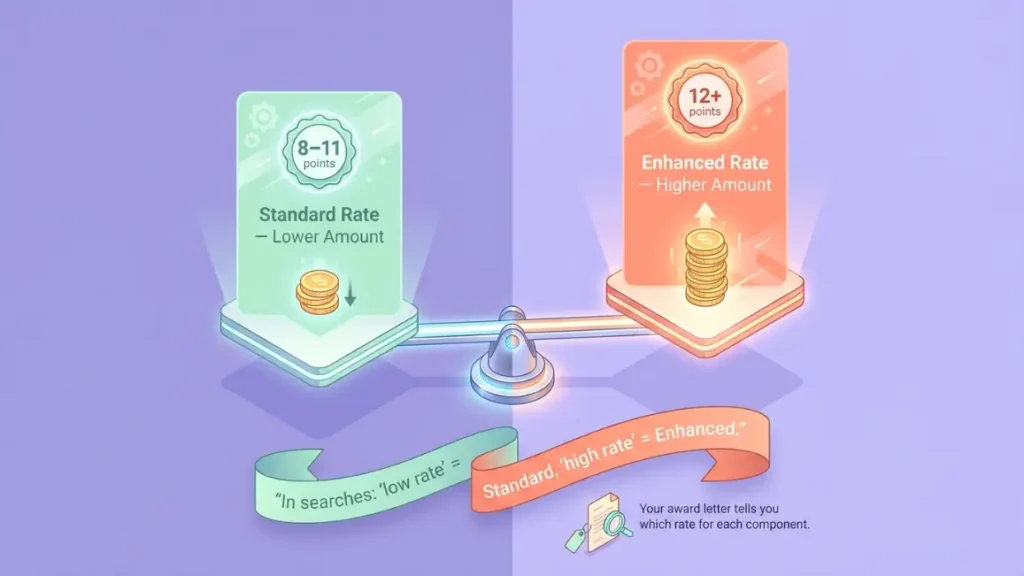
The Standard rate is the lower amount. The Enhanced rate is the higher amount. You get the Standard rate if you score 8–11 points for a component. You get the Enhanced rate if you score 12 points or more. In searches, “low rate” usually means the Standard rate and “high rate” means the Enhanced rate. Your award letter will tell you which rate you have been awarded for each component.
How much is PIP per week, per month, and per year?
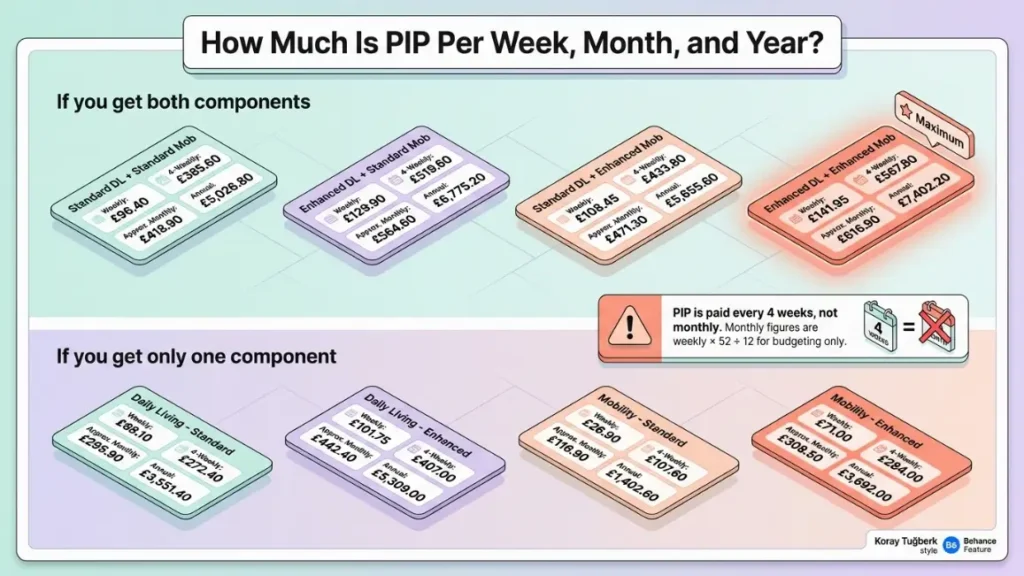
The total amount you receive depends on which combination of Daily Living and Mobility rates you are awarded. If you receive both components, your weekly PIP payment is the sum of the two rates you are awarded. The monthly figures below are approximate: PIP is paid every 4 weeks, not monthly, so the “per month” column is the weekly rate × 52 ÷ 12, rounded to the nearest 10 pence, for budgeting only.
| Award combination | Weekly | Every 4 weeks | Approx. per month | Annual |
|---|---|---|---|---|
| Standard Daily Living + Standard Mobility | £107.00 | £428.00 | £463.70 | £5,564.00 |
| Standard Daily Living + Enhanced Mobility | £156.70 | £626.80 | £679.00 | £8,148.40 |
| Enhanced Daily Living + Standard Mobility | £144.90 | £579.60 | £627.90 | £7,534.80 |
| Enhanced Daily Living + Enhanced Mobility | £194.60 | £778.40 | £843.30 | £10,119.20 |
If you receive only one component, use the figures below.
| Component only | Weekly | Every 4 weeks | Approx. per month | Annual |
|---|---|---|---|---|
| Standard Daily Living | £76.70 | £306.80 | £332.40 | £3,988.40 |
| Enhanced Daily Living | £114.60 | £458.40 | £496.60 | £5,959.20 |
| Standard Mobility | £30.30 | £121.20 | £131.30 | £1,575.60 |
| Enhanced Mobility | £80.00 | £320.00 | £346.70 | £4,160.00 |
The most common mistake is assuming the “highest rate” is one number. It is the combination of the Enhanced Daily Living rate and the Enhanced Mobility rate.
What are the weekly, 4-weekly, and annual totals for each PIP award?
If you receive both the Daily Living and Mobility components, your total PIP payment is the sum of the two weekly rates you are awarded. The tables above show the four possible combinations and the single-component totals.
What is the maximum PIP payment?
The maximum PIP payment is £194.60 per week. This equals £778.40 every 4 weeks, roughly £843.30 per month (weekly × 52 ÷ 12), or £10,119.20 per year. This is the Enhanced rate of both components combined. PIP is paid every 4 weeks, so the monthly figure is approximate and for budgeting only.
How much has PIP gone up in April 2026?
PIP rates increased by 3.8% from 6 April 2026.
| Component and rate | 2025/26 weekly | 2026/27 weekly | Increase |
|---|---|---|---|
| Daily Living Standard | £73.90 | £76.70 | +£2.80 |
| Daily Living Enhanced | £110.40 | £114.60 | +£4.20 |
| Mobility Standard | £29.20 | £30.30 | +£1.10 |
| Mobility Enhanced | £77.05 | £80.00 | +£2.95 |
The increase applies to all four rates.
How do the 2025/26 and 2026/27 PIP rates compare?
The 2026/27 rates are higher than the 2025/26 rates for every component and level. The table above shows the exact weekly increase for each rate. The 2026 review-period changes affect how often awards are reviewed, not the rates themselves — see our PIP review changes guide for that.
When do PIP rates change?
PIP rates usually change each April at the start of the new tax year. The 2026/27 rates took effect on 6 April 2026.
What were the PIP rates in previous years?
Historical PIP weekly rates for the last five tax years are below.
| Tax year | Standard Daily Living | Enhanced Daily Living | Standard Mobility | Enhanced Mobility |
|---|---|---|---|---|
| 2021/22 | £60.00 | £89.60 | £23.70 | £62.55 |
| 2022/23 | £61.85 | £92.40 | £24.45 | £64.50 |
| 2023/24 | £68.10 | £101.75 | £26.90 | £71.00 |
| 2024/25 | £72.65 | £108.55 | £28.70 | £75.75 |
| 2025/26 | £73.90 | £110.40 | £29.20 | £77.05 |
Use these rates if you need to check back-pay or payments for a past period.
How do I know which PIP rate I have been awarded?
Your PIP decision letter tells you which component and rate you have been awarded. Keep the letter safe. It is the official record of your award.
What does your PIP decision letter tell you?
The decision letter tells you the weekly rate for each component. It also tells you the date of your first payment, the day of the week you are paid, how long your award lasts, and when it will be reviewed. Award letters list the weekly rate but not the 4-weekly total. This causes confusion for many people.
How can you check your PIP rate by phone?
You can call the DWP PIP helpline and use the automated line to hear your next payment amount and date. Steps:
- Call the DWP PIP helpline.
- Choose the option for payment information.
- Enter your details when asked.
How often is PIP paid?
PIP is paid every 4 weeks. If you have a terminal illness, it is paid weekly. Claimants often confuse 4-weekly payments with monthly payments and worry their award is wrong.
Why does your bank statement not match the weekly PIP rate?
Your bank statement shows 4 weeks of payments at once. It does not show the weekly rate. For example, the maximum combined weekly rate is £194.60. Every 4 weeks you receive £778.40. This is not the same as a calendar month. Do not multiply the weekly rate by 4 to get a monthly amount. PIP is paid every 4 weeks, not monthly. If you need a monthly figure for budgeting, multiply the weekly rate by 52 and divide by 12 instead.
What should I do if my PIP payment doesn’t match the published rate?
Contact the DWP straight away if your payment does not match the published rate for your award. Do not wait for a review or the end of your award.
When should you report a change in circumstances?
Report a change straight away if your condition gets worse or better. Also report changes to your care or mobility needs. You might get an overpayment if you do not report a change. You might miss extra money if your condition gets worse.
When should you challenge a PIP decision about the amount?
Ask for a Mandatory Reconsideration within one month of the decision date if you think the rate is wrong. The DWP will look at the decision again. Only challenge the amount if you have evidence that the rate does not match your needs.
Where can you verify the official PIP rates?
The official PIP rates are published on GOV.UK and nidirect. You can also check your rate by calling the DWP PIP helpline.
Are PIP rates the same in Scotland, Northern Ireland, and Wales?
The weekly PIP rates are the same in England, Wales, and Northern Ireland. In Scotland, new claims are for Adult Disability Payment (ADP). ADP pays the same rates as PIP. If you move between Scotland and England or Wales, you must tell the relevant department and make a new claim.
Frequently asked questions about PIP rates
How Much Is PIP Per Month?
There is no monthly PIP payment — PIP is paid every 4 weeks (£778.40 at the maximum). As a rough monthly figure for budgeting, multiply the weekly rate by 52 and divide by 12. On that basis the maximum award works out to about £843 a month, an Enhanced Daily Living award to about £497 a month, and a single Standard Daily Living award to about £332 a month.
What is the maximum PIP payment per month?
The maximum weekly PIP payment is £194.60, the Enhanced rate of both the Daily Living and Mobility components combined. It equals £778.40 every 4 weeks, roughly £843 per month (weekly × 52 ÷ 12), or £10,119.20 per year. PIP is paid every 4 weeks, so there is no exact monthly amount.
How much did PIP go up in April 2026?
PIP rates increased by 3.8% from 6 April 2026. The Enhanced Daily Living rate rose by £4.20 to £114.60 per week, and the Enhanced Mobility rate rose by £2.95 to £80.00 per week.
Are PIP rates the same in Scotland and Northern Ireland?
PIP rates are the same in England, Wales, and Northern Ireland. In Scotland, new claims are for Adult Disability Payment (ADP), which pays the same rates as PIP.
Is PIP taxable?
No. PIP is tax-free. It is also not means-tested, so your income and savings do not affect how much you receive. What is the difference between standard and enhanced PIP? The Standard rate is the lower amount within each component. The Enhanced rate is the higher amount. You get the Standard rate if you score 8–11 points in a component, and the Enhanced rate if you score 12 points or more.