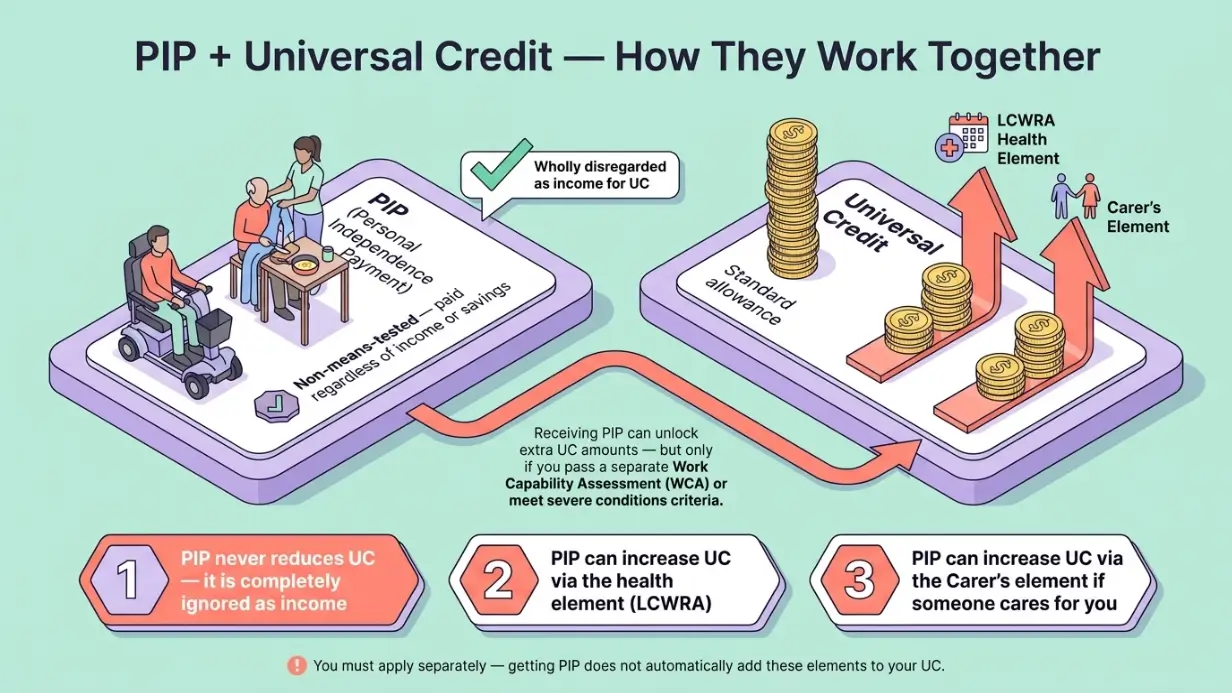
Personal Independence Payment (PIP) does not reduce your Universal Credit (UC) payments. PIP is a non-means-tested benefit, while UC is means-tested; the Department for Work and Pensions (DWP) treats PIP as wholly disregarded income. However, receiving PIP can increase your UC through the LCWRA (health) element and the Carer’s element — but only if you pass a separate Work Capability Assessment (WCA) or meet the severe conditions criteria. This guide gives exact combined totals and the steps you must take.
Is PIP counted as income for Universal Credit?
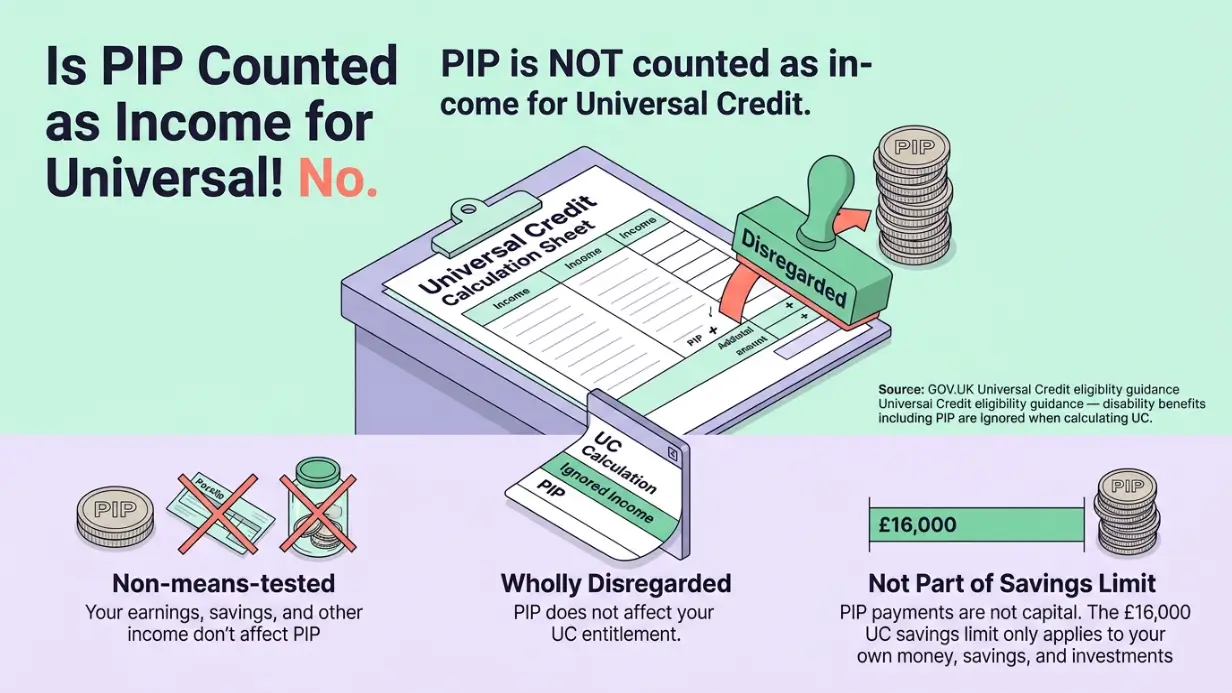
No. PIP is not counted as income for Universal Credit. The DWP classifies PIP as a non-means-tested disability payment. That means your savings, earnings, and other income do not affect your PIP award. And conversely, your PIP award does not affect your UC income calculation. The official GOV.UK guidance for Universal Credit states that certain disability benefits, including PIP, are ignored when calculating your UC entitlement — you can confirm this at https://www.gov.uk/universal-credit/eligibility.
Also, PIP does not count toward the £16,000 savings limit that applies to UC. That limit is for money, savings, and investments you hold — not for your PIP payments. Many people confuse this, but the savings test only applies to your own capital, not to disability benefits you receive.
Does PIP reduce my Universal Credit pound for pound?
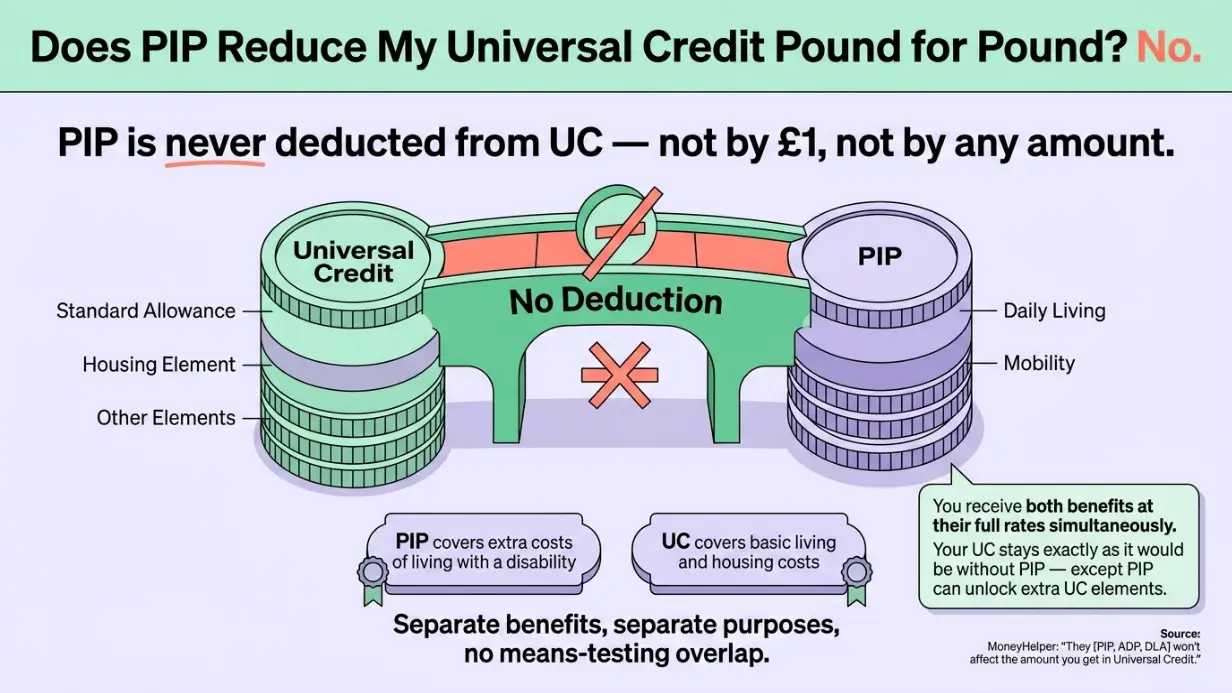
No. PIP is never deducted from your Universal Credit award, not by £1, not by any amount. The DWP treats PIP as a separate benefit with a separate purpose: PIP covers the extra costs of living with a disability, while UC covers basic living and housing costs. The MoneyHelper guide for sick and disabled people confirms this: “They [PIP, ADP, DLA] won’t affect the amount you get in Universal Credit” — see https://www.moneyhelper.org.uk/en/benefits/benefits-if-youre-sick-disabled-or-a-carer/universal-credit-for-disabled-people.
You can receive both benefits at their full rates simultaneously. There is no means-testing overlap. If you get PIP, your UC standard allowance, housing element, and any other UC elements remain exactly as they would be without PIP — except for the extra elements that PIP can unlock, which we cover below.
What is the LCWRA (health) element, and does PIP automatically give it to me?
PIP does not automatically give you the LCWRA element. LCWRA stands for “Limited Capability for Work and Work-Related Activity.” It is an extra monthly payment on top of your standard UC allowance. However, you do not get it simply because you receive PIP. You must go through a separate Work Capability Assessment (WCA) conducted by the DWP.
The WCA determines whether your health condition or disability limits your ability to work. You start by getting a fit note from your GP and adding it to your UC journal. The DWP will then send you a form called the UC50 (or WCA50 in some cases), which you fill out to describe how your condition affects daily tasks. After that, you may be asked to attend a face-to-face or telephone assessment. The MoneyHelper guide explains this process in detail: https://www.moneyhelper.org.uk/en/benefits/benefits-if-youre-sick-disabled-or-a-carer/universal-credit-for-disabled-people.
Receiving PIP does strongly support your case during the WCA. For example, if PIP has already awarded you points for daily living tasks (like preparing food or washing), that evidence helps demonstrate your functional limitations. But the WCA assessor makes a separate decision based on different criteria. They do not simply copy the PIP outcome.
The LCWRA payment rates depend on when you claimed:
| Claimant type | LCWRA monthly amount | Condition |
|---|---|---|
| Existing claimants (awarded LCWRA before 6 April 2026) | £429.80 | You keep this rate as long as your award continues |
| New claimants (awarded LCWRA on or after 6 April 2026) | £217.26 | This lower rate applies unless you meet the severe conditions criteria |
The severe conditions criteria apply if you have a terminal illness, are receiving certain cancer treatments, or have other specified conditions that make a WCA unnecessary. The BenefitsandWork timeline for April 2026 confirms that the higher rate is frozen for existing claimants, while the lower rate applies to new claims: https://www.benefitsandwork.co.uk/personal-independence-payment-pip/pip-uc-changes.
A common mistake people make is assuming PIP daily living automatically qualifies them for LCWRA. It does not. You must still complete the WCA process. However, if you receive PIP daily living and then pass the WCA, your UC payment will increase by the LCWRA amount on top of your standard allowance.
Can my partner get the Carer’s element on my UC if I get PIP?
Yes, but only if you receive the daily living component of PIP. The UC Carer’s element is available to your partner if they look after you for at least 35 hours per week and they are already claiming Universal Credit. The Turn2us guide states that the Carer’s element of Universal Credit can be up to £209.34 per month for the carer — see https://www.turn2us.org.uk/get-support/information-for-your-situation/personal-independence-payment-pip-and-other-help/i-get-the-daily-living-component-of-pip-what-else-can-i-get.
The conditions are:
-
You receive any rate of the daily living component of PIP (standard or enhanced).
-
Your partner cares for you for at least 35 hours per week.
-
Your partner’s net earnings are below a certain threshold (currently £204 per week, though this figure changes — check the latest on GOV.UK).
-
Your partner is already on Universal Credit and makes a joint claim with you.
Important: The mobility component of PIP does not qualify for the Carer’s element. Only daily living counts. Also, if your partner claims the Carer’s element, you cannot get the Severe Disability Premium (SDP) — the two are mutually exclusive, as Turn2us explains.
In practice, many couples miss this extra payment because they do not realise that caring for a PIP recipient on daily living triggers this UC add-on. The money is paid directly into your combined UC monthly payment, not as a separate Carer’s Allowance cheque.
Does PIP affect my UC housing costs or work allowance?
PIP affects housing costs in one specific way, but it does not affect your work allowance or taper rate.
Housing costs
If you receive the daily living component of PIP, non-dependant deductions do not apply to your UC housing element. A non-dependant is a person living with you who is not your partner or a dependent child. Normally, the DWP reduces your UC housing payment if a non-dependant adult lives in your home. But if you or your partner receives PIP daily living, that reduction is removed. Turn2us states this clearly: “If you or your partner get the daily living component of PIP, your Housing Benefit or Universal Credit is not affected by non-dependants.” — https://www.turn2us.org.uk/get-support/information-for-your-situation/personal-independence-payment-pip-and-other-help/i-get-the-daily-living-component-of-pip-what-else-can-i-get.
Work allowance and taper rate
PIP does not affect your UC work allowance or taper rate. The work allowance is the amount you can earn before your UC payments start to reduce. For 2026/27, the work allowance is:
-
£427 per month if your UC includes housing support.
-
£710 per month if your UC does not include housing support.
These figures come from the MoneyHelper guide for sick and disabled people: https://www.moneyhelper.org.uk/en/benefits/benefits-if-youre-sick-disabled-or-a-carer/universal-credit-for-disabled-people.
After you earn above your work allowance, your UC reduces by 55p for every £1 you earn. That taper rate applies only to your earned income, not to your PIP. PIP is not earnings, so it does not reduce your work allowance, and it does not trigger the taper. Many claimants worry that PIP will eat into their work allowance — it does not. You can work, claim PIP, and claim UC, and the taper only hits your wages.
What happens if my PIP is reduced or stopped — does my UC change immediately?
Your UC does not change immediately. A reduction or stop in PIP does not automatically reduce your UC payment. The reason is that UC and PIP are separate systems. Your UC LCWRA element depends on your WCA decision, not on your PIP award. If PIP stops, your LCWRA stays as long as your WCA outcome remains valid. The DWP only reassesses your WCA if they initiate a separate review or if you report a change in your health condition.
However, you must report the PIP change to UC. The statutory deadline is within 1 month of the decision letter that changes your PIP award. The GOV.UK guidance for reporting changes to Universal Credit states that you must report any change in your circumstances within one month: https://www.gov.uk/universal-credit/report-a-change-of-circumstances.
If you report late, you may receive an overpayment that you have to repay. But the UC amount itself stays the same until you report it. The DWP will then check whether your LCWRA status is still valid. If your WCA decision is still in place, your UC remains unchanged. If your PIP reduction was due to a reassessment of your daily living needs, that does not automatically affect your WCA status — they are separate assessments.
In practice, I have seen many claimants panic when PIP reduces, assuming their UC will also drop. That is rarely the case. Only if the WCA is re-run and finds you fit for work would you lose the LCWRA element. So the safe rule is: report the PIP change within 1 month, but do not assume your UC payment will reduce.
Where and how do I report my PIP award on my UC journal?
You report it through your online UC journal using the “Report a change” function. Here is the exact step-by-step path:
-
Sign in to your Universal Credit account at https://www.gov.uk/universal-credit/sign-in.
-
Click on “Report a change” on your home dashboard.
-
Select “Health or disability” from the list of change types.
-
Choose “You have been told you’re eligible for PIP“ (or similar wording — the dropdown changes occasionally, but it will be under the health/disability category).
-
Enter the date of your PIP decision letter and the rate (standard/enhanced daily living or mobility).
-
Upload a photo or scan of your PIP decision letter as evidence. The DWP accepts PDFs, JPEGs, or PNG files.
-
Click Submit.
After you submit, your work coach will receive a notification. They may send you a message in the journal to confirm that the change has been processed. Keep the submission reference number in case of future disputes.
One common error is to wait until the first PIP payment arrives before reporting. Do not do that. The deadline is from the decision letter date, not from the payment date. Report as soon as you receive the letter.
How much do I get in total — a real-world example for a single person?
Here is a worked example for a single person, aged over 25, renting privately with no housing support included in UC, and with no other income. The rates below are for 2026/27.
| Scenario | Components | Monthly total |
|---|---|---|
| UC only (standard allowance) | £424.90 (UC standard allowance) | £424.90 |
| UC + PIP standard daily living + LCWRA (new claimant) | £424.90 (UC) + £217.26 (LCWRA new) + £76.70/week PIP × 4.333 (monthly equivalent) = £332.33 | £974.49 |
| UC + PIP enhanced daily living + LCWRA (existing claimant) | £424.90 (UC) + £429.80 (LCWRA existing) + £114.60/week PIP × 4.333 (monthly equivalent) = £496.55 | £1,351.25 |
The BBC article confirms the PIP weekly rates: standard daily living £76.70, enhanced daily living £114.60 — https://www.bbc.com/news/articles/cj924xvzrr2o. The BBC also confirms UC standard allowance for a single person over 25 is £424.90 — same source. The LCWRA rates come from MoneyHelper and BenefitsandWork as cited above.
If you have housing costs, you add your housing element on top of these totals. If you are a couple, your UC standard allowance is higher, and the PIP Rates stay the same per person. These examples give you a baseline to calculate your own combined figure.
Frequently asked questions about PIP and Universal Credit
Can I claim PIP and Universal Credit at the same time?
Yes. They are separate benefits; PIP is not means-tested, so it does not stop you from getting UC. You can receive both at their full rates.
Does PIP automatically give me the LCWRA extra on UC?
No. You must undergo a separate Work Capability Assessment (WCA) unless you meet the severe conditions criteria. PIP only supports your case; it does not replace the WCA.
How long do I have to report my PIP award to UC?
You must report it within 1 month of the PIP decision letter. Use your UC journal to avoid overpayments or sanctions.
If I get PIP mobility only, does that affect my UC?
No. Mobility alone does not affect UC elements — only the daily living component qualifies for the Carer’s element and non-dependant deduction exemptions.
I was on LCWRA before April 2026 — do I keep the higher rate?
Yes. Existing claimants retain £429.80/month. New claimants after that date get £217.26/month unless they meet the severe conditions criteria.
What happens to my UC if my PIP is stopped?
Your UC stays the same unless your WCA decision changes. LCWRA is based on the WCA, not on PIP — so report the change, but your UC may not reduce immediately.
This article covers only the interplay between PIP and Universal Credit payments. For application procedures, appeals, Motability, Blue Badge, free prescriptions, or other passported discounts, please refer to the separate guides on those topics.