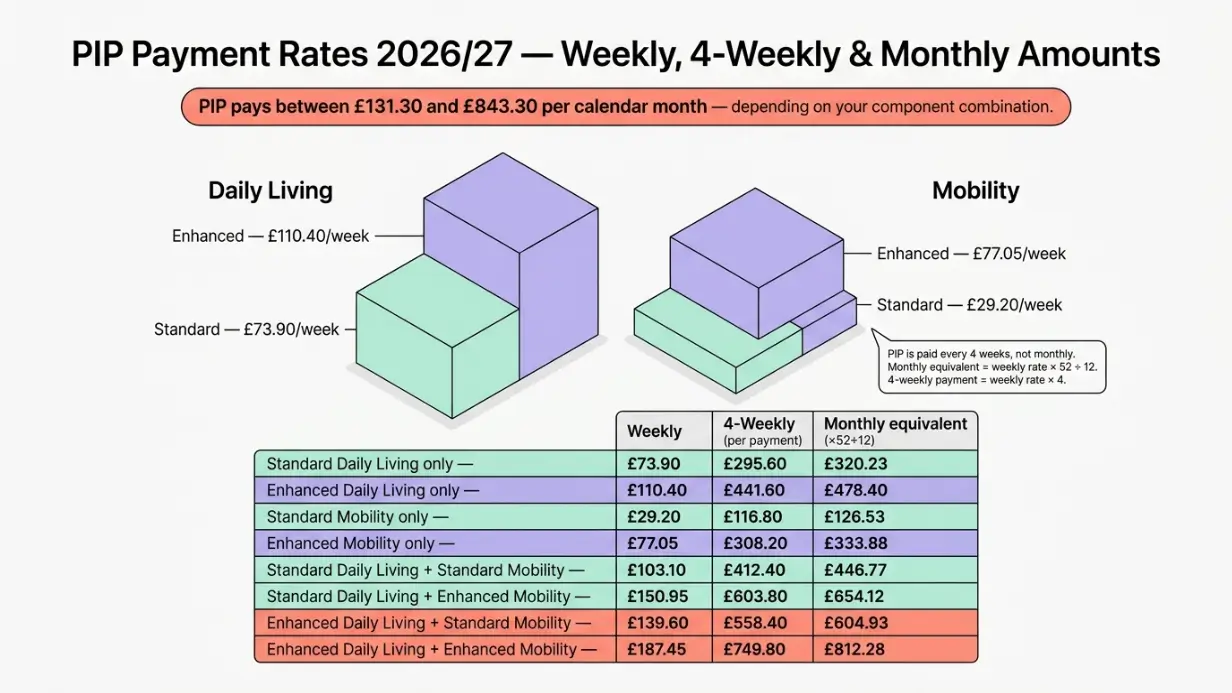
Personal Independence Payment (PIP) pays between £131.30 and £843.30 per calendar month in 2026/27, depending on your combination of the Daily Living and Mobility components. Because PIP is paid every 4 weeks (not monthly), the exact monthly equivalent is the weekly rate multiplied by 52 and divided by 12. Below, every possible PIP award is broken down into weekly, 4-weekly, and true monthly amounts.
What Are the Current PIP Weekly Rates for 2026/27?
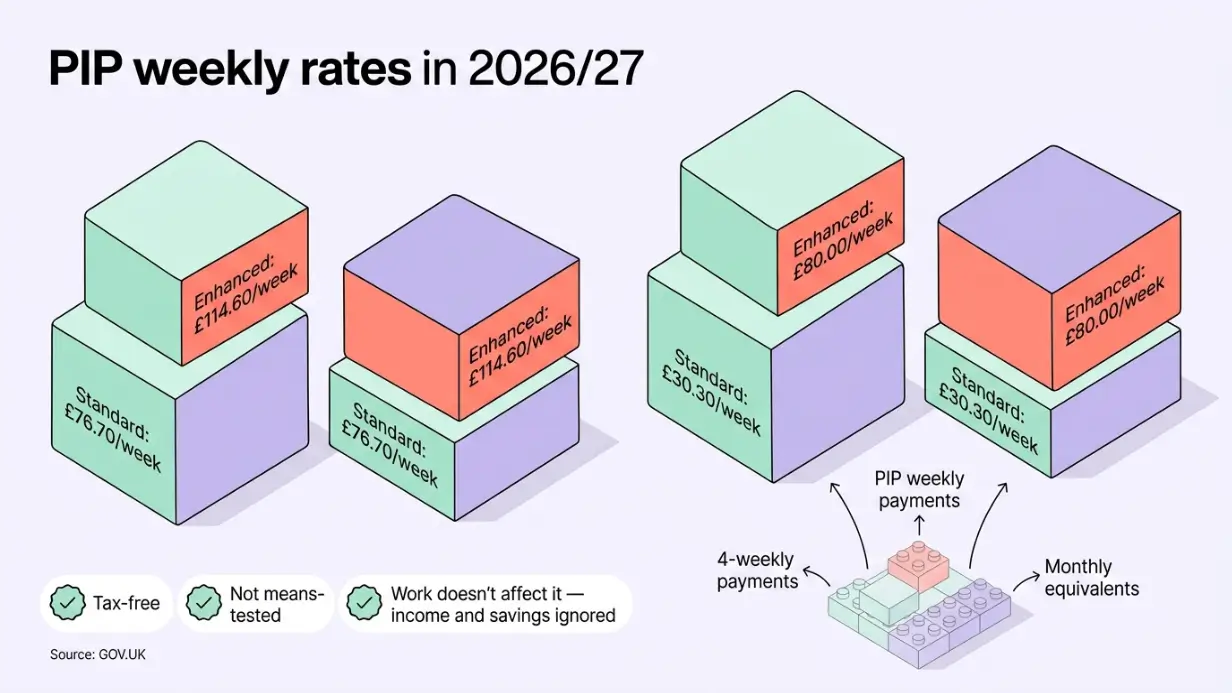
The 2026/27 PIP weekly rates for each component and rate level are:
| Component | Standard rate (weekly) | Enhanced rate (weekly) |
|---|---|---|
| Daily living | £76.70 | £114.60 |
| Mobility | £30.30 | £80.00 |
Source: https://www.gov.uk/pip/how-much-youll-get
PIP is tax-free. The amount you receive does not depend on your income, savings, or whether you work. PIP is not means-tested. These weekly amounts are the building blocks for all the monthly and 4-weekly figures that follow.
How Often Is PIP Paid, and How Do I Convert Weekly Payments to a Monthly Figure?
PIP is paid every 4 weeks, not once per calendar month. You receive 13 payments per year, not 12. To budget on a true monthly basis, you must convert the weekly rate to a monthly equivalent. The formula is:
Monthly amount = (Weekly rate × 52) ÷ 12
This gives you the average amount you can count on each calendar month across a full year. Many people mistakenly treat the 4-weekly payment as their monthly income. In practice, the 4-weekly amount is lower than the true monthly equivalent. For example, the standard daily living component pays £306.80 every 4 weeks, but the average monthly figure is £332.40.
| Component / rate | 4-weekly payment | True monthly equivalent |
|---|---|---|
| Daily living standard | £306.80 | £332.40 |
| Daily living enhanced | £458.40 | £496.60 |
| Mobility standard | £121.20 | £131.30 |
| Mobility enhanced | £320.00 | £346.70 |
As a benefits caseworker, I always tell clients to base their monthly budget on the true monthly equivalent. If you simply multiply the 4-weekly payment by 12, you under-budget – PIP gives you 13 payments a year, and ignoring the extra payment can leave you short on bills.
Don’t make the common mistake of using the 4-weekly lump sum as your monthly income. Your direct debits and rent are likely due on the same calendar date each month, and your PIP landing date will drift forward each month because 4-week cycles do not align with calendar months. Plan around the monthly average.
What Is the Total PIP Amount I Could Get Each Month? Full Combination Payouts
Your overall PIP award is the sum of whatever you qualify for in the daily living and mobility components. You may receive one or both components, and each is paid at either the standard or enhanced rate. The table below shows every possible combination.
| Award combination | Weekly total | Every 4 weeks | True monthly equivalent |
|---|---|---|---|
| Standard daily living + Standard mobility | £107.00 | £428.00 | £463.70 |
| Enhanced daily living + Standard mobility | £144.90 | £579.60 | £627.90 |
| Standard daily living + Enhanced mobility | £156.70 | £626.80 | £679.00 |
| Enhanced daily living + Enhanced mobility (maximum award) | £194.60 | £778.40 | £843.30 |
| Standard mobility only (minimum award) | £30.30 | £121.20 | £131.30 |
The highest possible PIP payment is £843.30 per month (combined enhanced rates). The lowest possible PIP payment is £131.30 per month (standard mobility only). All figures are for the 2026/27 financial year, effective from April 2026.
These monthly numbers are what to use when you work out your household budget. Remember they are averages – some calendar months will receive two 4-weekly payments, others one. The annual total remains exactly the weekly amount multiplied by 52.
Is PIP Taxable or Means-Tested? Will Anything Reduce How Much I Actually Receive?
-
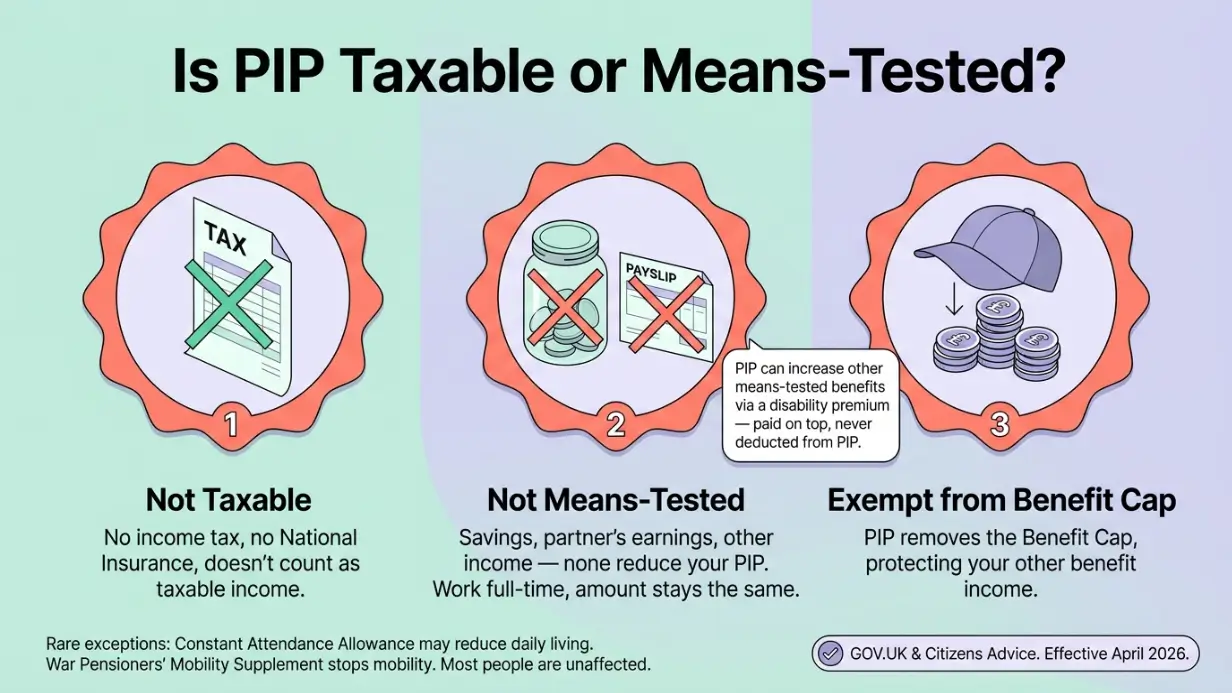
PIP is not taxable. You do not pay income tax or National Insurance on it, and it does not count as taxable income. (Source: https://www.gov.uk/pip/how-much-youll-get)
-
PIP is not means-tested. Your savings, your partner’s earnings, or any other income you have do not reduce your PIP award. Even if you work full-time, the amount stays the same.
-
PIP makes you exempt from the Benefit Cap. If your household benefits would otherwise be capped, PIP removes that cap, protecting your other benefit income. (Source: https://www.citizensadvice.org.uk/benefits/sick-or-disabled-people-and-carers/pip/before-claiming/how-much-you-get-and-how-long/)
No, your PIP amount is not reduced by other benefits. In fact, getting PIP can increase means-tested benefits via a disability premium, but that extra amount is paid on top, not deducted from your PIP. The only exceptions are if you also receive Constant Attendance Allowance (which reduces the daily living component) or War Pensioners’ Mobility Supplement (which stops the mobility component). Those situations are rare.
How Do I Get the Higher Rate of PIP?
Whether you get the standard or enhanced rate of each component depends on how many points you score in the PIP assessment. You get the standard rate if you score between 8 and 11 points for that component’s activities. You get the enhanced rate if you score 12 points or more.
PIP is not awarded by condition. The DWP does not have a list of diagnoses that automatically qualify for a particular rate. Two people with the same medical label can receive completely different awards because PIP looks at how your condition affects your daily living and mobility, not the name of the condition. This is why questions like “How much is PIP for anxiety?” have no single answer – you could receive any rate depending on the severity of your functional difficulties.
From my experience supporting claimants, many people who qualify for the enhanced daily living rate do not realise they may also score enough points for enhanced mobility. For example, overwhelming psychological distress when following a journey can meet the mobility descriptor, even if you can physically walk. Always describe every way your condition impacts you, not just the most obvious one.
For a full breakdown of the points system and descriptors, see the separate PIP Eligibility guide. This page focuses on the cash amounts.
When Do PIP Rates Change, and How Much Did They Increase in April 2026?
PIP rates are reviewed every year and usually rise in April, in line with inflation. For 2026/27, the increase was 3.8%. The table below shows the 2025/26 rates next to the new 2026/27 rates so you can see exactly how much each component has risen.
| Component | 2025/26 weekly rate | 2026/27 weekly rate | Increase (£ per week) |
|---|---|---|---|
| Daily living standard | £73.90 | £76.70 | £2.80 |
| Daily living enhanced | £110.40 | £114.60 | £4.20 |
| Mobility standard | £29.20 | £30.30 | £1.10 |
| Mobility enhanced | £77.05 | £80.00 | £2.95 |
Source: DWP benefit uprating 2026/27, https://www.gov.uk/government/publications/proposed-benefit-and-pension-rates-2026-to-2027
The new rates apply from 6 April 2026. Your first payment at the increased amount will arrive in your first 4-weekly payment after that date.
Where Can I Verify These PIP Figures?
Every rate on this page is taken directly from the official GOV.UK PIP page. You can confirm the current weekly amounts there at any time: https://www.gov.uk/pip/how-much-youll-get
Other reliable sources that mirror the official data include Citizens Advice (https://www.citizensadvice.org.uk/benefits/sick-or-disabled-people-and-carers/pip/before-claiming/how-much-you-get-and-how-long/) and Turn2us (https://www.turn2us.org.uk/get-support/information-for-your-situation/personal-independence-payment/how-much-personal-independence-payment-(pip)-will-i-get). All three use the same DWP-published rates.
How Does PIP Interact with Other Benefits? (Brief)
PIP can increase your entitlement to some means-tested benefits. If you receive PIP, you may get a disability premium added to Income-Related Employment and Support Allowance, Housing Benefit, Income Support, or Jobseeker’s Allowance. Universal Credit includes a similar extra amount. You must tell the office that handles those benefits that you are getting PIP so they add the premium.
If you receive Constant Attendance Allowance, your PIP daily living component is reduced pound for pound. If you receive War Pensioners’ Mobility Supplement, you do not get the PIP mobility component.
You also automatically qualify for a £10 Christmas Bonus each year. It is paid without you needing to claim it and does not affect your other benefits.
For a full guide to benefit combinations, see our dedicated PIP and other benefits page.
Frequently Asked Questions About PIP Payments
How much is PIP going up in April 2026?
PIP rates increased by 3.8% from 6 April 2026. The enhanced daily living rate rose from £110.40 to £114.60 per week; the enhanced mobility rate rose from £77.05 to £80.00. All rates are now higher by between £1.10 and £4.20 per week compared to 2025/26.
Is PIP paid weekly or monthly?
PIP is paid every 4 weeks, not weekly and not on a fixed calendar date each month. You receive 13 payments a year. There is no option to be paid weekly unless you are terminally ill.
What is the maximum PIP payment per month?
The maximum true monthly amount is £843.30. This is achieved when you receive the enhanced rate of both the daily living and mobility components.
How many PIP payments do you get in a year?
You receive 13 payments per year because PIP is paid every 4 weeks (52 weeks ÷ 4 = 13). This means one calendar month each year will typically contain two PIP payments.
Does PIP affect Universal Credit?
No, PIP does not reduce your Universal Credit. PIP is disregarded as income. In fact, getting PIP can increase your Universal Credit award because it entitles you to the disability element or the limited capability for work-related activity addition.
What is the minimum PIP payment per month?
The lowest possible award is £131.30 per month. This is the standard rate of the mobility component only. There is no payment lower than this in 2026/27.
How much is PIP per month for anxiety?
PIP is not paid at a fixed rate based on your condition. Two people with anxiety can receive completely different amounts. Your monthly amount depends entirely on how many points you score in the daily living and mobility assessments. It could be as low as £131.30 or as high as £843.30.
What is the middle rate of PIP?
There is no “middle rate” in PIP. That term belongs to Disability Living Allowance (DLA), which PIP replaced. PIP has only standard and enhanced rates for each component.
All the figures above serve the single purpose of showing you exactly how much PIP pays per month. For help with eligibility, claiming, or challenging a decision, follow the links to our separate guides.