
To report a change of circumstances for PIP Personal Independence Payment (PIP), you must call the PIP enquiry line on 0800 121 4433 as soon as the change happens. Changes include your health, daily living or mobility needs, going into hospital or a care home, imprisonment, going abroad for more than four weeks, or a change to personal details. Your PIP award could increase, decrease, stay the same, or stop. Failing to report can lead to overpayment recovery or a penalty.
What changes do I need to report to PIP?
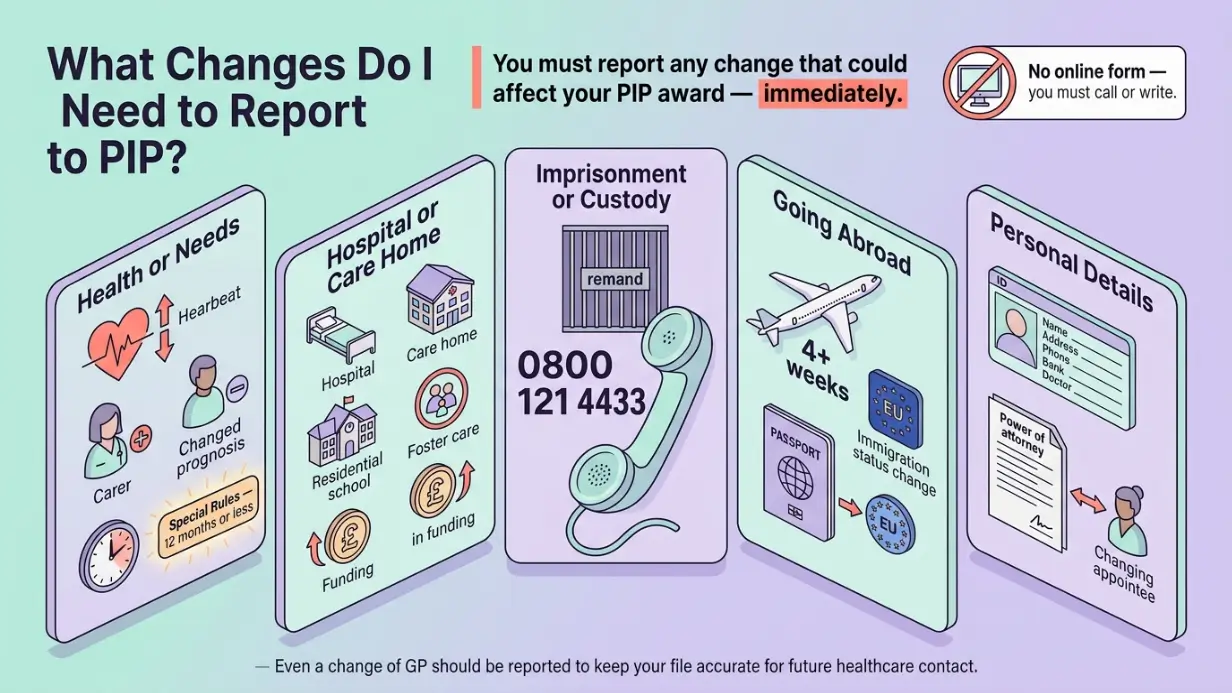
You must tell the Department for Work and Pensions (DWP) about any change that could affect your PIP award. The duty to report is mandatory and applies straight away. A change of circumstances is any event that alters your condition, the help you need, or your personal situation. The DWP considers the following as reportable changes:
Changes to your health or needs
-
Your condition gets better or worse
-
The level of help or care you need with daily living or mobility tasks changes
-
A medical professional tells you that your condition will last for a longer or shorter time than you reported before
-
A medical professional says you might have 12 months or less to live — you could get PIP at a higher rate under the ‘special rules for end of life’
Going into a hospital, care home or similar institution
-
You go into a hospital, a hospice, a nursing home or a care home
-
You go into a residential school or college
-
You go into foster care or into the care of a local authority or health and social care trust
-
You move from one care home to another, or your stay changes from temporary to permanent
-
There is a change to the way your care home fees are funded
Imprisonment or custody
-
You are imprisoned or held in detention — this includes being on remand
Going abroad
-
You plan to go abroad for more than 4 weeks — even if it is a holiday
-
Your immigration status changes and you are not a British or Irish citizen
-
You or your spouse, civil partner or a parent you depend on starts or stops getting pensions or benefits from an EU country, Switzerland, Norway, Iceland or Liechtenstein
Personal details
-
Your name, address, phone number, bank account or doctor changes
-
The person acting for you (an appointee or someone with power of attorney) changes
All of these are listed on the official GOV.UK PIP change-of-circumstances page (https://www.gov.uk/pip/change-of-circumstances). Note: You cannot report a PIP change of circumstances online. The DWP does not offer a digital form for this. You must call or write.
Many claimants do not realise that a change of GP or specialist should be reported even though it does not affect payment. Keeping your file accurate matters if the DWP ever needs to contact your healthcare provider later.
How do I report a change of circumstances for PIP?
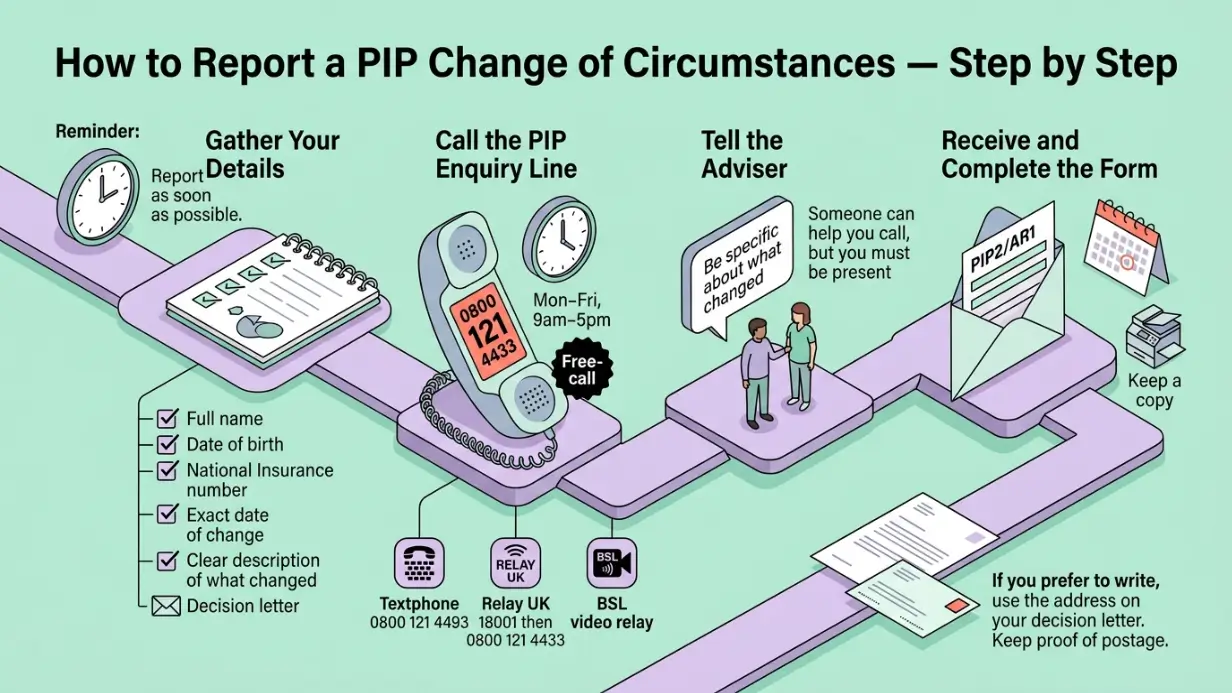
Report a change as soon as possible. Follow these steps:
-
Gather your details. You will need your full name, date of birth, National Insurance number, the exact date the change happened or will happen, and a clear description of what has changed. Having your decision letter to hand helps.
-
Call the PIP enquiry line. Dial 0800 121 4433 (Textphone: 0800 121 4493). Lines are open Monday to Friday, 9am to 5pm. Calls are free from mobiles and landlines (https://www.gov.uk/pip/change-of-circumstances).
-
Tell the adviser what has changed. Be specific. If you need someone to help you, you can ask for them to be added to your call or have someone else call on your behalf — you must be with them when they call. Relay UK users can dial 18001 then 0800 121 4433. A British Sign Language video relay service is also available.
-
Receive and complete the form you are sent. After you phone, the DWP posts a ‘How your disability affects you’ form (also called a PIP2 or AR1 Form). Fill it in and return it by the deadline on the front page. Keep a copy of everything you send.
If you prefer to write, use the address on your PIP decision letter. If you cannot find it, call the enquiry line and ask for the postal address. Keep proof of postage — ask the Post Office for a free certificate of posting.
What evidence should I send with my PIP change of circumstances form?
Include any evidence that supports the change. Good evidence includes:
-
A letter from your consultant, GP, or specialist that describes the change and when it started
-
Your care plan or support needs assessment from social services
-
Recent test results, scans, or clinic letters
-
A daily symptom diary covering the period since the change occurred
-
A statement from a carer or family member who has witnessed the change in your needs
Do not send original documents. Send photocopies and keep the originals safe.
Common mistakes when reporting a PIP change of circumstances
-
Waiting too long. Every day you delay increases the risk of an overpayment or a missed increase.
-
Assuming the DWP will backdate automatically. Backdating is not guaranteed — you must request it and provide evidence.
-
Not keeping copies of your form and evidence. If the DWP loses your paperwork, your copy is your proof.
-
Not telling your support person or appointee about the change. If someone acts for you, they need to know so that the report is consistent.
What happens after I report a change to PIP?
Once you report a change, the DWP reviews your PIP award. This is called a supersession. The process can take several weeks to months.
The form you’ll receive
You will be sent a ‘How your disability affects you’ form (PIP2). This is the same form used for new claims. You must describe how your condition and needs have changed for every relevant daily living and mobility activity. Answer every question, even if you think the change only affects one area. The DWP reviews your whole award.
Will I need another assessment?
Many people who report a change of circumstances will need a new assessment. This can be by telephone, video call, or face-to-face. In some cases, a health professional may decide there is enough written evidence to make a decision without an assessment (called a paper-based review). Provide strong evidence to increase the chance of a paper-based decision.
How long does a PIP change of circumstances take?
The DWP does not publish official waiting times for change-of-circumstances reviews. Based on community reports, a typical timeline from the initial phone call to receiving a decision is 8 to 16 weeks. The table below breaks this down.
| Stage | Typical time |
|---|---|
| Phone call to receiving the PIP2 form | 1–2 weeks |
| Returning the form to confirmation of receipt | 1–2 weeks |
| Waiting for an assessment appointment | 4–8 weeks |
| Assessment to decision letter | 2–6 weeks |
These times are not guaranteed. Delays can happen. If you have not heard anything after 12 weeks, call the PIP enquiry line for an update.
Success rates by condition
DWP figures for the year to April 2026 show that, on average, out of every 100 PIP change-of-circumstances clearances (supersessions), around 39 people received an increased award, 50 stayed on the same amount, 3 had their award decreased, and just over 5 were disallowed after failing the assessment (https://www.benefitsandwork.co.uk/news/pip-change-of-circumstances-Autism-and-ADHD-have-highest-failed-assessment-rates). The original source is the Department for Work and Pensions.
Some conditions have much higher failure rates. For autism, 17% of change-of-circumstance claims were disallowed; for ADHD, 16.3%. Conditions such as lung Cancer (0.4% disallowed) and Parkinson’s disease (1.4% disallowed) had far lower disallowance rates and higher rates of award increases. If you have a condition with a higher risk of a reduced award, talk to a welfare rights adviser before you report the change.
We have seen that claimants who provide contemporaneous evidence — like daily symptom diaries and a detailed letter from their consultant — are far more likely to receive an increase without a further assessment.
Coping with the wait
Waiting for a decision can be stressful. Many people find it helpful to:
-
Put all your paperwork in one folder so that it is easy to find
-
Keep a short daily note of any difficulties — it can be used if you need to request a Mandatory Reconsideration later
-
Talk to a benefits adviser at Citizens Advice or a local welfare rights organisation if your Anxiety spikes
Will my PIP payments stop or change if I report?
When you report a change, the DWP decides whether your PIP award should go up, go down, stay the same, or stop. The effect depends on what type of change you report. The table below summarises the main rules.
| Change | Effect on daily living component | Effect on mobility component |
|---|---|---|
| NHS hospital stay of 28 days or more | Stops after 28 days | Stops after 28 days |
| Care home stay of 28 days or more (publicly funded) | Stops after 28 days | Continues |
| Prison or legal custody of 28 days or more | Stops after 28 days | Stops after 28 days |
| Going abroad for more than 4 weeks | May stop; depends on circumstances | May stop; depends on circumstances |
| Reaching State Pension age (if already claiming PIP) | Continues as long as you still meet the criteria | Continues |
| Starting work or a change in earnings | No effect | No effect |
If you go into hospital or a care home and are then discharged but readmitted within 28 days, the periods are ‘linked’ and the 28-day clock does not reset. Both components of PIP stop after a total of 28 days in hospital, and the daily living component stops after a total of 28 days in a care home where the costs are met from public funds (https://www.communities-ni.gov.uk/articles/ni-pip-handbook-changes-circumstances). The Northern Ireland rules mirror the GB rules in these respects.
Claimants often panic when they receive a suspension letter after a hospital stay, but payments usually resume the day after discharge if you inform the DWP promptly.
What happens to my Motability car if my PIP stops?
If you lose the enhanced rate of the mobility component following a change of circumstances, your Motability lease will end. Motability will contact you and give you a period to arrange the return of the vehicle. You may be entitled to a one-off payment to help with transport costs, depending on how long you have been in the scheme. Contact Motability directly as soon as you receive your PIP decision to discuss your options.
Will I get warning before PIP payments stop?
The DWP should send you a decision letter before any payment change. Always check that your address is up to date. If your PIP stops without any warning, call the PIP enquiry line immediately. It could be a suspension due to a hospital stay they only just learned about, or an error. You have the right to ask for a written explanation.
How long do I have to report a change to PIP?
You must tell the DWP about a change straight away. There is no fixed legal deadline stated in days, but the rule is clear: once you know about a change that could affect your PIP, you must report it as soon as you can.
If you report a worsening condition late, you might be able to get your increased award backdated to the date your needs increased, but only if you have good reasons for the delay and strong supporting evidence. Backdating is not automatic. Each request is decided on its own facts.
If you fail to report a change that would reduce your PIP, the DWP will treat any extra money paid as an overpayment. You will have to repay it. You could also face a penalty or be taken to court for giving wrong information or not reporting a change straight away (https://www.gov.uk/pip/change-of-circumstances).
Can I get help with reporting a change to PIP?
Yes. You do not have to report the change alone.
-
Someone you trust can call with you, or call on your behalf — you must be present to give permission.
-
Citizens Advice and local welfare rights organisations can help you understand what to report and how to fill in the form.
-
If you have an appointee or someone with power of attorney, they can handle the entire process for you. Tell the DWP if the person acting for you changes.
Always take the name of anyone who gives you advice, and note the date. If you later need to challenge a decision, this record is valuable.
What if I disagree with the decision after reporting a change?
If the DWP reduces or stops your PIP after a change-of-circumstances decision and you think the decision is wrong, you can challenge it. The first step is a Mandatory Reconsideration (MR).
You must request the MR within one month of the date on the decision letter. Explain clearly why you think the decision is wrong. Point to specific evidence and the PIP Descriptors you believe you satisfy. Send your request to the address on the letter. Keep a copy of everything.
We often see MR requests succeed when the claimant identifies errors in the assessor’s report and submits fresh evidence — such as a new consultant letter or a detailed daily log — that directly addresses the PIP activity points.
If the MR does not change the outcome, you can appeal to an independent tribunal. There is a strict one-month deadline from the date of the MR notice. Full appeals guidance is beyond the scope of this page, but you can find step-by-step help on GOV.UK (https://www.gov.uk/appeal-benefit-decision).
What changes do I NOT need to report to PIP?
You do not need to tell the DWP about:
-
Starting work, returning to work, or leaving work
-
A change in your earnings or other income
-
Someone joining or leaving your household
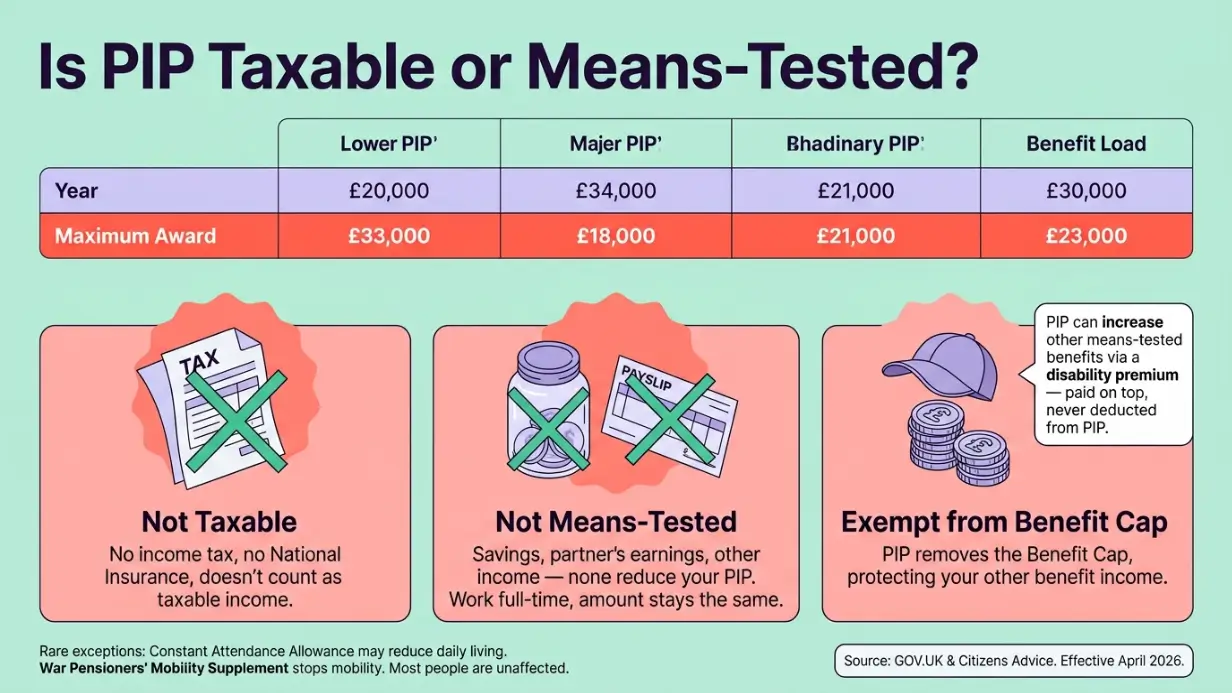
PIP is not means-tested, so these things do not affect how much you get or your eligibility (https://www.citizensadvice.org.uk/benefits/sick-or-disabled-people-and-carers/pip/pip-changes-and-reviews/changes-that-affect-pip/). The only exception is if a work-related change means the amount of daily living or mobility help you need has changed — then you must report the change in your needs, not the work itself.
If you are unsure whether a change affects your PIP, report it anyway. It is safer to tell the DWP and let them decide than to risk an overpayment.
Frequently Asked Questions about PIP Change of Circumstances
How long does a PIP change of circumstances take? A change-of-circumstances decision typically takes 8 to 16 weeks from the initial call. You will receive a form within two weeks, an assessment may be booked a few weeks after you return it, and the decision follows. Delays can stretch the process longer.
Can I report a PIP change of circumstances online? No. The DWP does not provide an online change-of-circumstances service. You must phone the PIP enquiry line on 0800 121 4433 or write to the address on your decision letter. A form will be posted to you after you call.
What happens to my Motability car if PIP stops? If you lose the enhanced mobility component, your Motability lease ends. Motability will contact you to arrange the vehicle’s return. You may receive a one-off transitional payment. Ring Motability as soon as your PIP decision arrives.
What should I do if the DWP reduces my PIP after I report a change? Request a Mandatory Reconsideration within one month of the decision letter. Explain why the decision is wrong and include new evidence. If the MR fails, you can appeal to a tribunal.
Can PIP stop your money without telling you? The DWP should send a letter before any payment change. If payments stop without warning, call 0800 121 4433 immediately. It could be a suspension linked to a hospital stay or an error that needs correcting.
Is it safe to report a worsening condition, or could I lose everything? A small risk of reduction exists, but most change-of-circumstance reviews result in an increase or no change. Over 88% of people either see their award maintained or increased. Strong medical evidence significantly lowers the risk of a decreased award.