
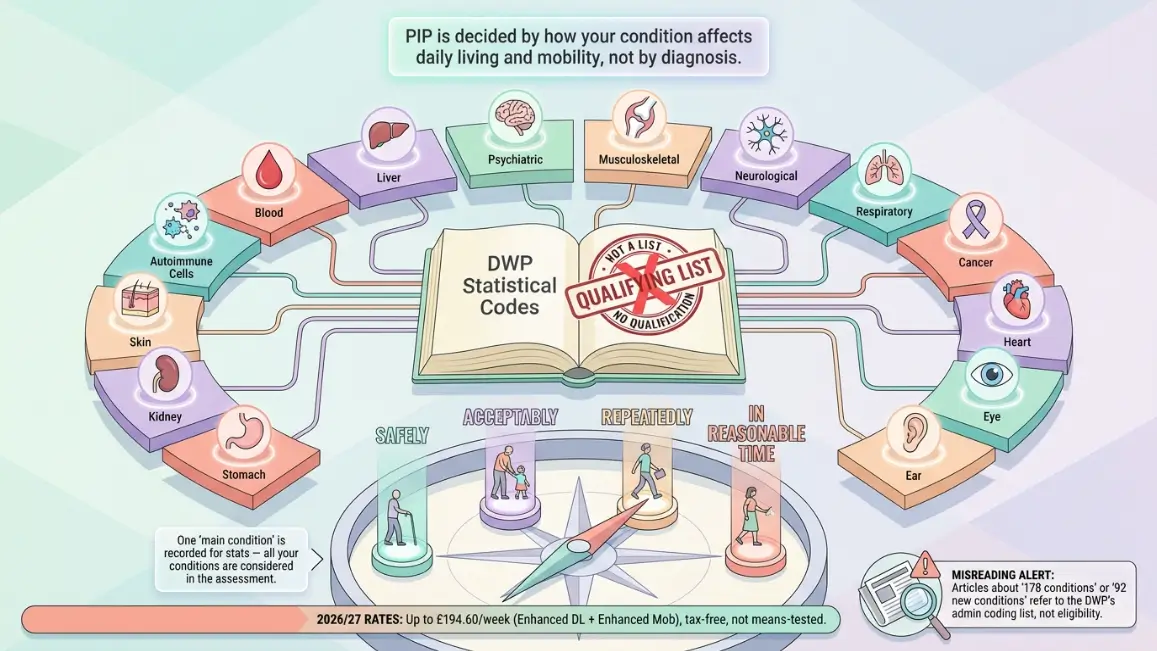
There is no official list of medical conditions that automatically qualify for PIP Personal Independence Payment (PIP). The DWP does record every claim under a clinical condition category for statistical purposes — and this page sets out those categories and the conditions within them — but eligibility is always decided by how your condition affects your daily living and mobility, not by your diagnosis. No condition guarantees an award, and no long-term condition is excluded.
Is there a fixed list of qualifying conditions for PIP?
No. PIP does not use a fixed list of qualifying medical conditions. You may have seen headlines about a “list of 178 conditions” or “92 new conditions added” — this is a misreading of the DWP’s internal coding list. That list is an administrative tool the assessor uses to record your condition; it is not a checklist of what qualifies, and it is not used to decide entitlement. The DWP confirms there is no automatic entitlement attached to any clinical condition.
Instead, you may be eligible for PIP if all of the following apply:
- You are aged 16 or over and under State Pension age (for a new claim).
- You have a long-term physical or mental health condition that makes everyday tasks or getting around difficult.
- Those difficulties have lasted at least 3 months and are expected to continue for at least another 9 months.
- PIP is not means-tested — you can claim regardless of income, savings or employment status.
- Different (faster) rules apply if you are nearing the end of life.
So the right question is not “is my condition on the list?” but “does my condition affect the activities PIP scores?” You can check that against our PIP eligibility guide and estimate your score with the PIP points calculator.
What medical conditions does the DWP record, and how are they categorised?
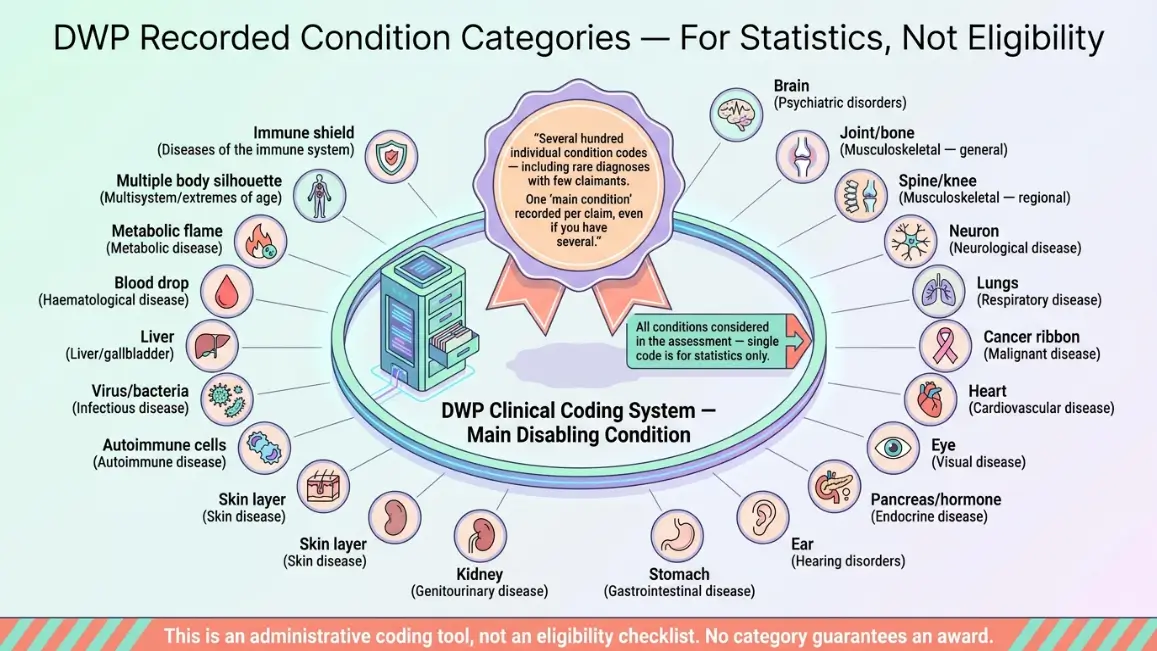
While there’s no qualifying list, the DWP does record each claim under a “main disabling condition” — the condition with the most significant impact on your function — using a clinical coding system. These records exist for statistics and administration, not eligibility. The conditions are grouped under around fifteen broad clinical categories, which between them cover several hundred individual condition codes (including many rare diagnoses with very few claimants).
| Category | What it covers |
|---|---|
| Psychiatric disorders | Conditions affecting mental health, mood, cognition and behaviour |
| Musculoskeletal disease (general) | Widespread conditions affecting bones, muscles and joints across the body |
| Musculoskeletal disease (regional) | Localised conditions affecting specific areas such as back, neck or knees |
| Neurological disease | Disorders of the brain, spinal cord and nervous system |
| Respiratory disease | Conditions affecting the lungs and breathing |
| Malignant disease | Cancers and malignant tumours |
| Cardiovascular disease | Conditions affecting the heart and blood vessels |
| Visual disease | Disorders of the eye and vision |
| Endocrine disease | Hormonal and glandular disorders, including diabetes |
| Hearing disorders | Conditions affecting hearing and balance |
| Gastrointestinal disease | Disorders of the digestive system |
| Genitourinary disease | Conditions affecting kidneys, bladder and reproductive organs |
| Skin disease | Disorders of the skin and connective tissue |
| Autoimmune disease (connective tissue disorders) | Conditions where the immune system attacks the body’s own tissues |
| Infectious disease | Illnesses caused by bacterial, viral or parasitic infection |
| Diseases of the liver, gallbladder, biliary tract | Hepatic and biliary conditions |
| Haematological disease | Blood and bone marrow disorders |
| Metabolic disease | Disorders of metabolism and enzyme function |
| Multisystem and extremes of age | Conditions affecting multiple body systems, or age-related frailty |
| Diseases of the immune system | Primary immune system disorders (excluding autoimmune conditions) |
How does the DWP assign a main condition when a claimant has several?
The DWP records only one “main disabling condition” per claim — the one identified as having the most significant functional impact — even if you have several. Someone with arthritis, depression and diabetes will appear under just one category in the statistics, even though all three affect their daily living. This means the published data understates how many claimants live with multiple long-term conditions. In your actual assessment, though, all your conditions are considered together — the single-category coding is only how the statistics are recorded afterwards.
Which broad categories account for the most PIP awards?
A small number of categories make up the large majority of claims. mental health conditions are the single largest group, followed by musculoskeletal and neurological conditions.
| Category | Approximate share of claims |
|---|---|
| Psychiatric disorders | ~38% |
| Musculoskeletal disease (general) | ~19% |
| Neurological disease | ~13% |
| Musculoskeletal disease (regional) | ~12% |
| Respiratory disease | ~4% |
| Malignant disease (cancer) | ~3% |
| Cardiovascular disease | ~3% |
| All other categories combined | ~8% |
Two of the biggest groups have dedicated guides on this site: PIP for Mental Health (psychiatric disorders) and PIP for arthritis (a large part of the musculoskeletal group). Figures are approximate and shift slightly with each DWP statistical release.
How much is PIP in 2026/27?
There is no condition-specific rate — the amount depends only on whether you’re awarded the daily living component, the mobility component, or both, and at which rate. The 2026/27 rates took effect on 6 April 2026.
| Component | Standard (weekly) | Enhanced (weekly) |
|---|---|---|
| Daily living | £76.70 | £114.60 |
| Mobility | £30.30 | £80.00 |
If you’re awarded both enhanced components, that’s £194.60 a week (£778.40 every four weeks). PIP is paid every four weeks, is tax-free, and doesn’t reduce your other benefits. See the full breakdown of every combination in our PIP rates guide, and if you’ve recently been awarded PIP, estimate any arrears with the PIP back pay calculator.
How do I find my condition, and what does it mean if it’s listed?
Scan the directory below for your diagnosis — but check related labels too, because the DWP may record your condition under a different functional category. Epilepsy, for example, sits under neurological disease; chronic pain may be coded under musculoskeletal or neurological depending on the primary diagnosis. Look for the broad category that matches your symptoms rather than your exact clinical name. Remember: finding (or not finding) your condition here tells you nothing about whether you’ll be awarded PIP — that depends entirely on functional impact.
Conditions the DWP records, by category
Psychiatric disorders: anxiety disorders, autistic spectrum disorders, cognitive disorders, conduct disorder (including oppositional defiant disorder), eating disorders, enuresis, factitious disorder, faecal soiling (encopresis), hyperkinetic disorder (including ADHD), learning disability (global), mixed anxiety and depressive disorders, mood disorders (including depression and bipolar disorder), obsessive compulsive disorder, other psychiatric disorders of childhood, personality disorder, psychotic disorders, somatoform and dissociative disorders, specific learning disorder, stress reactions (including PTSD), substance misuse disorders. Related on this site: PIP for mental health, and condition calculators for anxiety, PTSD, ADHD and autism.
Musculoskeletal disease (general): benign tumours of bone, chronic pain syndromes (including fibromyalgia), crystal deposition disorders (including gout), fracture complications, genetic disorders, dysplasias and malformations, inflammatory arthritis (including rheumatoid and psoriatic arthritis), metabolic and endocrine musculoskeletal disorders, osteoarthritis, osteonecrosis and osteochondritis, other generalised musculoskeletal disease. Related on this site: PIP for arthritis, and calculators for osteoarthritis, fibromyalgia and walking through pain.
Musculoskeletal disease (regional): amputations, ankle and foot disorders, elbow disorders, hip disorders, injuries/fracture/dislocation, knee disorders, neck disorders, non-specific back pain, other regional musculoskeletal disease, shoulder disorders, specific back pain, wrist and hand disorders. Related on this site: the sciatica and walking through pain calculators.
Neurological disease: ataxia, benign tumours, cerebral palsy, cerebrovascular disease (including stroke), degenerative neuronal diseases, disease of muscle, epilepsy, head injury, headache (including migraine), hydrocephalus, infections, movement disorders (including Parkinson’s), multiple sclerosis, muscular dystrophy, neuropathy, non-epileptic disturbance of consciousness, other neurological disorders, peripheral nerve injury, spina bifida, spinal cord compression.
Respiratory disease: asthma, bronchiectasis, chronic obstructive pulmonary disease (chronic bronchitis/emphysema), cystic fibrosis, disease of the pleura, diseases of the upper respiratory tract, granulomatous lung disease and pulmonary infiltration, heart and lung transplantation, infectious diseases of the respiratory tract, lung transplantation, other diseases of the lower respiratory tract, pneumoconiosis, pulmonary embolus, pulmonary fibrosis. Related on this site: the COPD calculator.
Malignant disease (cancer): cancer of breast, cancer of the brain and spinal cord, cancers of bone, cancers of the adrenal gland, cancers of the genitourinary tract, cancers of the gastrointestinal tract, cancers of the haematological system, cancers of the respiratory tract, cancers of the skin, other cancers, other sarcomas, unknown primary. (People nearing the end of life can claim under fast-tracked Special Rules — see How to Claim PIP.)
Cardiovascular disease: aneurysm, cardiac arrhythmias, cardiac failure, cardiomyopathy, congenital heart disease, heart transplantation, hypertension, ischaemic heart disease, other cardiovascular disease, pericarditis, peripheral arterial disease, peripheral venous disease, valve disease.
Visual disease: cataract, diseases of conjunctiva, cornea, eyelids and lacrimal apparatus, diseases of the retina and optic nerve, disorders of eye movement, glaucoma, visual injuries, other diseases affecting vision, refractive errors, uveitis, visual field defects, vitreous disease.
Endocrine disease: adrenal disease, hypothalamic and pituitary disease, other endocrine diseases, pancreatic disease (including diabetes), parathyroid disease, thyroid disease.
Hearing disorders: conductive hearing loss, mixed hearing loss, other diseases affecting hearing and balance, sensorineural hearing loss.
Gastrointestinal disease: abdominal hernias, benign tumours of the GI tract, congenital disorders of the GI tract, diseases of the colon, diseases of the oesophagus, stomach and duodenum, diseases of the pancreas, diseases of the rectum and anus, diseases of the small bowel, inflammatory bowel disease (Crohn’s and ulcerative colitis), irritable bowel syndrome, other diseases of the gastrointestinal tract. Related on this site: the Crohn’s and IBS calculators.
Genitourinary disease: diseases of bladder, urethra, prostate, testes and penis, diseases of the ovary, uterus, cervix, vagina and vulva, kidney disease, other genitourinary disease, renal failure, urinary incontinence.
Skin disease: bullous disease, burns, diseases of blood vessels/lymphatics, diseases of collagen and elastic tissue, other skin disease, papulosquamous and inflammatory rashes.
Autoimmune disease (connective tissue disorders): antiphospholipid syndrome, other autoimmune disease, Sjögren’s syndrome, systemic lupus erythematosus (SLE), systemic sclerosis (scleroderma), vasculitis.
Infectious disease: bacterial diseases, infections and parasites, other infectious diseases, protozoal diseases, viral diseases.
Diseases of the liver, gallbladder, biliary tract: chronic hepatitis, cirrhosis, disease of gallbladder and biliary tract, liver failure, liver transplantation.
Haematological disease: anaemia, blood disorders, clotting disorders, haemolytic disorders, metabolic red cell disorders, platelet disorders.
Metabolic disease: amyloidosis, hyperlipidaemia, inborn errors of metabolism, obesity, other metabolic diseases, porphyria.
Multisystem and extremes of age: extremes of age, multisystem conditions.
Diseases of the immune system: hypersensitivity diseases, other diseases of the immune system.
Can I get PIP if my condition isn’t in this directory?
Yes. This directory is a record of how existing claims are coded — it is not an eligibility checklist. PIP is awarded on functional impact, so you can receive it for any long-term condition that affects your daily living or mobility, even one that doesn’t appear in the published data or is too rare to show up. A condition appearing here doesn’t guarantee an award either. What matters is whether you can carry out the assessed activities safely, to an acceptable standard, repeatedly and in a reasonable time — the test explained in our PIP Points System and PIP descriptors guides.
Where does this condition data come from?
The categories and conditions above come from the DWP’s published PIP statistics (the “main disabling condition” data on Stat-Xplore) and its clinical coding standard. The DWP does not publish an official A–Z list or PDF of “qualifying conditions” for applicants — any article presenting one as a checklist of what qualifies has misunderstood the coding data. The NHS does not administer PIP or hold these statistics; it provides diagnosis and treatment, while the DWP uses the diagnosis only as a category label for administration.
Frequently asked questions
Is there an official DWP list of conditions that qualify for PIP?
No. There is no list of qualifying conditions. The DWP uses a clinical coding list to record each claim’s main condition for statistics, but it has no bearing on eligibility — PIP is decided on how your condition affects you, not the diagnosis.
Why do some articles say there are 178 conditions (or 92 new ones)?
Those figures are a misreading of the DWP’s internal coding list, which records conditions for administrative purposes. It is not a list of what qualifies, and conditions aren’t “added” to make people eligible. Eligibility has always been based on functional impact, not a condition count.
How does the DWP choose my “main condition” if I have several?
It records the single condition identified as having the most significant functional impact in your assessment. The others still count in the assessment itself — the single-category coding only affects how the claim is recorded in the statistics afterwards.
Can I get PIP if my condition isn’t on the DWP’s recorded list?
Yes. The recorded categories are a statistical record of existing claims, not an eligibility checklist. PIP is awarded on functional impact, so any long-term condition that affects your daily living or mobility can qualify.
Does my condition having few claimants mean I shouldn’t apply?
No. Rare conditions with few recorded claims still qualify on exactly the same basis — functional impact. If your daily living or mobility is significantly affected and you have supporting evidence, you should apply regardless of how common your condition is.
Which conditions get the most PIP awards?
Mental health conditions (psychiatric disorders) are the largest group at around 38% of claims, followed by musculoskeletal conditions at roughly 31% combined and neurological conditions at about 13%. These are shares of recorded claims, not approval guarantees — every claim is decided individually.
Last reviewed: June 2026. Figures are approximate and based on DWP statistical releases, which update periodically. Always check GOV.UK for the current position before claiming.