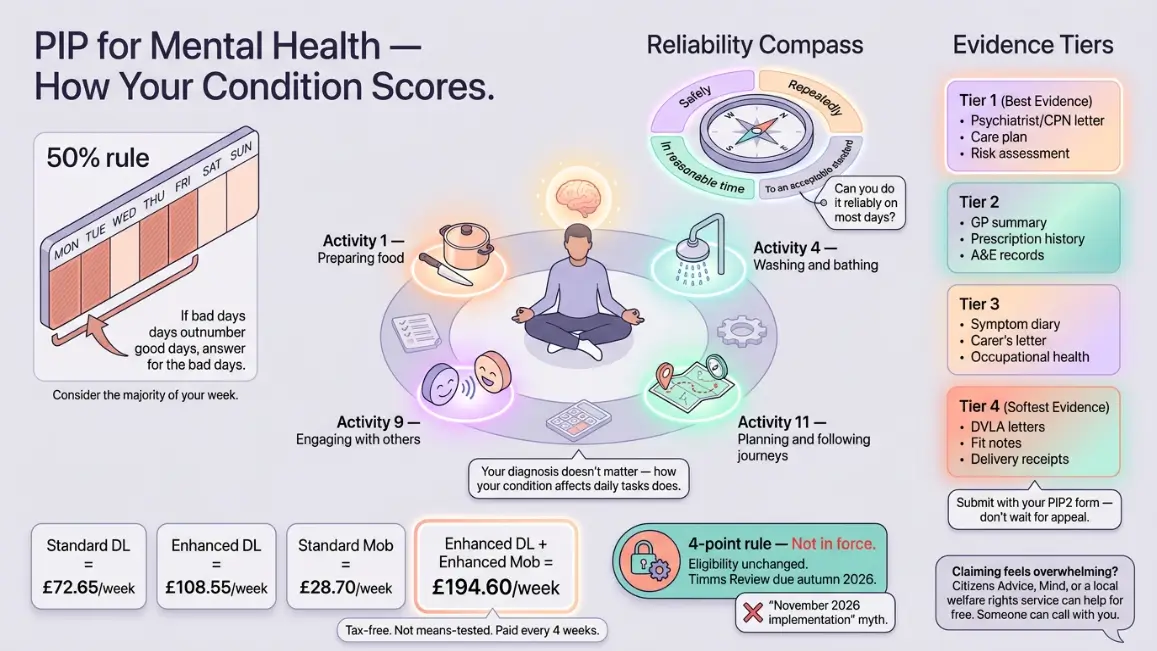
 Personal Independence Payment (PIP) can be awarded for arthritis when joint pain, stiffness, fatigue, swelling or reduced mobility makes daily living or getting around difficult enough to score PIP points. Arthritis does not qualify automatically. The DWP assesses what you can do safely, repeatedly, to an acceptable standard and in a reasonable time.
Can you get PIP for arthritis?
You can get
Personal Independence Payment (PIP) for arthritis if your arthritis affects your ability to carry out assessed daily living or mobility activities. The award depends on how arthritis affects you, not on the diagnosis alone.
PIP is a disability benefit with two components:
- Daily living component: for help with everyday tasks.
- Mobility component: for help with getting around.
Arthritis can affect both components. Hand arthritis can affect cooking, eating, medication, washing and dressing. Knee, hip, foot or spine arthritis can affect standing, walking, bathing, toilet transfers and dressing.
You should consider a PIP claim if arthritis affects your ability to:
- prepare food safely
- use knives, pans, jars or tins
- eat with cutlery or cut food
- manage medication or therapy
- wash or bathe safely
- use the toilet or clean yourself
- dress and undress
- walk outdoors
- leave home safely
- use aids, appliances or adaptations
- complete tasks without another person helping
The
Department for Work and Pensions (DWP) will not award PIP because a person has arthritis recorded in medical notes. The DWP awards PIP when the evidence shows that the person has enough difficulty with PIP activities.
PIP is not means-tested. Income and savings do not decide entitlement. A person can
claim PIP while working if their daily living or mobility needs meet the rules.
The NHS may mention PIP on arthritis information pages, but the NHS does not decide PIP claims. PIP is claimed through the official benefit process and decided by the DWP.
Practitioner observation: Many weak PIP arthritis claims describe the diagnosis but not the task failure. A stronger claim explains what happens when the person tries to cook, wash, dress, manage medication or walk.
What are the PIP Eligibility rules for arthritis?
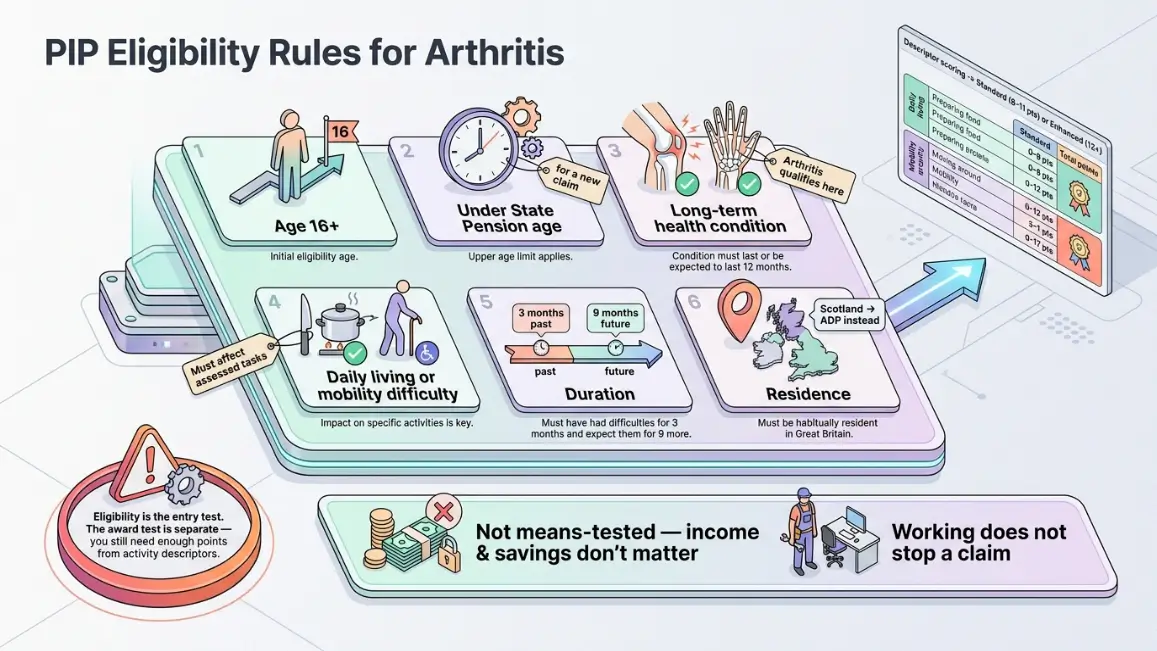
A person with arthritis must meet the basic PIP eligibility rules before the DWP considers the points. The basic rules do not guarantee an award.
| Eligibility rule |
What it means for arthritis |
| Age |
You must be 16 or over. |
| State Pension age |
You usually need to be under State Pension age to make a new PIP claim. |
| Health condition or disability |
Arthritis can meet this part if it is a long-term physical condition. |
| Daily living or mobility difficulty |
Arthritis must make everyday tasks or getting around difficult. |
| Duration |
The difficulty must have lasted for the required past period and be expected to continue for the required future period. |
| Residence |
PIP rules depend on where you live in the UK. |
| Scotland |
New claims in Scotland use Adult Disability Payment (ADP), not PIP. |
| Income and savings |
PIP is not means-tested. |
| Work |
Working does not automatically stop a PIP claim. |
Eligibility is the entry test. The award test is separate. The DWP still checks which daily living and mobility activities you struggle with and how many points apply.
A person with mild arthritis can meet the medical-condition part but still receive no PIP if they do not have enough difficulty with assessed activities. A person with severe arthritis can receive daily living, mobility, both components or neither, depending on the evidence and
descriptors.
Can you claim PIP for arthritis if you are working?
You can claim PIP for arthritis if you are working because PIP is based on daily living and mobility needs, not employment status. Work does not automatically prove that you can cook, wash, dress, manage medication or walk reliably.
The DWP can look at your work when it seems relevant to the limitations you describe. Your explanation must show how your job fits with your arthritis.
Useful details include:
- reduced hours
- seated duties
- working from home
- avoiding lifting
- avoiding standing
- occupational health adjustments
- extra breaks
- help from colleagues
- pain or fatigue after shifts
- changes to duties after arthritis worsened
A person who works at a desk may still struggle to stand in a shower, prepare food from fresh ingredients or walk outdoors. A person in a physical job needs to explain how they manage that work and why the same ability does not transfer to the PIP activity.
Can you claim PIP for arthritis if you are over State Pension age?
You usually cannot make a new PIP claim after reaching State Pension age. Attendance Allowance is the separate benefit for many people over State Pension age who need help with personal care or supervision.
There are separate rules for people who already receive PIP or recently received PIP. Those rules need checking before action is taken.
This page does not explain Attendance Allowance in detail because that is a separate search intent. The key boundary is simple: PIP is usually the working-age disability benefit, and Attendance Allowance is usually the older-person care benefit.
How does the DWP assess arthritis for PIP?
The DWP assesses arthritis by looking at PIP activities, descriptors and points. The DWP asks what you can do, what help you need, and whether you can complete each activity reliably.
The DWP does not assess arthritis as a medical label. It assesses the effect of arthritis on daily living and mobility activities.
The main assessment questions are:
- Can you do the activity safely?
- Can you do it to an acceptable standard?
- Can you do it repeatedly?
- Can you do it in a reasonable time?
- Do you need an aid or appliance?
- Do you need another person to help?
- Do you need supervision to stay safe?
- Do you need prompting because of a relevant health condition?
- How often does the difficulty happen?
Arthritis often fluctuates. Pain, stiffness, swelling and fatigue can be worse in the morning, after activity, during cold weather, after poor sleep or during a flare-up. The PIP explanation must show the usual pattern, not only the best day or the worst day.
What does “safely, repeatedly, to an acceptable standard and in a reasonable time” mean for arthritis?
The PIP reliability criteria mean you must be able to complete an activity safely, well enough, as often as needed and without taking too long. If arthritis stops you meeting one of those tests, the activity may count as difficult even if you can sometimes do it.
| Reliability test |
What it means |
Arthritis example |
| Safely |
You can do the task without likely harm to yourself or another person. |
Knee arthritis makes you unsteady in the shower, so you risk falling unless you use a shower seat or another person supervises you. |
| Acceptable standard |
The result is good enough for normal daily life. |
Shoulder arthritis means you cannot wash your hair or upper body properly without help. |
| Repeatedly |
You can do the task as often as reasonably needed. |
You can walk to the corner shop once, but you cannot walk back safely without severe pain and a long rest. |
| Reasonable time |
The task does not take much longer than it would for a person without the condition. |
Dressing takes much longer because hand stiffness stops you fastening buttons and knee pain means you need long breaks. |
These criteria are important for arthritis because many people “push through” pain. PIP does not only ask whether you can force yourself through a task once. It asks whether you can do the task reliably.
Practitioner observation: Many arthritis claimants under-explain recovery time. If walking to a shop means the person cannot safely prepare food or wash later that day, the after-effect belongs in the explanation.
How should you explain arthritis flare-ups for PIP?
You should explain arthritis flare-ups by giving a clear pattern of frequency, duration, task impact and recovery. A flare-up is relevant when it changes what you can do for PIP activities.
Use this structure:
- State how often flare-ups happen.
- State how long they last.
- State which joints are affected.
- State which activities become unsafe, slow or impossible.
- State what help, aids or rest you need.
- State what remains difficult outside flare-ups.
- State how long recovery takes after activity.
A useful explanation does not exaggerate. It shows the real pattern across time.
Example:
My knee and hand arthritis affect me on most days. During flare-ups, which usually last several days, I cannot stand long enough to cook safely, I cannot grip pans, and I need help washing because I am unsteady. After walking outside, I usually need to rest before doing another task.
What daily living problems caused by arthritis can count for PIP?
Arthritis can count for the PIP daily living component when it affects assessed everyday activities such as preparing food, washing, dressing, managing medication, eating or toilet needs. The issue must be linked to a PIP activity.
Daily living difficulties often come from hand pain, finger stiffness, shoulder restriction, back pain, knee pain, fatigue or reduced grip.
The daily living activities include:
- preparing food
- taking nutrition
- managing therapy or monitoring a health condition
- washing and bathing
- managing toilet needs or incontinence
- dressing and undressing
- communicating verbally
- reading and understanding signs, symbols and words
- engaging with other people face to face
- making budgeting decisions
Arthritis usually affects the physical daily living tasks most directly. It does not usually affect reading, communication or budgeting unless another health condition is involved.
Can arthritis in your hands or fingers help you score daily living points?
Arthritis in your hands or fingers can help you score daily living points if it affects assessed activities such as preparing food, eating, managing medication, washing or dressing. The claim must explain the exact task difficulty.
Hand and finger arthritis can affect:
- gripping a knife
- chopping vegetables
- peeling food
- opening jars
- opening tins
- lifting pans
- draining hot water
- holding cutlery
- cutting food on a plate
- opening tablet packets
- opening medication bottles
- using creams or gels
- squeezing shampoo bottles
- fastening buttons
- pulling zips
- fastening bras
- putting on socks
- tying laces
- using walking sticks or crutches safely
The DWP needs the functional detail. “I have arthritis in my hands” is too thin. A useful explanation says what happens when you try the activity.
Example:
Because of swelling and stiffness in my fingers, I cannot grip a knife safely on most days. I drop utensils and cannot chop fresh ingredients without help. I use pre-cut food when I can, but another person usually prepares meals that need chopping or lifting pans.
Hand arthritis can also affect mobility indirectly. A person with knee arthritis may need a walking stick, but hand arthritis may make the stick painful or unsafe to grip. That detail belongs in the mobility section.
Which daily living activities are most often affected by arthritis?
The daily living activities most often affected by arthritis are the tasks that require grip, standing, bending, reaching, balance or repeated movement.
| PIP daily living activity |
Arthritis-related difficulty |
Example wording for claim form |
| Preparing food |
Standing at a worktop, gripping knives, chopping, lifting pans, draining hot water. |
“Because of hand pain and knee stiffness, I cannot prepare a simple meal safely without using a stool and help with chopping and pans.” |
| Taking nutrition |
Cutting food, holding cutlery, lifting cups, sitting upright long enough to finish food. |
“I need food cut up because finger stiffness stops me using a knife safely.” |
| Managing medication or therapy |
Opening packets, pressing tablets from blister packs, applying creams, doing prescribed exercises. |
“I cannot press tablets out of packaging because my fingers lock and I drop tablets.” |
| Washing and bathing |
Getting in and out, standing in the shower, reaching hair, washing feet, squeezing bottles. |
“I use a shower stool and grab rail because my knees give way and I cannot stand safely.” |
| Toilet needs |
Getting on and off the toilet, wiping, adjusting clothing, reaching the toilet in time. |
“I need a raised seat and rail because knee and hip pain make transfers unsafe.” |
| Dressing and undressing |
Bending, lifting arms, socks, shoes, bras, buttons, zips. |
“I wear slip-on shoes and loose clothing because I cannot bend or fasten buttons without pain.” |
| Engaging with other people |
Pain, fatigue or a relevant mental health condition may affect face-to-face contact. |
“I avoid contact because pain and fatigue become overwhelming, and I need another person for support.” |
| Budgeting, reading, communication |
Arthritis alone usually does not affect these tasks. |
“These activities are only relevant if another health condition causes the difficulty.” |
Mistakes to avoid when describing daily living problems
- Writing only “I have arthritis”.
- Listing cleaning and shopping without linking the difficulty to PIP activities.
- Saying “I can cook” when you only reheat ready meals or rely on unsafe workarounds.
- Forgetting to mention aids, rests, supervision or help from another person.
- Describing only the best day.
- Describing only the worst day.
- Leaving out pain after the activity.
- Leaving out help you need but do not currently receive.
[GAP] A strong arthritis PIP page must translate symptoms into PIP activities. “Cleaning is hard” is not enough. “I cannot stand at the sink or cooker long enough to prepare food safely” is a PIP-relevant explanation.
What mobility problems caused by arthritis can count for PIP?
Arthritis can count for the PIP mobility component when it affects moving around or, in some cases, planning and following journeys. For arthritis, the most common mobility issue is physical movement.
The mobility activities are:
- planning and following journeys
- moving around
Joint pain, swelling, stiffness, balance problems and fatigue can affect moving around. The DWP looks at distance, safety, speed, rest breaks, walking aids, repeatability and after-effects.
Can arthritis in your knees, feet, hips or spine affect PIP mobility?
Arthritis in your knees, feet, hips or spine can affect PIP mobility if it limits how far, safely, repeatedly or quickly you can stand and walk. The claim must describe the walking difficulty in practical detail.
Common examples include:
- Knee arthritis: knees give way, stairs are unsafe, standing is limited, walking causes severe pain, falls happen without warning.
- Foot arthritis: walking distance is limited, feet swell, footwear is difficult, balance is poor, pain increases after walking.
- Hip arthritis: standing from a chair is difficult, walking is slow, dressing the lower body is painful, getting into a bath or car is hard.
- Back or spine arthritis: standing at a worktop is limited, bending is painful, walking triggers pain, recovery time is long.
- Neck or shoulder arthritis: washing, dressing and reaching may be affected. Mobility is only affected if movement, balance, safe travel or use of aids is affected.
Mobility evidence should focus on what happens before, during and after walking.
Useful details include:
- the distance you can walk
- whether pain starts immediately or later
- whether you stop and rest
- how long you rest
- whether you walk slowly
- whether you stumble or fall
- whether you use a walking stick, crutch, frame or another person
- whether hand arthritis stops you using a walking aid
- how long recovery takes
How should you describe walking distance for arthritis PIP?
You should describe walking distance by stating how far you can walk before pain, safety, speed, rest breaks or fatigue stop you walking reliably. Distance alone is not enough.
Use this sequence:
- Distance: state the distance you can usually manage.
- Pain point: state when pain becomes severe.
- Safety: state whether you stumble, fall or need support.
- Speed: state whether you walk slowly or very slowly.
- Rest breaks: state how often you stop and for how long.
- Repeatability: state whether you can repeat the walk.
- After-effects: state what happens later that day.
- Aids: state whether you use a stick, crutch, frame, scooter or another person.
Example:
I can walk about 30 metres before knee pain becomes severe and my left knee feels unstable. I walk slowly and stop for several minutes. I use a stick, but my hand arthritis makes gripping it painful. After walking, I usually need to sit before I can wash or prepare food.
Do not guess a distance if you do not know. Use a real local example, such as the distance from your front door to the car, bus stop, corner shop or nearby bench.
Does difficulty planning journeys count if arthritis is the main condition?
Difficulty planning journeys usually counts only when it is caused by a physical, sensory, cognitive or mental health condition. Arthritis alone most often affects the “moving around” activity, not route planning.
Being unable to use a navigation app does not count by itself. Not speaking English does not count by itself. Being unfamiliar with technology does not count by itself.
Journey planning may be relevant if another health condition causes confusion, panic, cognitive difficulty, sensory impairment or unsafe travel. That issue belongs in the claim only if it is caused by a health condition and supported by evidence.
How many PIP points can you get for arthritis?
Arthritis has no fixed PIP score. You score PIP points only when your difficulty matches a daily living or mobility descriptor.
Two people with the same arthritis diagnosis can receive different awards. One person may score for preparing food and dressing. Another may score for moving around. Another may score no points if they can complete the activities reliably.
PIP points are grouped by component:
| Component |
Standard award |
Enhanced award |
| Daily living component |
8 to 11 points |
12 points or more |
| Mobility component |
8 to 11 points |
12 points or more |
The points do not come from the word “arthritis”. They come from the effect of arthritis on assessed activities.
A person can receive:
- daily living only
- mobility only
- both components
- no award
- standard rate for one component and enhanced for another
- enhanced rate for both components
Is there a fixed PIP score for arthritis?
There is no fixed PIP score for arthritis because PIP is descriptor-based, not diagnosis-based. The DWP scores the help you need with each activity.
Examples:
- Hand arthritis may affect preparing food, eating, medication and dressing.
- Knee arthritis may affect moving around, bathing and toilet transfers.
- Hip arthritis may affect dressing, bathing and walking.
- Shoulder arthritis may affect washing hair, dressing upper body and preparing food.
- Mild arthritis may score no points if the person can complete all activities reliably.
The correct question is not “How many points does arthritis get?” The correct question is “Which PIP activities can I not do reliably because of arthritis?”
What PIP activities commonly matter for arthritis points?
The PIP activities that commonly matter for arthritis points are the activities that involve grip, standing, bending, reaching, balance, walking or repeated movement.
| Activity |
Why arthritis may affect it |
Common evidence |
| Preparing food |
Grip problems, standing pain, unsafe pan use, chopping difficulty. |
Occupational therapy report, kitchen aids, family statement, examples of unsafe cooking. |
| Taking nutrition |
Difficulty cutting food or holding cutlery. |
Hand-function notes, carer statement, adapted cutlery. |
| Managing medication |
Difficulty opening packets, bottles or applying treatment. |
Medication list, pill aids, pharmacy packaging, carer statement. |
| Washing and bathing |
Falls risk, standing pain, reaching difficulty, fatigue. |
Shower stool, grab rails, OT report, falls record. |
| Toilet needs |
Unsafe transfers, wiping difficulty, slow movement to toilet. |
Raised seat, rail, commode, carer statement. |
| Dressing |
Buttons, zips, socks, shoes, bras, bending, lifting arms. |
Adapted clothing, dressing aids, OT report. |
| Moving around |
Walking distance, pain, slow pace, rests, falls, recovery time. |
GP notes, physiotherapy notes, walking aid, falls diary. |
[GAP] The page must say plainly that arthritis points are not automatic. This prevents false hope and answers the “how many PIP points for arthritis” query with the correct scoring logic.
What evidence should you provide for a PIP arthritis claim?
You should provide evidence that links arthritis to daily living or mobility problems. Diagnosis-only evidence is useful background, but functional evidence is stronger.
Good evidence answers one question:
what can you not do reliably because of arthritis?
Evidence can come from medical professionals, therapists, people who help you, and your own records. The strongest evidence connects symptoms to PIP activities.
Are GP notes enough for a PIP arthritis claim?
GP notes can help a PIP arthritis claim, but GP notes are often not enough by themselves if they only confirm diagnosis, pain or medication. The DWP needs evidence of functional impact.
A GP record that says “osteoarthritis in both knees” proves the condition. It does not fully prove that you cannot stand safely in a shower, prepare food, use stairs or walk outdoors reliably.
Better evidence explains:
- how far you can walk
- whether you fall or stumble
- whether you use aids
- whether you need help bathing
- whether hand pain affects medication
- whether fatigue or pain stops repeat tasks
- how often the difficulty happens
What is the best evidence for arthritis and PIP?
The best evidence for arthritis and PIP is evidence that connects your condition to a PIP activity.
| Evidence type |
What it can show |
Best used for |
| Specialist or rheumatology letter |
Diagnosis, inflammation, treatment, joint involvement, flare pattern. |
Overall condition context and subtype evidence. |
| GP records |
Long-term symptoms, medication, referrals, pain reports, falls reports. |
Continuity and history. |
| Occupational therapy report |
Aids, adaptations, home safety, kitchen and bathroom difficulty. |
Preparing food, washing, toilet needs, dressing. |
| Physiotherapy notes |
Walking, balance, strength, exercises, mobility limits. |
Moving around and repeatability. |
| Medication list |
Pain management, treatment burden, side effects if relevant. |
Medication management and pain context. |
| Prescription history |
Long-term treatment pattern. |
Supporting the ongoing nature of symptoms. |
| Falls diary |
Dates, places, injuries, triggers, near misses. |
Safety in bathing, cooking and mobility. |
| Pain or flare-up diary |
Frequency, duration, after-effects, recovery time. |
Reliability criteria and “most of the time” pattern. |
| Carer or family statement |
Help actually given or needed. |
Assistance, supervision, prompting and daily routine. |
| Workplace adjustment evidence |
Reduced duties, seated work, occupational health limits. |
Work consistency and functional limits. |
| Photos of aids or adaptations |
Equipment used in real life. |
Aids, appliances and home adaptations. |
Practitioner observation: Evidence that names the activity is usually more useful than evidence that only names the diagnosis. A letter saying “arthritis in both knees” is weaker than a report saying the person cannot stand safely in the shower or can only walk a short distance before stopping.
Do X-rays or scans prove PIP entitlement for arthritis?
X-rays or scans can support a PIP arthritis claim by showing joint changes, but they do not prove PIP entitlement by themselves. PIP is awarded for functional difficulty, not imaging results.
A scan may show arthritis in a knee. The PIP Form still needs to explain walking distance, pain, falls, aids, rest breaks, bathing difficulty, toilet transfers or dressing problems.
[GAP] Evidence must be matched to activities. A pile of medical papers is less useful than a clear link between each document and a daily living or mobility problem.
How should you fill in the PIP form for arthritis?
You should fill in the PIP form for arthritis by explaining how arthritis affects each activity, how often it happens, what help you need and whether you can do the task reliably. The form needs task-level detail.
The main form is the
“How your disability affects you” form, also called the
PIP2 form.
For each activity, describe:
- the joint or symptom involved
- what you try to do
- what goes wrong
- whether it is unsafe
- whether it takes too long
- whether you can repeat it
- whether the result is good enough
- what aid or adaptation you use
- whether another person helps
- how often this happens
- what happens afterwards
Do not assume the assessor understands arthritis. Write the practical effect.
What should you write on a PIP form for arthritis?
You should write clear task examples that show what happens when you try to do each PIP activity. The best answers connect arthritis symptoms to safety, time, repeatability, standard and help needed.
Use this formula:
- Activity: name the activity.
- Symptom: name the arthritis symptom or joint affected.
- Attempt: explain what happens when you try.
- Reliability: state whether it is unsafe, slow, incomplete or not repeatable.
- Help: state the aid, adaptation, assistance, supervision or prompting.
- Frequency: state how often this happens.
- After-effect: state pain, fatigue or recovery time afterwards.
Example structure:
Because of arthritis in my hands and knees, I cannot prepare food safely on most days. I cannot grip knives or lift pans, and standing at the worktop increases knee pain. I use a stool, but I still need another person to chop food and handle hot pans.
This is stronger than:
I have arthritis and cooking is hard.
What is a strong example answer for arthritis on a PIP form?
A strong PIP form answer gives a practical example, frequency, help needed and reliability problem. It does not rely on the diagnosis alone.
| Weak answer |
Stronger answer structure |
| “I have arthritis in my hands.” |
“Because of swelling and stiffness in my fingers, I cannot grip a knife or press tablets out of packaging on most days. I drop small items and need another person to open medication and prepare food.” |
| “I cannot walk far.” |
“I can usually walk about 30 metres before knee pain becomes severe. I walk slowly, stop to rest, and cannot repeat the distance without a long recovery. I use a stick, but hand pain makes it hard to grip.” |
| “I struggle to wash.” |
“I cannot stand safely in the shower because my knees give way. I use a shower stool and grab rail. I still need someone nearby on bad days because I have nearly fallen when turning or stepping out.” |
Common PIP form mistakes with arthritis
- Writing only the diagnosis.
- Assuming the assessor understands arthritis pain.
- Forgetting pain after the activity.
- Saying “I manage” without explaining aids or help.
- Describing rare worst days as every day.
- Describing only good days.
- Leaving out help you need but do not currently receive.
- Focusing on work ability instead of PIP activities.
- Listing housework without linking it to assessed activities.
- Leaving out walking speed, rests and recovery.
[GAP] The strongest form answers follow a repeatable pattern: activity, symptom, failed attempt, reliability problem, help needed, frequency and after-effect.
How much PIP can you get for arthritis?
There is no separate PIP rate for arthritis. The amount depends on whether you are awarded the daily living component, the mobility component, or both.
| PIP component |
Standard weekly rate |
Enhanced weekly rate |
| Daily living |
£76.70 |
£114.60 |
| Mobility |
£30.30 |
£80.00 |
The maximum combined weekly amount is £194.60 when the enhanced daily living component and enhanced mobility component are both awarded.
PIP is usually paid every 4 weeks. PIP is tax free. Income and savings do not reduce the PIP amount.
A PIP mobility award can also connect to other support. Depending on the rate and rules, this may include the Motability Scheme, Blue Badge, vehicle tax help or travel concessions. Those topics have separate eligibility rules, so this page does not cover them in full.
The key point is simple: arthritis does not have its own payment amount. The award depends on the component and rate the DWP awards.
How do you claim PIP for arthritis?
You claim PIP for arthritis by starting a PIP claim through the official route, completing the “How your disability affects you” form, giving evidence and explaining how arthritis affects PIP activities. The process is the same as other PIP claims, but your examples should be arthritis-specific.
The claim should focus on daily living and mobility activities. It should not focus only on the diagnosis, pain level or ability to work.
What are the steps to claim PIP for arthritis?
The steps to claim PIP for arthritis are:
- Check basic eligibility
Check age, residence, State Pension age, Scotland/ADP rules and duration of difficulty.
- Start the PIP claim
Start the claim through the official PIP route.
- Complete the “How your disability affects you” form
Explain how arthritis affects each relevant daily living and mobility activity.
- Match arthritis problems to PIP activities
Link hand, knee, hip, foot, spine, shoulder or neck problems to specific tasks.
- Gather evidence
Include evidence that shows functional impact, not only diagnosis.
- Complete the assessment if required
Some claims involve an assessment. Some are considered on papers.
- Read the decision letter
Check which component, rate and points have been awarded.
- Challenge the decision if needed
Ask for a Mandatory Reconsideration if the decision does not reflect the evidence.
This process can feel slow and detailed. A careful form is better than a short form with vague statements.
Can someone help you with a PIP arthritis claim or assessment?
Someone can help you with a PIP arthritis claim if you struggle with forms, memory, fatigue, pain or explaining your needs. Help can come from a family member, friend, adviser, welfare rights worker or charity support service.
Useful support can include:
- reading the form with you
- helping you remember examples
- organising evidence
- writing a statement about help they give
- attending an assessment as support
- helping you challenge a decision
Do not rely only on social media advice. Forum and Reddit experiences can show real problems, but they do not replace official guidance or tailored welfare advice.
What if your PIP claim for arthritis is refused or the award is wrong?
If your PIP claim for arthritis is refused or the award is wrong, you can challenge the decision through the PIP dispute process. The first stage is usually a mandatory reconsideration.
A refusal does not always mean arthritis is irrelevant. It may mean the DWP decided the evidence did not show enough difficulty with the descriptors.
Common problems include:
- 0 points despite daily help
- daily living awarded but mobility refused
- standard rate awarded when enhanced rate seems supported
- aids ignored
- pain after activity ignored
- walking distance misunderstood
- work used without context
- flare-ups treated as rare
- help from family treated as optional
- safety risks underplayed
A challenge should focus on activities and descriptors. It should not only say the decision is unfair.
What should you check before challenging a PIP arthritis decision?
You should check the points, descriptors and reasons before challenging a PIP arthritis decision. The challenge must show which activities were scored wrongly and why.
Use this checklist:
- Which activities scored points?
- Which activities scored 0?
- Which daily living tasks were ignored?
- Which mobility problems were ignored?
- Did the decision ignore aids?
- Did it ignore help from another person?
- Did it ignore supervision for safety?
- Did it assume you can do a task because you did it once?
- Did it ignore pain, fatigue or recovery time?
- Did it ignore how long tasks take?
- Did it ignore flare-up frequency?
- Did it misunderstand work or caring duties?
- Do you have evidence for each disputed activity?
A strong challenge gives one activity at a time. It explains the correct descriptor, the real difficulty and the evidence.
Can people get PIP for arthritis after being refused?
People can get PIP for arthritis after being refused if a mandatory reconsideration or tribunal appeal changes the decision. A later award is not guaranteed.
A stronger challenge focuses on:
- the specific PIP activities
- the descriptors
- functional examples
- frequency
- safety
- aids
- help from another person
- medical and non-medical evidence
Challenging a PIP decision can be worthwhile when the decision does not reflect the evidence, but it can take time and may feel stressful. Focus on the specific activities and points, not only on disagreement with the overall decision.
A full tribunal guide is a separate topic. This page only covers the arthritis-specific first steps.
PIP for osteoarthritis, rheumatoid arthritis and psoriatic arthritis
PIP can be claimed for osteoarthritis, rheumatoid arthritis, psoriatic arthritis or another arthritis type if the condition affects daily living or mobility activities. The arthritis subtype does not decide entitlement by itself.
The DWP looks at the effect on function. The same rule applies to all arthritis types.
| Arthritis type |
PIP relevance |
Examples of PIP activity impact |
| Osteoarthritis |
Often affects knees, hips, hands, spine or other joints. |
Walking, standing, bending, cooking, washing, dressing. |
| Rheumatoid arthritis |
Can affect hands, wrists, feet, fatigue and flare-ups. |
Grip, medication, dressing, walking, repeated tasks. |
| Psoriatic arthritis |
Can affect joints, stiffness, fatigue and mobility. |
Preparing food, washing, dressing, moving around. |
| Inflammatory arthritis |
Can vary with flares and fatigue. |
Reliability, repeatability, morning stiffness, recovery time. |
| Arthritis with fibromyalgia |
Combined pain and fatigue may affect activities. |
Needs careful explanation of all conditions and their combined effect. |
Can you claim PIP for osteoarthritis?
You can claim PIP for osteoarthritis if osteoarthritis affects daily living or mobility activities enough to score points. Osteoarthritis does not qualify automatically.
Relevant examples include hand pain affecting cooking, knee pain affecting walking, hip pain affecting dressing, or spine pain affecting standing and bending. You may find the Osteoarthritis PIP Calculator helpful for understanding how your symptoms might score.
Can you claim PIP for rheumatoid arthritis?
You can claim PIP for rheumatoid arthritis if rheumatoid arthritis affects assessed activities such as preparing food, managing medication, washing, dressing or moving around. Rheumatoid arthritis does not create an automatic PIP award.
Explain flare-ups, fatigue, hand function, foot pain, treatment, aids and help from another person.
Can you claim PIP for psoriatic arthritis?
You can claim PIP for psoriatic arthritis if it causes enough daily living or mobility difficulty to meet the descriptors. The DWP assesses function, not the condition name.
Useful details include affected joints, flare pattern, stiffness, fatigue, walking limits, grip problems and help needed.
What if you have arthritis and fibromyalgia?
If you have arthritis and fibromyalgia, the DWP can consider the combined effect of your conditions on PIP activities. The claim should explain how pain, fatigue, stiffness and mobility problems affect daily living and getting around. A fibromyalgia PIP calculator can also help you understand how fibromyalgia symptoms might score alongside your arthritis.
Do not make the claim only about labels. Explain the task difficulty caused by all relevant conditions.
PIP for arthritis by body area: hands, knees, feet, back, hips, spine, neck and shoulders
The body area affected by arthritis does not decide PIP entitlement. The PIP activity affected by that body area decides whether points may apply.
| Arthritis area |
PIP activities it may affect |
Examples of difficulty |
Evidence that may help |
| Hands |
Preparing food, taking nutrition, medication, washing, dressing. |
Poor grip, dropping knives, opening jars, cutting food, pressing tablets from packaging, buttons and zips. |
OT report, adapted cutlery, pill aids, medication packaging issue, carer statement. |
| Fingers |
Preparing food, taking nutrition, medication, dressing. |
Finger stiffness, swelling, pain when pinching, trouble with small items, trouble with fasteners. |
GP notes, rheumatology letter, photos of aids, family statement. |
| Wrists |
Preparing food, washing, dressing, using aids. |
Lifting pans, twisting jars, using sticks or crutches, applying pressure through hands. |
OT report, wrist support evidence, functional examples. |
| Knees |
Moving around, bathing, toilet needs, dressing, preparing food. |
Standing pain, knees giving way, falls, slow walking, difficulty getting on and off toilet, difficulty stepping into shower. |
Physiotherapy notes, falls diary, walking aid, grab rails, shower stool. |
| Feet |
Moving around, dressing, bathing. |
Walking distance, swelling, footwear problems, pain after walking, balance problems. |
GP notes, podiatry notes, physio notes, footwear adaptations. |
| Ankles |
Moving around, bathing, dressing. |
Instability, swelling, slow walking, difficulty standing in shower. |
Physio notes, ankle support, falls record. |
| Hips |
Moving around, dressing, bathing, toilet needs. |
Standing from chair, getting in/out of bath, bending to socks, walking pain. |
OT report, physio notes, raised toilet seat, dressing aids. |
| Back |
Preparing food, washing, dressing, moving around. |
Standing at worktop, bending, washing lower body, dressing lower body, recovery after walking. |
GP notes, physio notes, perching stool, personal diary. |
| Spine |
Preparing food, washing, dressing, moving around. |
Limited bending, pain with standing, slow walking, difficulty reaching feet. |
Imaging, GP notes, physio notes, functional diary. |
| Neck |
Washing, dressing, preparing food, safe movement. |
Trouble washing hair, looking down to prepare food, turning head safely. |
Physiotherapy notes, OT notes, task examples. |
| Shoulders |
Washing, dressing, preparing food. |
Lifting arms, washing hair, putting on tops or bras, reaching cupboards. |
OT report, physio notes, adapted clothing, carer statement. |
| Multiple joints |
Any relevant daily living or mobility activity. |
Combined grip, standing, walking, fatigue and recovery problems. |
Specialist letter, GP records, diary, carer statement, aids list. |
[GAP] This body-area map answers the long-tail searches competitors leave thin. Searchers often know where arthritis hurts before they know which PIP activity applies. The page must bridge that gap.
What does not usually count for PIP if you have arthritis?
Some problems do not usually count for PIP unless they are caused by a relevant health condition and affect a PIP activity. This section prevents wasted form space and false expectations.
| Issue |
Does it count for PIP? |
How to handle it |
| Arthritis diagnosis alone |
No. |
Explain the daily living or mobility activity affected. |
| Pain alone |
Not without task impact. |
Explain safety, time, repeatability, standard and help needed. |
| Cleaning |
Not directly. |
Link the difficulty to standing, bending, grip or fatigue only where it supports a PIP activity. |
| Shopping |
Not directly. |
Use it only if it shows walking distance, carrying limits or mobility effects. |
| General housework |
Not directly. |
Translate relevant problems into assessed tasks such as preparing food, washing or moving around. |
| Not being able to work |
Not by itself. |
Explain daily living and mobility needs instead. |
| Not speaking English |
Not by itself. |
Only relevant if a health condition causes communication difficulty. |
| Not using navigation apps |
Not by itself. |
Only relevant if a cognitive, sensory or mental health condition causes journey difficulty. |
| Being older |
Not by itself. |
Explain the diagnosed or evidenced health condition causing the difficulty. |
| Forgetfulness |
Only if health-related. |
Provide evidence if caused by dementia, brain injury, mental health condition or another relevant condition. |
| Having help available |
Help still matters. |
Explain the help you need, even if family currently provides it unpaid. |
| Using aids |
It may still count. |
Explain whether the aid makes the task reliable or only partly helps. |
This boundary matters because PIP has specific activities. The strongest claim uses the right frame:
activity, difficulty, help, frequency and evidence.
FAQs about PIP for arthritis
How much PIP can you get for arthritis?
There is no arthritis-specific PIP rate. PIP pays £76.70 or £114.60 weekly for daily living and £30.30 or £80.00 weekly for mobility. The amount depends on the components and rates awarded.
How many PIP points do you get for arthritis?
Arthritis has no fixed PIP score. Points depend on descriptors for daily living and mobility activities. Arthritis may score points if it affects cooking, washing, dressing, medication, toilet needs or moving around.
Can you claim PIP for arthritis in your hands?
You can claim PIP for hand arthritis if it affects assessed activities. Examples include gripping knives, chopping food, using cutlery, opening medication, washing, fastening buttons or using aids safely. Diagnosis alone is not enough.
Can you claim PIP for arthritis in your knees?
You can claim PIP for knee arthritis if it affects mobility or daily living tasks. Examples include standing, walking, falls, showering, toilet transfers and dressing the lower body. Points depend on functional impact.
Can you claim PIP for arthritis and still work?
You can claim PIP for arthritis while working. PIP is based on daily living and mobility needs, not employment status. Work tasks may still be considered if they support or contradict the limitations described.
What evidence helps a PIP claim for arthritis?
Helpful evidence links arthritis to daily living or mobility problems. Examples include GP or specialist letters, occupational therapy reports, physiotherapy notes, medication lists, aids and adaptations, falls records, pain diaries and carer statements.
Related PIP guides