
To apply for PIP Personal Independence Payment, you must request the PIP2 form — called “How your disability affects you” — by phoning the DWP on 0800 917 2222 or writing to Freepost DWP PIP 1. Once you’ve provided basic details, the form will be sent to you online or by post. You then have one month to complete and return it with your supporting evidence.
How do I get a PIP form without phoning the DWP?
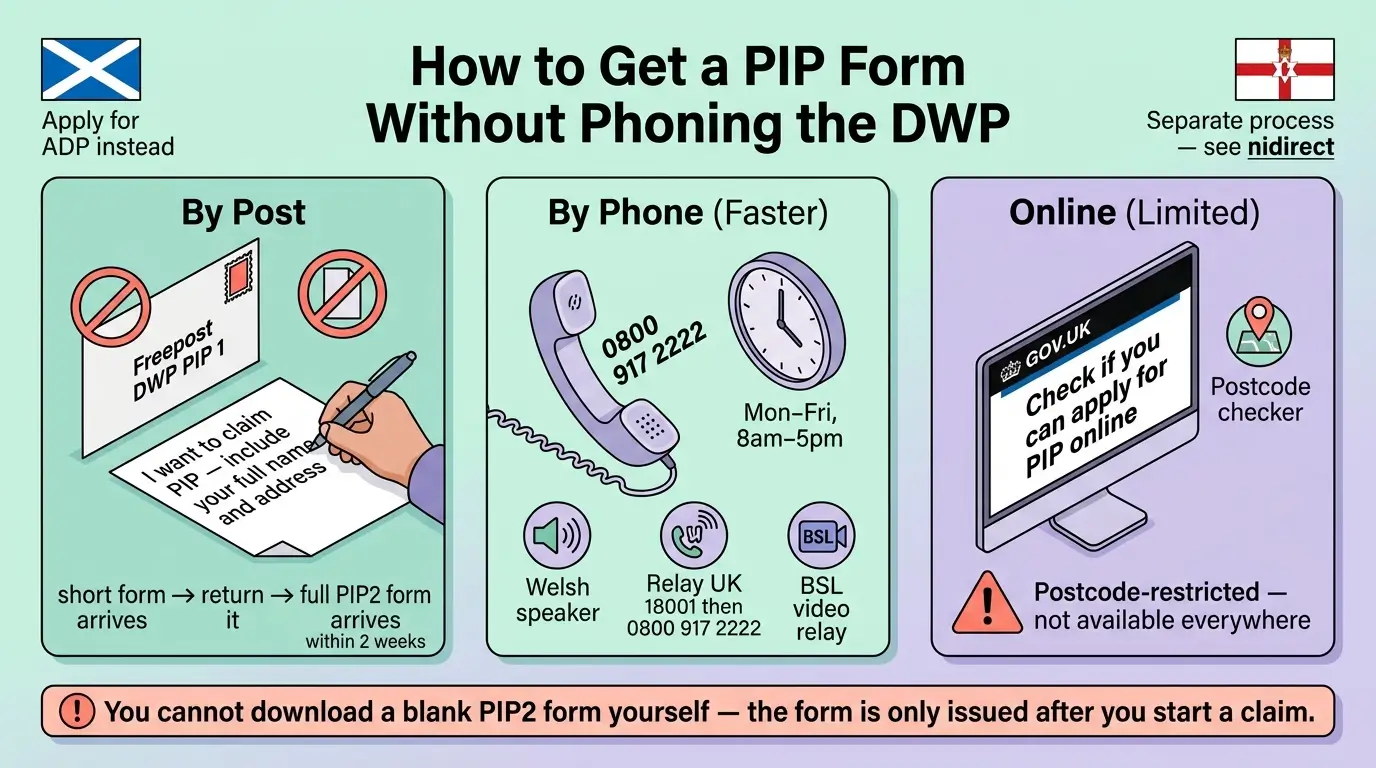
You cannot download a blank PIP2 form yourself. The form is issued only after you start a claim. But you do not need to phone the DWP to start that claim. You can write a letter instead.
To start your PIP claim by post, send a letter saying you want to claim PIP. Include your full name and address. Post it to:
Freepost DWP PIP 1
You do not need a stamp or a postcode. You’ll then receive a short form asking for basic information about you and your condition. After you return that, you’ll be sent the full PIP2 form — the “How your disability affects you” form — usually within 2 weeks.
If you’re open to using the phone, calling is faster. The PIP new claims phone line is 0800 917 2222 (Monday to Friday, 8am to 5pm) [source: www.gov.uk/pip/how-to-claim]. You can also request a Welsh speaker, use Relay UK on 18001 then 0800 917 2222, or use the British Sign Language video relay service.
Some people in England and Wales can start their claim entirely online through the “Check if you can apply for PIP online” service on GOV.UK. This is postcode-restricted. You can check your eligibility at www.gov.uk/pip/how-to-claim and follow the link.
If you live in Scotland, you need to apply for Adult Disability Payment (ADP) instead. If you live in Northern Ireland, the claim process is separate — see nidirect.
Practitioner observation: The “check if you can apply online” tool often says you’re not eligible. If that happens, you must use the phone or post route to start your claim.
Can I fill in the entire PIP form online, or do I have to print and post it?
If you start your claim by phone and the DWP sends you an email link to the digital PIP2 form, you can complete the whole form online and submit it digitally — no printing, no postage. If you start by post, or if the online option isn’t available in your area, you’ll get a paper form. You fill that in by hand or type your answers separately, then post it back.
There is no self-service blank PDF that you can download, complete offline, and submit. The online form is tied to your unique claim reference. You cannot print a blank form from a website and use it as your official submission.
If you have a paper form and prefer typing, you can type your answers on a computer, print the sheets, and attach them to the form. Write your name, National Insurance number, and the question number clearly on every page. The DWP routinely accepts typed attachments. (Experience-based observation: Many claimants do this successfully.)
What do I need before I start the PIP form?
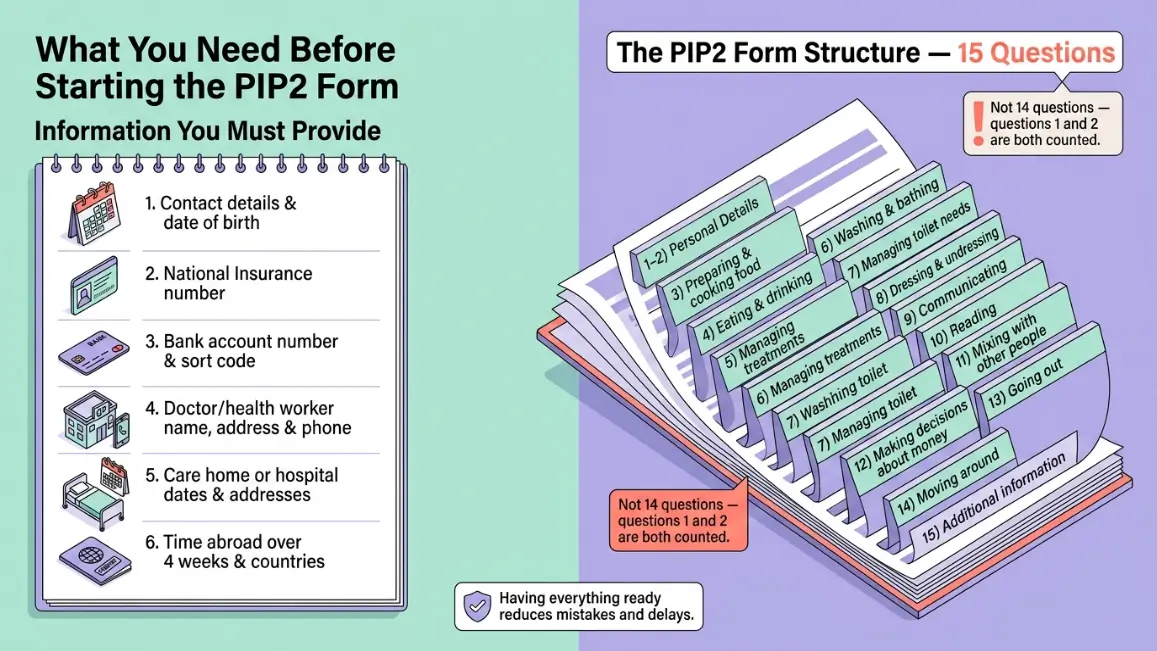
Before you open the PIP2 form, gather the following. Having everything ready reduces mistakes and delays.
Information you must provide:
-
Your contact details and date of birth
-
Your National Insurance number
-
Your bank or building society account number and sort code
-
Your doctor or health worker’s name, address, and phone number
-
Dates and addresses for any time you’ve spent in a care home or hospital
-
Dates for any time you’ve spent abroad for more than 4 weeks, and the countries visited
What the form looks like:
The PIP2 form contains 15 numbered questions. It is not 14 questions — “14” is a common misapprehension because the first two are grouped as personal details. The full structure:
-
Your condition, medication, and treatments
-
Your health professionals
-
Preparing and cooking food
-
Eating and drinking
-
Managing treatments
-
Washing and bathing
-
Managing toilet needs
-
Dressing and undressing
-
Communicating
-
Reading
-
Mixing with other people
-
Making decisions about money
-
Going out
-
Moving around
-
Additional information
[Source for the 15-question structure: www.citizensadvice.org.uk/benefits/sick-or-disabled-people-and-carers/pip/help-with-your-claim/fill-in-form-pip/]
The form uses tick boxes and space for you to explain the difficulties you have. It comes with a guidance booklet.
How to answer the PIP form questions (with examples and points)
PIP is not awarded for a diagnosis. It is awarded based on how your condition affects you when you carry out 12 specific everyday activities. Each activity is scored using descriptors that range from “no difficulty” (0 points) to “cannot do the activity at all” (8, 10, or 12 points, depending on the activity).
Practitioner observation: Write about your bad days. If you can cook a meal on a good day but on a bad day you need someone to step in and finish, describe that and how often bad days happen. If you need prompting, supervision, or extra time, state it clearly even when you eventually manage the task.
Common PIP form mistakes to avoid:
-
Listing medical conditions instead of describing functional difficulties.
-
Forgetting to say what happens if you do not get help.
-
Not reading the descriptor levels before you write — your answer must map to what the DWP actually measures.
Below is a table of the 12 activity areas with a shortened example of what to explain, based on real descriptor criteria. These are not full answers; they show the kind of detail the DWP expects.
| Activity question | What to explain (example) |
|---|---|
| 3. Preparing and cooking food | How you need help to peel, chop, use the hob safely, or if you can only prepare a simple meal using a microwave and why. |
| 4. Eating and drinking | If you need help cutting food, using adapted cutlery, or if you need prompting to eat. |
| 5. Managing treatments | Whether you need someone to remind you to take medication, or to administer it, and what happens without that help. |
| 6. Washing and bathing | How you need help getting in and out of the bath, washing safely, or if you need supervision. |
| 7. Managing toilet needs | If you need help adjusting clothing, using a commode, or managing incontinence. |
| 8. Dressing and undressing | Whether you need help with buttons, zips, shoes, or choosing weather-appropriate clothing. |
| 9. Communicating | If you need communication support such as a British Sign Language interpreter, or if you struggle to understand people. |
| 10. Reading | If you need help reading letters, signs, or instructions, and whether you can read with aids. |
| 11. Mixing with other people | If social situations cause overwhelming Anxiety, and you need someone with you to engage. |
| 12. Making decisions about money | If you cannot budget or recognise fraud, and need someone to handle your finances. |
| 13. Going out | If you cannot follow a route without help, or if unfamiliar journeys cause severe distress. |
| 14. Moving around | How far you can walk using any aids, and whether you can do so safely, repeatedly, and in a reasonable time. |
Worked condition-specific answer outlines:
Anxiety and Depression (questions 11 and 12) Mixing with people: “I avoid social contact because I become panicked. When I must interact, I need a person I trust with me. If I go alone, I will have a panic attack and have to leave. This happens every time.” Managing money: “I cannot budget. I forget to pay bills and have had debt letters. My partner handles all my finances, including grocery payments. Without help, I would not eat properly because I would avoid shops.”
Fibromyalgia and chronic pain (questions 3 and 14) Preparing food: “On a bad day I cannot grip a knife or stand long enough to cook. I use a perching stool but still need my partner to prepare hot food. Bad days occur 4-5 times a week.” Moving around: “I can walk about 20 metres with a stick, then I must stop because of severe pain. After 20 metres the pain makes it impossible to continue safely. I can’t repeat this within the same hour.”
Autism and ADHD (questions 9 and 13) Communicating: “I take spoken instructions literally and often misunderstand. I need written information or a support worker to rephrase things. Without this I become extremely anxious and confused.” Going out: “I cannot follow an unfamiliar route at all. I need someone who knows the way to accompany me, or I will get lost and have a meltdown. Even on familiar journeys I need prompts.”
These are illustrative structures. Every claimant’s answer must be true to their own experience.
How long does it take to get a decision after sending the PIP form?
Timeline step by step:
-
Form arrives within 2 weeks of your initial phone call. If you applied by post, the PIP1 short form comes first; after you return it, the PIP2 form takes about 2 weeks to arrive. [Source: www.gov.uk/pip/how-to-claim]
-
You have 1 month to return the completed PIP2 form. The deadline is on the letter. [Source: www.gov.uk/pip/how-to-claim]
-
If you need more time, call the PIP enquiry line before the deadline. The number is 0800 121 4433. [Source: www.gov.uk/disability-benefits-helpline]
-
After you return the form, the DWP may book a medical assessment. Waiting times for an assessment vary. The DWP’s decision letter usually arrives within 8 to 12 weeks after you send the form back, but this can take longer. No official fixed timeline exists.
-
If you do not receive a decision letter, or if your form was sent back and you hear nothing, call the PIP enquiry line.
What if my form is lost or doesn’t arrive? If 2 weeks pass and you don’t receive the form, call the PIP enquiry line on 0800 121 4433 and ask them to check the status. If the form is lost in the post on its way back, you may need to request an extension while a replacement is issued.
Sending your form back safely: You can send it by recorded delivery if you want proof of posting. The return address is on the envelope included with your form. If you’ve lost that address, contact the enquiry line. There is no universal published returns address, as it depends on your regional processing centre.
I have a paper PIP form — can I switch to the online version?
If you started your claim by post and received a paper PIP2 form, you can call the PIP enquiry line on 0800 121 4433 and ask whether you can be switched to the digital version. This is not guaranteed — it depends on your claim stage and whether your postcode is within the online application area. But it is worth asking.
If a switch is not possible, you still have the right to submit typed answers as extra sheets attached to the paper form, as described earlier. That method is widely accepted. (Experience-based observation: Support workers regularly submit typed attachments without any complaint from the DWP, as long as the claimant’s details and question numbers are clearly noted on each page.)
Where to get free help filling in the PIP form
You do not have to fill in the form alone. Several free, independent services can help.
Citizens Advice offers a detailed, question-by-question guide and, in many areas, in-person help. Visit www.citizensadvice.org.uk and search “help with PIP form”.
Turn2us provides an interactive PIP Helper tool that gives personalised tips based on your answers to a pre-form questionnaire. Available at pip.turn2us.org.uk.
Scope runs a disability support agency finder. Call their helpline or use their online directory to locate a local service that can assist with benefit forms.
Mind lists mental health charities, many of which offer form-filling support. Use the directory at www.mind.org.uk.
Age UK helps older people with benefit claims, including PIP. Contact your local Age UK branch.
Mencap holds a free benefit form filling clinic every Wednesday for people with a learning disability and their families in England. Call their Learning Disability Helpline for details.
DWP home visit: If you cannot leave home and cannot get help elsewhere, you can request a DWP visiting officer to help you complete the form. Phone 0800 121 4433 to ask. [Source: pip.turn2us.org.uk/how-do-you-fill-in-your-pip-form] Note that home visits can have long waiting times.
Under the Equality Act 2010, you have the right to request a reasonable adjustment — such as a form in large print or help over the phone — from the DWP. [Source: www.legislation.gov.uk/ukpga/2010/15/contents]
Wellbeing reminder: Filling in a form that focuses entirely on what you can’t do can be draining. Take breaks. If you feel low, contact Samaritans on 116 123 or use Mind’s urgent help resources.
How to save your progress and log back into the online PIP form
When you first access the digital PIP2 form via the link emailed by the DWP, you’ll be asked to register for an account. You may need to create a Government Gateway ID or use an email address and password. The form automatically saves your answers as you complete each section.
You do not need to finish in one go. You can sign out and sign back in later. To return, go to the “Check if you can apply for PIP online” page on GOV.UK and use the sign-in link for existing applicants. If you lose the email link, do not start a new claim — simply sign in with the credentials you created. Your partially completed form is stored under that account.
If the sign-in process fails or the link says “expired,” call the PIP enquiry line on 0800 121 4433 to ask for a new link.
Frequently asked questions about the PIP form
What is a PIP form?
The PIP form, officially called PIP2 “How your disability affects you,” is the main claim document for Personal Independence Payment. It asks detailed questions about how your condition impacts daily living and mobility. It is not available for download.
Where do I get a form for PIP?
You cannot download it. Call the DWP on 0800 917 2222 or write to Freepost DWP PIP 1 to start your claim. The DWP will then send you the form online or by post.
What are the 14 questions on the PIP form?
There are 15 questions. Questions 1 and 2 ask about your condition and health professionals. Questions 3 to 14 cover 12 activities such as preparing food, dressing, and moving around. Question 15 is a blank space for additional information.
Can I type my PIP form answers?
Yes. If you have a paper form, type your answers on a computer, print them, and attach the sheets. Include your name, National Insurance number, and the question number on each page. On the digital form, you type directly into the fields.
How long does it take to fill in the PIP form?
Many people take several days to complete it properly. Plan to work through one activity question per session. You have one month to return the form; you can get an extension by calling 0800 121 4433.
What happens if I send the PIP form back late?
Call the PIP enquiry line before the deadline if you need more time. If you send it late without an extension, your claim may be closed and you could have to start again from the beginning.