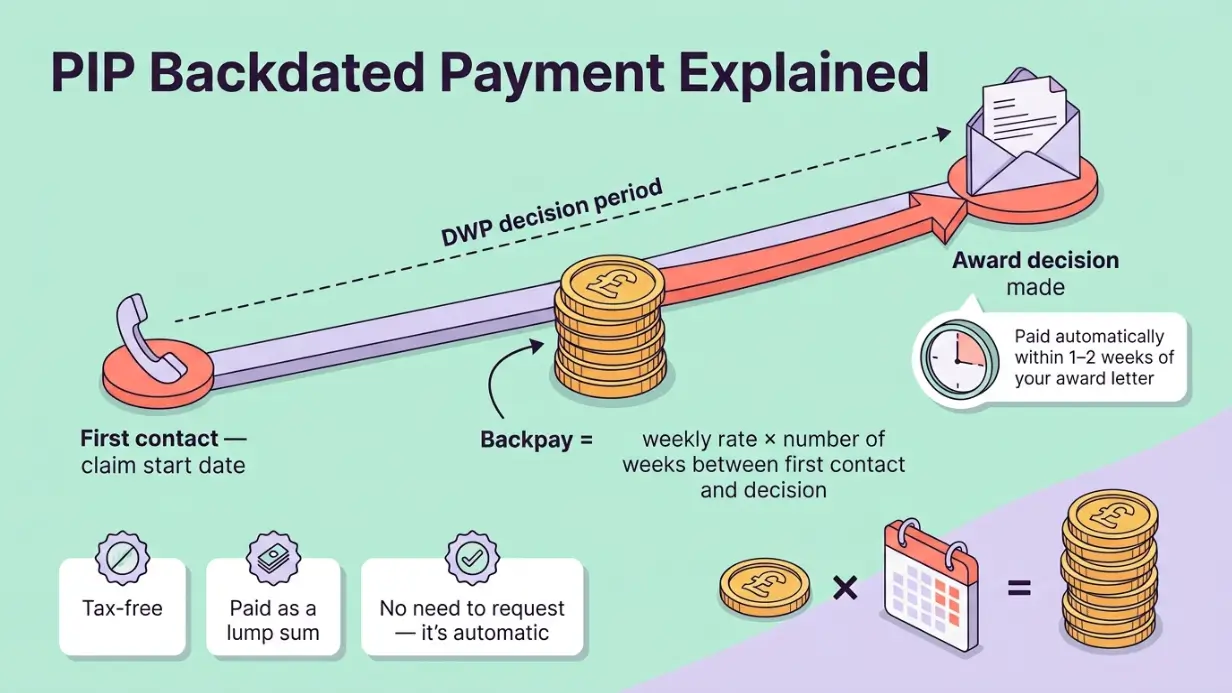
A PIP backdated payment is the lump sum of Personal Independence Payment the Department for Work and Pensions (DWP) owes you from the date you first contacted them to start your claim until the date your award decision is made. It is paid automatically as a tax-free lump sum within one to two weeks after your award letter arrives, and its value equals your awarded weekly PIP rate multiplied by the number of weeks the DWP took to decide your claim.
What Exactly Is a PIP Backdated Payment and When Does It Arise?
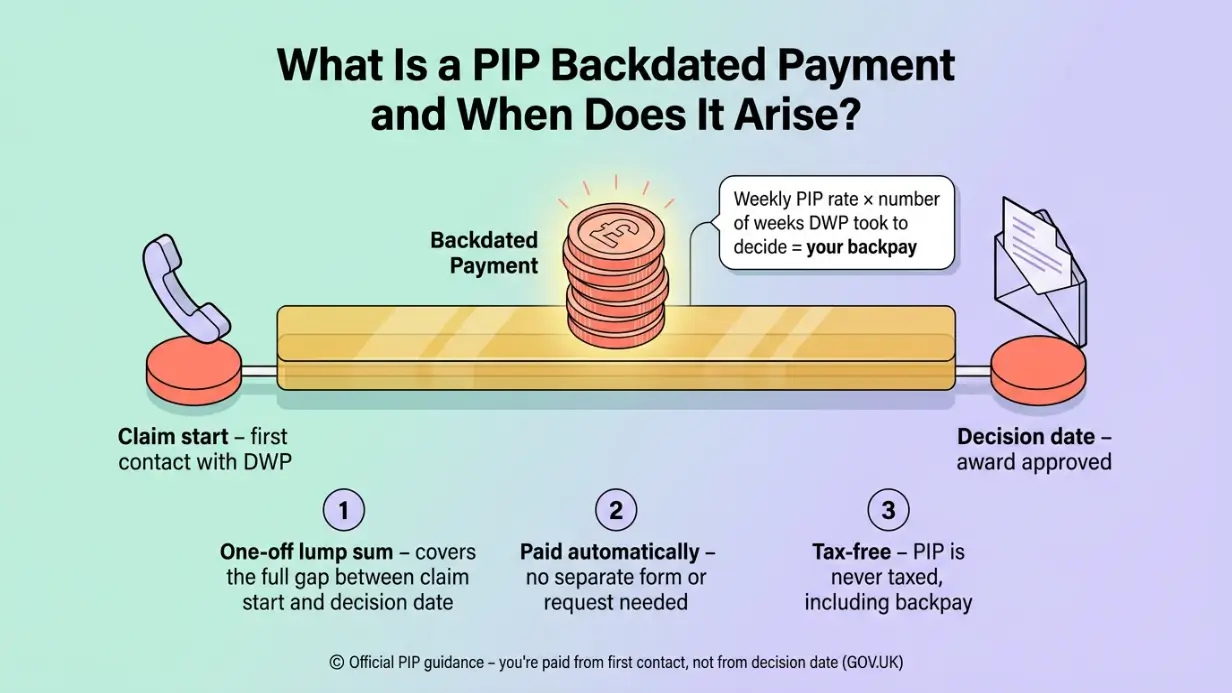
A PIP backdated payment is the money you were entitled to while the DWP processed your claim. It is not a bonus, an extra award, or a separate benefit. When your PIP claim is approved, the DWP works out how much you should have received from the day your entitlement began and pays that amount in one lump sum.
A backdated payment has three fixed characteristics:
-
It is a one-off lump sum. It covers the period between your claim start date and the decision date.
-
It is paid automatically. You do not need to fill in a separate form or make a special request.
-
It is tax-free. PIP payments, including backdated amounts, are never taxed.
The official PIP guidance confirms that you are paid from the date you first contact the DWP, not from when a decision is made (source: https://www.gov.uk/pip/what-youll-get).
From What Date Is PIP Backdated? (The Start-Date Rule)
Your PIP backdated payment starts from the later of:
-
The date you first contacted the DWP to begin your claim, or
-
The end of your three-month qualifying period.
The first contact date is usually the day you phoned the PIP new claims line or used the online claim form. That date determines when your entitlement begins. The DWP will not backdate your payment to before that date, no matter how long you have had your condition.
What Is the 3-Month Qualifying Period and How Can It Reduce My Backpayment?

To receive PIP you must have needed help with daily living or mobility for at least three months before you can be paid. You must also be expected to need that help for at least a further nine months (the “nine-month prognosis rule”). This is the three-month qualifying period (source: https://www.gov.uk/pip/eligibility).
The rule affects your backpayment start date in two ways:
| Scenario | Backpayment starts from |
|---|---|
| You already needed help for more than 3 months when you first contacted the DWP | The date you first contacted the DWP |
| Your condition was new and you had needed help for less than 3 months when you first contacted the DWP | The date the 3-month qualifying period ended |
Example: You broke your leg on 1 March. You phone the DWP on 15 March to start a claim. Your three-month qualifying period ends on 1 June. Even though your claim began in March, the backpayment can only cover from 1 June onwards. The weeks between 15 March and 1 June are not paid.
This timeline is not an error. It is the legal rule the DWP must follow.
There is a common myth that PIP is automatically backdated three months before you made the claim. That is not true. PIP is never backdated to before your first contact date. If you hear someone say “you always get three months extra backpay,” that is wrong. The only three-month period that matters is the qualifying period, and it can only reduce your backpayment, never add to it.
How Far Back Will the DWP Pay If I Win a Mandatory Reconsideration or Tribunal appeal?
If the DWP refuses your claim or awards you a lower rate than you believe is correct, you can challenge the decision. A successful challenge does not just increase your future payments. It also increases your backpayment.
The two main challenge routes are a Mandatory Reconsideration (MR) and an appeal to an independent tribunal (HMCTS).
-
Mandatory Reconsideration: You ask the DWP to look at the decision again. You must normally request an MR within one month of the date on your decision letter. If the MR increases your award, the DWP works out the difference between the old rate and the new rate from the original claim date and pays you the arrears as an additional lump sum. About 23% of MRs result in a changed award.
-
Tribunal appeal: If the MR does not succeed, you can appeal to the First-tier Tribunal. Around 70% of PIP appeals are successful. A tribunal win also backdates the increased amount to your original claim date. Because appeals often take many months, the backpayment can be several thousand pounds.
Beyond individual challenges, the DWP is also running a large-scale administrative review following the MM Supreme Court judgment of July 2019. That ruling changed how the DWP must consider “social support” for people with mental health conditions who find engaging with others face-to-face difficult. The DWP has been reviewing claims made since 6 April 2016 and issuing automatic backpayments where underpayments are found. The DWP expects to complete this review by the end of 2026. If you are affected, you will be contacted. You can check the official review page for updates (source: https://www.gov.uk/government/collections/pip-administrative-review-for-people-affected-by-the-mm-judgment).
In our experience, many claimants do not realise that winning a Mandatory Reconsideration increases backpay — not just future payments — and so they leave money unclaimed. Always check whether a challenge could unlock arrears.
Do I Need to Do Anything to Get the Backpayment, or Is It Automatic?
No. You do not need to request a PIP backpayment separately. The DWP calculates it and pays it automatically as part of your first award.
You do not need to:
-
Submit an extra form for backdating
-
Phone to ask for a backpayment
-
Write a letter requesting arrears
The backpayment is a built-in part of the award process. The only situation where you must act is if you disagree with the decision and need to challenge it. In that case you must request a Mandatory Reconsideration within one month of your decision letter. That challenge can itself produce additional backpayment — but for an initial correct award, the money simply arrives.
How Much Is a PIP Backdated Payment? (Calculation, Rates & Maximums)
The amount of your backpayment is determined by a single formula:
Weekly PIP rate × number of weeks waiting = total backpayment
Two factors control the final figure: the component and rate you are awarded, and the length of time between your claim start date and the decision date.
Current PIP Weekly Rates (2025/26 and 2026/27)
PIP Rates change each April. If your claim spans two tax years, the DWP applies the correct rate for each week. The table below shows both the 2025/26 rates and the new rates effective from April 2026. Source: https://www.gov.uk/pip/what-youll-get (the page updates each April with the new rates).
| Component | Standard Rate 2025/26 | Enhanced Rate 2025/26 | Standard Rate 2026/27 | Enhanced Rate 2026/27 |
|---|---|---|---|---|
| Daily Living | £73.90/week | £110.40/week | £76.70/week | £114.60/week |
| Mobility | £29.20/week | £77.05/week | £30.00/week | £80.00/week |
| Combined Maximum | £103.10/week | £187.45/week | £106.70/week | £194.60/week |
How the DWP Calculates Your Backpayment (Worked Examples)
The DWP multiplies the weekly rate you qualify for by the number of whole weeks from the correct start date to the decision date. Below are three examples using 2025/26 rates.
Example 1: Enhanced Daily Living only, 20-week wait
Award: Enhanced Daily Living £110.40/week Waiting period: 20 weeks Backpayment: 20 × £110.40 = £2,208.00
Example 2: Both components at Enhanced rate, 26-week wait
Award: Enhanced Daily Living + Enhanced Mobility = £187.45/week Waiting period: 26 weeks Backpayment: 26 × £187.45 = £4,873.70
Example 3: Both components at Standard rate, 15-week wait
Award: Standard Daily Living + Standard Mobility = £103.10/week Waiting period: 15 weeks Backpayment: 15 × £103.10 = £1,546.50
If your claim spans the April rate change, the DWP will split the calculation. For example, 10 weeks at the old rate and 10 weeks at the new rate. The payment is not simply the new rate multiplied by the full wait.
There is no fixed maximum backpayment. The length of the delay sets the top. Some claimants who waited over a year have received more than £10,000.
Can I Use a PIP back pay calculator?
Yes. A back pay calculator lets you enter your claim start date, decision date, and award components to get an estimate. It will automatically apply the correct historical rate for each period. Several free calculators are available online. They are useful for checking whether the DWP’s payment looks correct, but the final word is always the amount detailed in your decision letter.
Clients often tell us the backpayment seems smaller than expected. One common reason is that the rate changed during the wait and the earlier weeks used a lower rate — that is correct, not an error. Always check the date ranges and the table above before calling the DWP.
When Will My PIP Backpayment Actually Arrive?
Most people receive their PIP backpayment within one to two weeks after the decision letter is issued. Often the money arrives before the letter.
How Many Days Until the Money Lands?
The DWP processes payments electronically. Royal Mail delivers letters by post. A bank transfer normally clears faster. It is completely normal to see a large credit labelled “DWP PIP” in your account before the brown envelope lands.
If you have received your letter but no payment after two weeks, wait until the end of the third week. If nothing has arrived, call the PIP enquiry line on 0800 121 4433 (Monday to Friday, 9am to 5pm) and have your National Insurance number ready. Source: https://www.gov.uk/pip/how-to-claim.
When the payment arrives, it will appear as a single line on your bank statement similar to:
DWP PIP 12 34 56 78 9A 15JUL £2,208.00
That is your backpayment. The regular four-weekly PIP payments will follow separately.
Why Is My First Regular PIP Payment Less Than I Expected?
After the backpayment, your first ongoing PIP payment may be smaller than you think. PIP is paid in arrears. It covers the previous four weeks. If the decision was made part-way through a four-week cycle, your first “regular” payment might only cover a partial period. That means instead of £441.60 for Enhanced Daily Living, you might see £220.80 for two weeks. This is normal. Your second and later payments will be full four-week amounts.
This partial-first-payment pattern confuses many claimants. Knowing it in advance stops unnecessary worry.
Can a PIP Backpayment Affect My Other Benefits or Tax?
PIP backpayments do not reduce other benefits, and they are not taxed. In some cases, receiving PIP can increase your entitlement to other support.
Tax
PIP is completely tax-free. You do not declare it on a tax return. The lump sum itself is not taxable income.
Universal Credit and Means-Tested Benefits
PIP is not counted as income for Universal Credit, Housing Benefit, or Council Tax Reduction. The backpayment lump sum has a special savings protection.
For the first 12 months after you receive it, the lump sum does not count as savings at all. If the backpayment is more than £5,000, it is ignored indefinitely and never counts as capital for means-tested benefits (source: https://www.gov.uk/government/publications/personal-independence-payment-fact-sheets/personal-independence-payment-and-other-benefits).
Benefit Cap
If you were subject to the benefit cap, a PIP award can lift that cap. When the cap is lifted, the DWP should refund the amounts that were deducted because of the cap, going back to your claim start date. This refund is separate from your PIP backpayment.
Carer’s Allowance and Other Benefits
If someone cares for you, your PIP daily living award may trigger Carer’s Allowance for them. That allowance can also be backdated to your claim start date. Other benefits like disability premiums on Universal Credit may increase. You must report your PIP award to the other benefit offices; the adjustment is not always automatic.
A common worry we hear from clients is that the lump sum will push their savings over the limit and stop their Universal Credit. That fear is understandable but unfounded. The savings disregard rules mean a PIP backpayment does not affect UC. Showing the rule to a claimant usually removes the anxiety completely.
What Can I Do If My PIP Backpayment Is Missing or Seems Incorrect?
Errors happen. A missing or wrong backpayment is usually fixable with a phone call, but you must know what to check.
How to Check Your Award Letter for Backpayment Errors
Get your PIP decision letter. Find these four items:
-
The “From” date — this is the date your award starts.
-
The daily living rate and mobility rate you were awarded.
-
The first payment amount — it should be much larger than the ongoing four-weekly amount because it includes the backpayment.
-
Any mention of “arrears” or “back payment” — even if the sum is included, the letter should explain it.
If the “From” date shows the decision date instead of the date you first contacted the DWP, your backpayment has been calculated wrongly. That is a clear error. If the first payment amount equals exactly four weeks of your awarded rate, the backpayment has been omitted.
The image below shows a simplified decision letter with the key fields highlighted. Look for those three details.
[Labelled diagram of a mock decision letter: three arrows point to “From date”, “Components and rates”, and “First payment amount”.]
Exactly What to Say When You Call the PIP Enquiry Line
If you spot an error, call the PIP enquiry line on 0800 121 4433. Have your National Insurance number and your letter open. You can use these exact words:
“Hello, I received my award letter dated [date]. The ‘from’ date shown is [date on letter], but I first contacted the DWP on [your claim start date]. Please can you check whether my backpayment was calculated from the correct date, and if not, what the correct lump sum should be?”
The agent should be able to see your claim history and either explain the calculation or confirm a mistake. Many problems are corrected during that one call.
If the agent cannot resolve it, ask for a written breakdown of how the backpayment was calculated. You are entitled to this information. Keep notes of every call.
Escalating Your Backpayment Complaint (If the Helpline Can’t Fix It)
If the helpline does not solve the problem, you have further steps:
-
Request a Mandatory Reconsideration in writing within one month of the decision letter. State clearly why the start date or amount is wrong and include evidence such as a diary note of your first call or a phone bill showing the date.
-
If the MR fails, appeal to the First-tier Tribunal (HMCTS). The tribunal is independent of the DWP.
-
If the problem is poor handling rather than a wrong decision, you can make a formal complaint to the DWP. If unresolved, you can escalate to the Independent Case Examiner.
-
Your local MP can also contact the DWP on your behalf. MPs can often unstick delayed cases.
In our experience, a single digit wrong in the year — for example, “2023” instead of “2022” — is one of the most common errors. A claimant who notices it and phones can unlock a five-figure backpayment. That mistake is easy to miss, so always check the year on your “From” date.
Frequently Asked Questions About PIP Backdated Payments
How long does a PIP backpayment take to arrive?
Most people receive their backpayment within one to two weeks after the decision letter is issued. The money often arrives before the letter because bank transfers are faster than postal delivery. If nothing has arrived after three weeks, call the PIP enquiry line on 0800 121 4433 with your National Insurance number.
Is PIP back pay taxable?
No. PIP is completely tax-free, including any backdated lump sum. You do not need to declare it on a Self-Assessment tax return or pay income tax on it. Interest earned on the lump sum after you save it may be taxable under normal savings rules.
Will I get more backpay if my PIP award increases after a Mandatory Reconsideration or appeal?
Yes. If the DWP increases your award after reconsideration or a tribunal, you receive additional arrears covering the difference between the old and new rate from the original claim date. This extra lump sum is paid automatically once the new decision is made.
Does a PIP backpayment affect Universal Credit?
No. PIP is not counted as income for Universal Credit. The backpayment lump sum is disregarded as savings for 12 months. If the backpayment is over £5,000, it is ignored indefinitely and never affects your Universal Credit entitlement.
Can PIP be backdated to before my claim date if I’ve had the condition for years?
No. PIP is never backdated to before the date you first contacted the DWP. Even if your condition started years earlier, the backpayment can only cover from your claim start date or the end of the three-month qualifying period, whichever is later.
What should I do if my backpayment hasn’t arrived or the amount looks wrong?
First, check the “from” date on your decision letter and compare it with your claim start date. Then call the PIP enquiry line on 0800 121 4433 and ask for a breakdown of the calculation. If the problem is not resolved, request a Mandatory Reconsideration within one month.