
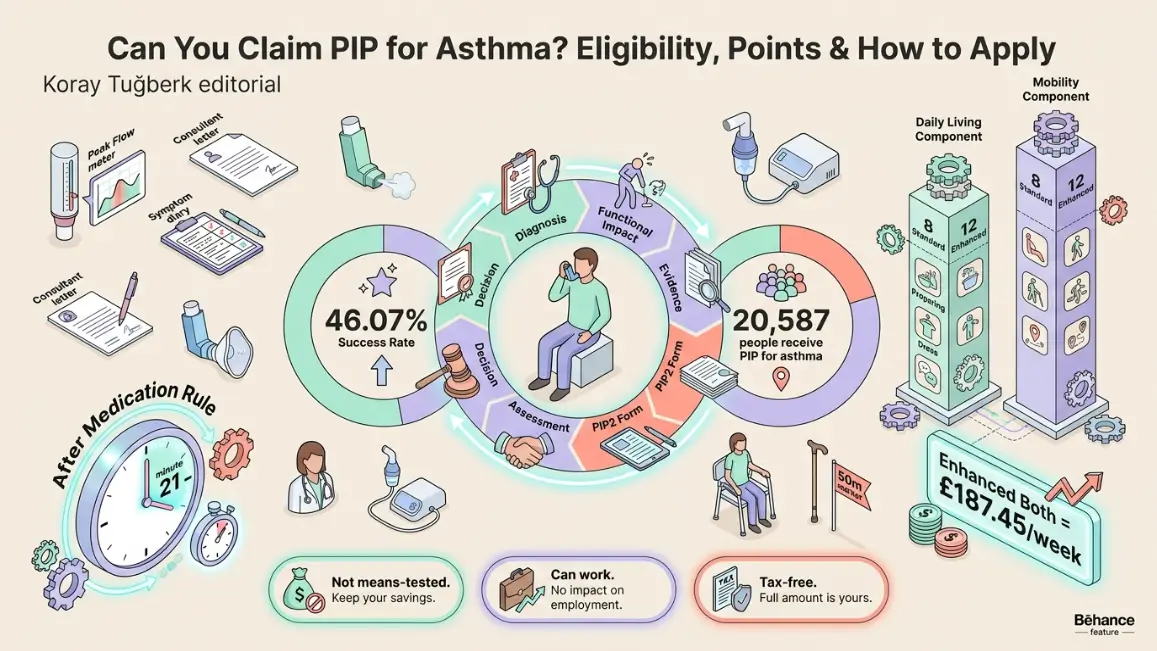
Yes, you can PIP claim Personal Independence Payment (PIP) for asthma — but only if your condition severely limits your daily living or mobility. PIP is not awarded for a diagnosis. It is awarded based on how your asthma affects your ability to perform everyday tasks, assessed after you have used your medication. Eligibility depends on scoring points against specific functional descriptors.
Is Asthma Something You Can Get PIP For?
Yes — asthma can qualify you for Personal Independence Payment (PIP), but the diagnosis alone is not enough. PIP is awarded based on how your condition affects your daily living and mobility, not on the name of the condition. You can read more about what PIP is for a full overview of the benefit.
The Department for Work and Pensions (DWP) assesses every PIP claim against 12 functional activities — 10 daily living activities and 2 mobility activities. You qualify if your asthma limits your ability to complete these activities reliably. You must be 16 or over and under State Pension age to make a new claim. Your difficulties must have lasted for at least 3 months and be expected to continue for at least another 9 months.
PIP is not means-tested. Your income, savings, and employment status do not affect eligibility. You can claim PIP whether you work full-time, part-time, or not at all. If you are wondering about the rules around employment, see our guide on whether you can work and claim PIP.
As of October 2024, 20,587 people across the UK receive PIP for asthmatic conditions, according to DWP data. The overall success rate for asthma PIP claims is 46.07%, based on DWP figures covering claims to October 2024 and published in February 2025. Asthma claims do succeed — nearly half of them — but they succeed because of how the condition affects the claimant, not because of the diagnosis itself.
PIP has two components: daily living and mobility. You can qualify for one component or both. The daily living component covers tasks like preparing food, washing, dressing, and managing medication. The mobility component covers planning and following journeys and physically moving around.
If you live in Scotland, PIP has been replaced by Adult Disability Payment (ADP) for new claims. The eligibility criteria are the same, but the application process differs. ADP is administered by Social Security Scotland. If you already receive PIP in Scotland, you will be transferred to ADP automatically — you do not need to reapply.
How Bad Does My Asthma Need to Be to Qualify for PIP?
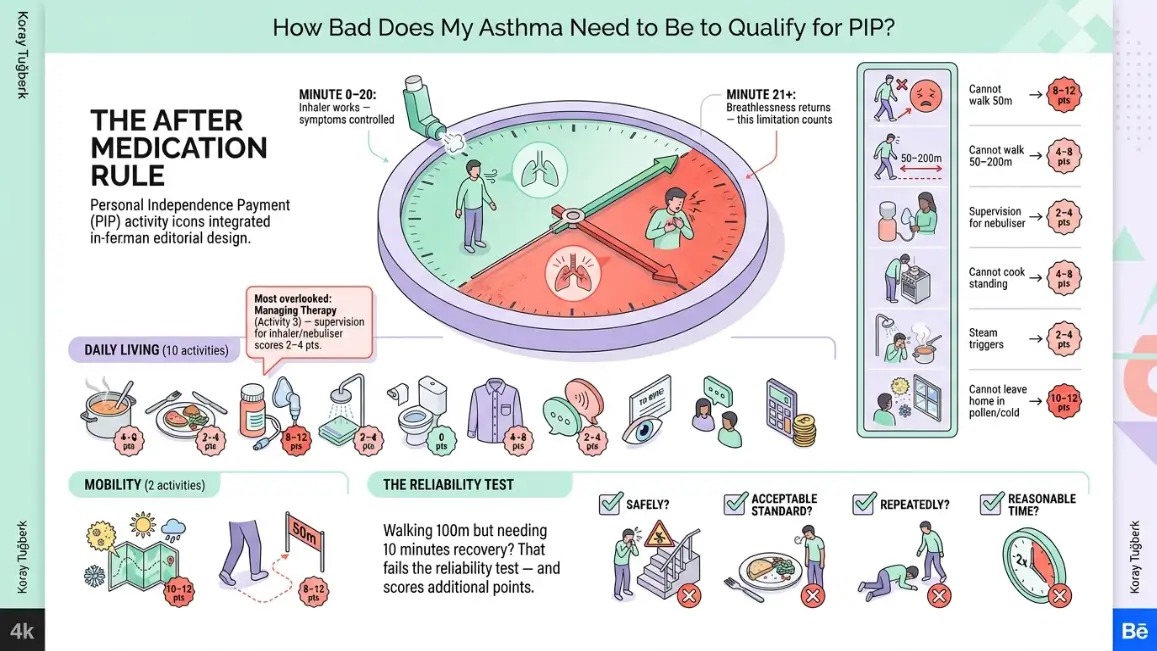
Your asthma needs to limit your ability to complete specific everyday tasks — reliably, repeatedly, safely, and in a reasonable time. PIP uses a points system. Each of the 12 assessment activities is scored from 0 to 12 points. You need at least 8 points across the daily living activities to receive the standard daily living rate, and 12 points for the enhanced rate. The same thresholds apply to the mobility activities. For a full explanation of how scoring works across all conditions, see our PIP Points System guide.
The DWP assesses you after you have used your medication — including inhalers and nebulisers. If your reliever inhaler controls your symptoms for 20 minutes, the assessor considers what you can do at minute 21. If you are breathless again, that limitation counts.
Here is how the 12 PIP activities apply to asthma, with likely points where functional limitations exist:
Daily Living Activities
-
Preparing food. If standing at a hob causes breathlessness, or you need a perch stool to cook, you may score 2–4 points (needs an aid or assistance). If you cannot prepare a meal at all without help, this can score 8 points.
-
Eating and drinking. If chewing and breathing simultaneously causes difficulty, or you need to eat smaller meals more frequently due to breathlessness, you may score points if this requires supervision or assistance.
-
Managing therapy or monitoring a health condition. This activity covers medication management. If you need someone to prompt you to take your inhaler, check you have used it correctly, set up a nebuliser, or supervise you during an attack, you may score 2–4 points. If you need daily supervision or assistance to manage your medication, this can reach 4 points.
-
Washing and bathing. If steam from a shower triggers breathlessness, or you need a shower chair, grab rail, or someone present to ensure safety, you may score 2–4 points. If you cannot bathe without assistance, this can score 8 points.
-
Managing toilet needs or incontinence. Breathlessness when bending or moving to and from the toilet may score points if you need aids or assistance.
-
Dressing and undressing. Bending to put on shoes and socks, or lifting arms to put on clothing, can cause significant breathlessness. If this means you need help or take much longer than someone without a respiratory condition, you may score 2 points.
-
Communicating verbally. Severe breathlessness can limit speech. If you struggle to hold a conversation or make yourself understood during or after exertion, this may score points.
-
Reading and understanding signs, symbols, and words. Asthma does not typically affect this activity. Most claimants score 0 points here.
-
Engaging with other people face to face. If breathlessness or anxiety about symptoms makes social interaction difficult, or you need someone with you to stay safe, you may score 2–8 points depending on the level of support needed.
-
Making budgeting decisions. Asthma does not typically affect this activity directly. However, if medication side effects (such as from frequent oral steroids) impair concentration or decision-making, this may be relevant.
Mobility Activities
-
Planning and following journeys. If you cannot leave your home on high-pollen, cold, or humid days due to asthma triggers, or you cannot navigate unfamiliar routes because anxiety about having an attack prevents you from going out, you may score 10–12 points. Trigger avoidance is a genuine functional limitation — but it must be described in assessment language: “I cannot follow a journey on days when the pollen count is high because exposure triggers an asthma attack.”
-
Moving around. This is the walking and wheeling activity. If you cannot walk more than 50 metres without stopping due to breathlessness, you may score 8–12 points. At 50–200 metres with breathlessness, you may score 4–8 points. The distance is measured on level ground, at a reasonable pace, after using your inhaler.
Asthma-to-Descriptor Mapping Table
| If your asthma means you… | PIP Activity | Points Range |
|---|---|---|
| Cannot walk more than 50 metres without stopping due to breathlessness | Moving around (Mobility 2) | 8–12 |
| Cannot walk 50–200 metres without stopping due to breathlessness | Moving around (Mobility 2) | 4–8 |
| Need supervision to take nebuliser or inhaler medication correctly during an attack | Managing therapy (Daily Living 3) | 2–4 |
| Cannot prepare a meal because standing causes breathlessness | Preparing food (Daily Living 1) | 4–8 |
| Need a shower chair or help bathing because steam triggers symptoms | Washing and bathing (Daily Living 4) | 2–4 |
| Cannot leave home on high-pollen, cold, or humid days due to asthma triggers | Planning and following journeys (Mobility 1) | 10–12 |
| Need help dressing because bending or reaching causes breathlessness | Dressing and undressing (Daily Living 6) | 2 |
| Cannot engage with people due to breathlessness or anxiety about symptoms | Engaging with others (Daily Living 9) | 2–8 |
The reliability test matters. Even if you can walk 100 metres, the DWP asks whether you can do so safely, to an acceptable standard, repeatedly, and in a reasonable time. If walking 100 metres leaves you gasping and needing 10 minutes to recover before moving again, you are not completing the activity reliably. This is where many asthma claims gain additional points — limitations that appear borderline on distance alone may meet the threshold once reliability is factored in.
In our experience working with asthma claimants, the most commonly overlooked scoring opportunity is supervision needs for medication management. If someone must prompt you, check your inhaler technique, or stay with you during an exacerbation, this scores under Daily Living Activity 3 — even if you manage your medication independently the rest of the time. You can estimate your potential award using our PIP Points Calculator.
What Evidence Do I Need to Prove My Asthma for PIP — and Will the DWP Believe Me?
Asthma is an invisible and variable condition. Many claimants worry that an assessor will not take them seriously because they do not look unwell. The answer to that problem is evidence — specific, functional, and sourced from professionals who understand your condition.
Here are the evidence types that carry weight in an asthma PIP claim, ranked from highest to lowest persuasive value:
1. Consultant respiratory letter (highest weight). A letter from your respiratory consultant that describes your functional limitations in PIP-relevant language is the strongest single piece of evidence. Ask your consultant to state specific distances, frequencies, and needs. “Cannot walk more than 50 metres without stopping due to breathlessness despite optimal therapy” is worth more than “has severe asthma.”
2. Spirometry or peak flow results showing variability. Objective lung function data that demonstrates obstruction or variability supports your account. Serial peak flow readings showing morning dipping or exercise-induced drops are particularly useful.
3. Prescription list showing treatment intensity. A repeat prescription list that includes high-dose inhaled corticosteroids, long-acting bronchodilators, leukotriene receptor antagonists (such as montelukast), biologic therapies (such as omalizumab, mepolizumab, or benralizumab), or frequent courses of oral prednisolone signals treatment-refractory asthma. Two or more courses of oral corticosteroids in the past 12 months indicate poor control.
4. Hospital admission or A&E attendance records. Acute care episodes are objective markers of severity. Discharge summaries that describe the trigger, the treatment given, and the frequency of exacerbations provide contemporaneous clinical evidence.
5. Asthma action plan (medium-high weight). A written asthma action plan, completed by your GP or consultant, outlines your treatment escalation steps, trigger avoidance measures, and emergency protocols. It doubles as evidence of the structured management your condition requires.
6. GP supporting letter using PIP descriptor language (medium-high weight). A brief letter from your GP that explicitly links your asthma to functional limitations carries significant weight. Provide your GP with a summary of your daily difficulties so the letter reflects your lived experience in assessment terms.
7. Symptom diary or breathlessness log (medium weight). A two-to-four-week record of breathlessness episodes, triggers, and functional impact transforms vague claims into specific evidence. Record the date, activity, distance walked before stopping, recovery time, and whether you used your reliever inhaler. This kind of contemporaneous record is difficult for a decision-maker to dismiss.
When you submit your PIP2 form, include supporting documents. The DWP accepts photocopies. Keep originals. Send documents with your completed form — do not wait for the assessment. Evidence submitted early shapes the decision-maker’s initial view.
What to ask your GP or consultant to write
When requesting a supporting letter, ask the clinician to describe functional limitations, not diagnoses. An effective letter states: “Ms X cannot walk more than 50 metres on level ground without stopping due to breathlessness, despite optimal inhaled therapy. She requires supervision to administer her nebuliser during exacerbations. She is unable to prepare a meal without sitting down due to exertional breathlessness.” An ineffective letter states: “Ms X has severe refractory asthma.”
The single most common reason asthma PIP claims fail is not that the condition is mild. It is that the evidence describes the diagnosis rather than the functional impact. A letter stating “severe asthma on biologic therapy” does not tell the DWP assessor what you cannot do. The same letter stating specific functional limitations scores points directly.
How Does the PIP Assessment Work for an Invisible Condition Like Asthma?
Most PIP claims require an assessment. This may be by phone, video call, or face-to-face. An independent healthcare professional — working for an assessment provider contracted by the DWP — conducts it. For asthma claims, the key challenge is communicating a variable, sometimes invisible condition to an assessor who may see you on a good day. If you want to prepare thoroughly, read our guide on common PIP Assessment Questions to understand what to expect.
Before the assessment
Gather your evidence. Bring your symptom diary, medication list, asthma action plan, and any supporting letters. If you have a face-to-face assessment, bring your inhaler and any aids you use — a nebuliser, spacer device, or portable oxygen. If your assessment is by phone or video, have these items beside you and refer to them when answering questions.
During the assessment: how to describe variable asthma
Asthma fluctuates. The DWP assesses you as you are most of the time — but the assessor must also consider variability. Use the following structure when describing a limitation: state your typical-day experience, then describe your bad days with frequency.
For example: “On a typical day I can walk about 100 metres before I need to stop and use my reliever inhaler. On a bad day — which happens 3 or 4 times a week — I can only walk 20 metres. My bad days are triggered by cold air, humidity, and pollen. I then need 10 to 15 minutes to recover before I can move again.”
This answer tells the assessor four things: typical distance, bad-day distance, frequency, and recovery time. It also links the limitation to specific triggers. This is far more useful than saying “I get breathless when I walk.”
If a limitation affects you on more than half of days, it counts as “most of the time.” A symptom diary covering at least two weeks provides the data to make this claim accurately.
The “after medication” rule in practice
The DWP assesses you after using your prescribed medication. If your reliever inhaler resolves your symptoms for 20 minutes, describe what you can do at minute 21. If symptoms return, that counts. Say: “After using my salbutamol inhaler, I can walk without breathlessness for about 15 minutes. After that, the breathlessness returns and I need to stop.”
Trigger avoidance as a functional limitation
If you avoid leaving your home on cold days, high-pollen days, or humid days because these conditions trigger asthma attacks, this is a functional limitation. Describe it in PIP mobility terms: “On days when the temperature is below 5°C, I cannot follow a familiar journey outdoors because cold air triggers bronchospasm. I stay inside on these days. This happens approximately 40% of days between November and March.”
Your rights during the assessment
You can bring someone with you to the assessment. They can take notes, prompt you, and describe what they observe. You can ask to record the assessment — request this in advance, as there are rules about recording equipment and notice. You can request a specific-gender assessor. If you need breaks during the assessment because talking triggers breathlessness, say so at the start.
After the assessment
The assessor writes a report and sends it to a DWP decision-maker. The decision-maker reviews the report alongside your PIP2 form and evidence. You will receive a decision letter, usually within 4 to 8 weeks of the assessment. The letter states how many points you scored for each activity and what award, if any, you receive.
Claimants with variable conditions frequently under-report their limitations because they describe their best days. We consistently see that asthma claimants who keep a two-week symptom diary before their assessment score more accurately because they have concrete data to draw on during questioning.
Do not answer assessment questions based on your single best day of the month. The assessor records your first answer. If you say “I can walk 200 metres” because that is your best-day distance, that is what goes into the report. Start with your typical-day limitation, then add the variability context.
How Many Points Would My Asthma Get — and What Does That Mean in Real Money?
The total points you score across the daily living activities determines your daily living award. The total points across the mobility activities determines your mobility award. You need 8 to 11 points for the standard rate in either component. You need 12 or more points for the enhanced rate.
The weekly payment rates for PIP in the 2026/27 tax year are:
| Component | Rate | Weekly Amount | Four-Weekly Amount |
|---|---|---|---|
| Daily Living | Standard | £73.90 | £295.60 |
| Daily Living | Enhanced | £110.40 | £441.60 |
| Mobility | Standard | £29.20 | £116.80 |
| Mobility | Enhanced | £77.05 | £308.20 |
If you are awarded both components at the enhanced rate, you receive £187.45 per week, paid as £749.80 every four weeks — approximately £9,750 per year. For the most current figures, check our page on PIP rates for 2026.
PIP is paid directly into your bank, building society, or credit union account. Payments are made every four weeks in arrears.
Backpay
Your PIP award is backdated to the date you first contacted the DWP to start your claim — that is the date of your initial phone call, not the date of your assessment or decision. If your claim takes 20 weeks from the initial call to the decision letter, and you are awarded enhanced daily living and enhanced mobility, you receive approximately £3,749 in backpay as a lump sum. This is paid separately from your regular four-weekly payments. Our guide on PIP back payments explained covers how this works in detail. You can also estimate what you might be owed using our PIP backpay calculator.
Award length
PIP awards for asthma are typically for a fixed period — commonly 2 to 5 years. Some claimants receive an ongoing award with a light-touch review after 10 years. Your decision letter states the length of your award and when the DWP plans to review your claim. If your condition deteriorates, you can report a Change of Circumstances and request a reassessment at any time. If your condition improves, you must report this to the DWP. For guidance on what happens when your award period ends, see our article on PIP reviews and changes.
If you receive the enhanced mobility component, you may be eligible for the Motability scheme, which allows you to lease a car, scooter, or powered wheelchair using your mobility payment. This is a separate application — contact Motability directly for eligibility details.
How Do I Actually Start a PIP Claim for Asthma?
The PIP claim process has three stages: the initial phone call, the form, and the assessment. Here is the step-by-step process.
Step 1: Call the PIP new claims phone line
Call 0800 917 2222 (Monday to Friday, 8am to 5pm). You will answer basic questions about your identity, your condition, and how it affects you. Have the following ready before you call:
-
Your date of birth
-
Your National Insurance number
-
Your bank or building society account number and sort code
-
Your GP’s name, address, and telephone number
-
Dates and addresses for any stays in hospital or a care home in the last three years
-
Dates and countries for any time spent abroad for more than four weeks at a time
If you cannot use the phone, you can start your claim by post. Send a letter with your name and address to: Freepost DWP PIP 1. No stamp or postcode is needed. You will receive a form to complete and return.
If you need someone to help you during the call, you can ask for them to be added to the line. If someone calls on your behalf, you must be present with them during the call.
Step 2: Complete the PIP2 form
After your phone call, you will receive a form called “How your disability affects you” — known as the PIP2 form. You can usually complete this online if you applied by phone, or on paper if you applied by post. The form typically arrives within two weeks. You have one month to return it.
The form asks about how your condition affects you across the 12 daily living and mobility activities. For every answer, describe a specific difficulty. Do not write “I have asthma.” Write: “I cannot walk more than 50 metres without stopping due to breathlessness. After walking 50 metres, I need to use my reliever inhaler and rest for 10 minutes before continuing.”
Attach all your supporting documents to the form — consultant letters, spirometry results, prescription lists, symptom diaries, and your asthma action plan. Send photocopies, not originals.
For a complete walkthrough of the application, see our guide on how to claim PIP.
Step 3: Attend your assessment (if required)
Most claimants have an assessment. See the previous section for full guidance on preparing for and handling the assessment with an asthma-specific approach.
Step 4: Receive your decision letter
The DWP sends a decision letter stating your points per activity, your award (if any), the rates, and the award length. If you disagree with the decision, you can request a Mandatory Reconsideration within one month. If that is unsuccessful, you can take your case further — our PIP appeal and tribunal guide explains the full process.
The most damaging mistake on the PIP2 form is writing your diagnosis instead of your functional limitations. Every answer must describe what you cannot do, or can only do with help, an aid, or unreliably.
The second most damaging mistake is submitting the form with no supporting evidence. A PIP2 form without medical evidence is significantly less likely to score accurately. Send evidence with the form.
What If I’m Already Getting Other Benefits — or Live in Scotland?
Can I claim PIP alongside other benefits?
Yes. PIP is not means-tested. It does not matter what you earn, what savings you have, or what other benefits you receive. You can claim PIP while working, while receiving Universal Credit, or while receiving Employment and Support Allowance.
Receiving PIP may increase your entitlement to other benefits. If you receive PIP, you may qualify for a disability addition within Universal Credit. Someone who cares for you for at least 35 hours per week may become eligible for Carer’s Allowance. PIP also entitles you to the Motability scheme if you receive the enhanced mobility rate.
What if I live in Scotland?
Personal Independence Payment has been replaced by Adult Disability Payment (ADP) for new claims in Scotland. ADP is administered by Social Security Scotland, not the DWP.
The eligibility criteria are the same 12 activities and points thresholds as PIP. The weekly payment rates are identical. The key differences are in the application process. ADP uses a two-part application: Part 1 is a short form to confirm eligibility; Part 2 is the detailed “About your condition” form. ADP relies more heavily on medical evidence and conducts fewer face-to-face assessments than PIP. Social Security Scotland aims to make decisions based on the information provided rather than requiring an assessment in most cases.
If you already receive PIP and live in Scotland, you will be transferred to ADP automatically. You do not need to apply again. Social Security Scotland will contact you when your case is due for transfer.
If you live in Northern Ireland, the PIP claim process is administered separately. Contact NI Direct for guidance on claiming PIP in Northern Ireland.
Has Anyone with Asthma Actually Been Awarded PIP?
Yes. As of October 2024, 20,587 people across the UK receive PIP for asthmatic conditions. The asthma PIP success rate is 46.07%. Nearly half of all asthma claims result in an award.
The common thread in successful asthma claims is functional evidence. Claims that succeed typically include a consultant or GP letter describing specific functional limitations, objective lung function data, and a contemporaneous symptom record. Claims that fail typically rely on the diagnosis alone — a letter stating “severe asthma” with no functional detail.
We see this pattern consistently: the difference between a rejected claim and an awarded claim is rarely the severity of the asthma. It is almost always the quality and specificity of the evidence.
Consider the profile of a typical successful claim: severe asthma managed with high-dose inhaled therapy plus a biologic, evidenced by a consultant letter stating specific walking distances and supervision needs, supported by spirometry results, a prescription list showing two or more oral steroid courses in the past year, and a two-week symptom diary. This evidence package maps asthma symptoms directly onto PIP Descriptors. The decision-maker can score points because the functional limitations are explicit.
Consider the profile of a typical rejected claim: moderate-to-severe asthma, diagnosed for years, described to the DWP as “I have asthma and get breathless.” No consultant letter. No GP letter. No symptom diary. The PIP2 form lists the diagnosis and medications but does not describe what the claimant cannot do. The decision-maker cannot award points because no functional limitation has been demonstrated.
Claimants who submit a two-to-four-week symptom diary alongside their PIP2 form consistently report better assessment experiences. The diary transforms “I get breathless sometimes” into “In the last 14 days, I was unable to walk more than 50 metres without stopping on 9 days.” This level of specificity gives the decision-maker what they need to award points.
Not all asthma claims succeed. But when they fail, the reason is typically addressable. If your asthma genuinely limits your daily living or mobility, the task is to demonstrate those limitations through evidence — not to hope the assessor infers them from the diagnosis. For more detail on what the DWP looks for, see our PIP eligibility guide.
Frequently Asked Questions About PIP and Asthma
Is asthma classed as a disability in the UK?
Asthma is not automatically classed as a disability. Under the Equality Act 2010, asthma qualifies as a disability if it has a substantial, long-term adverse effect on your ability to perform normal daily activities. PIP Eligibility uses different criteria — the 12 functional descriptors and points system — and does not depend on whether your asthma meets the Equality Act definition.
Can I claim PIP for asthma if I work?
Yes. PIP is not means-tested and is not affected by employment status, earnings, or savings. You can claim PIP while working full-time, part-time, or self-employed. Eligibility depends solely on how your asthma affects your daily living and mobility, not on whether you have a job.
Can you claim PIP for asthma and COPD together?
Yes. PIP is assessed on the combined functional impact of all your conditions. If you have both asthma and COPD, the DWP considers the cumulative effect on your daily living and mobility. You submit a single claim. Provide evidence for both conditions describing their combined functional limitations. We have a dedicated guide on the COPD PIP calculator that may help you understand how respiratory conditions are assessed.
Does severe asthma automatically qualify for PIP?
No. No condition, including severe asthma, automatically qualifies you for PIP. The DWP does not maintain a list of conditions that guarantee an award. Eligibility depends entirely on how your asthma affects your ability to complete the 12 assessed activities, measured against the points-based descriptors. You can review the full PIP Medical Conditions List to see how different conditions are recorded, but remember that it is functional impact that determines the outcome.
What benefits can I claim with asthma in the UK?
Beyond PIP, you may be eligible for Universal Credit if you have a low income or cannot work. You may qualify for Employment and Support Allowance if your asthma prevents you from working. Industrial Injuries Disablement Benefit covers occupational asthma caused by your work. You may also qualify for help with NHS prescription costs through a medical exemption certificate or the NHS Low Income Scheme.
How long does a PIP claim take for asthma?
A typical PIP claim takes 12 to 16 weeks from the initial phone call to a decision letter. Some claims are decided faster — as little as 4 to 6 weeks if no assessment is required. Claims that proceed to mandatory reconsideration or tribunal can take 6 months or longer. Backpay is calculated from the date of your initial phone call, regardless of how long the decision takes. If you have been waiting and are wondering about payment timing, read our guide on when PIP is paid.
Get Help with Your Asthma PIP Claim
You do not need to handle a PIP claim alone. The following organisations provide free, expert support:
-
Citizens Advice offers free, independent help with PIP forms and assessments. Local offices can assist face-to-face. Their website provides detailed form-filling guidance.
-
Asthma + Lung UK runs a helpline on 0300 222 5800, staffed by respiratory specialists who understand the intersection of lung conditions and benefits. They can advise on evidence gathering and assessment preparation.
-
Turn2Us provides a free online benefits calculator to check what support you may be entitled to beyond PIP.
-
Local welfare rights services — available through many local councils — offer free benefits advice and representation. Search your council’s website for “welfare rights” or “benefits advice.”
This page provides general information about claiming PIP for asthma. It is not legal or financial advice. For personalised guidance — especially if your claim is complex or has been rejected — contact one of the organisations listed above.