
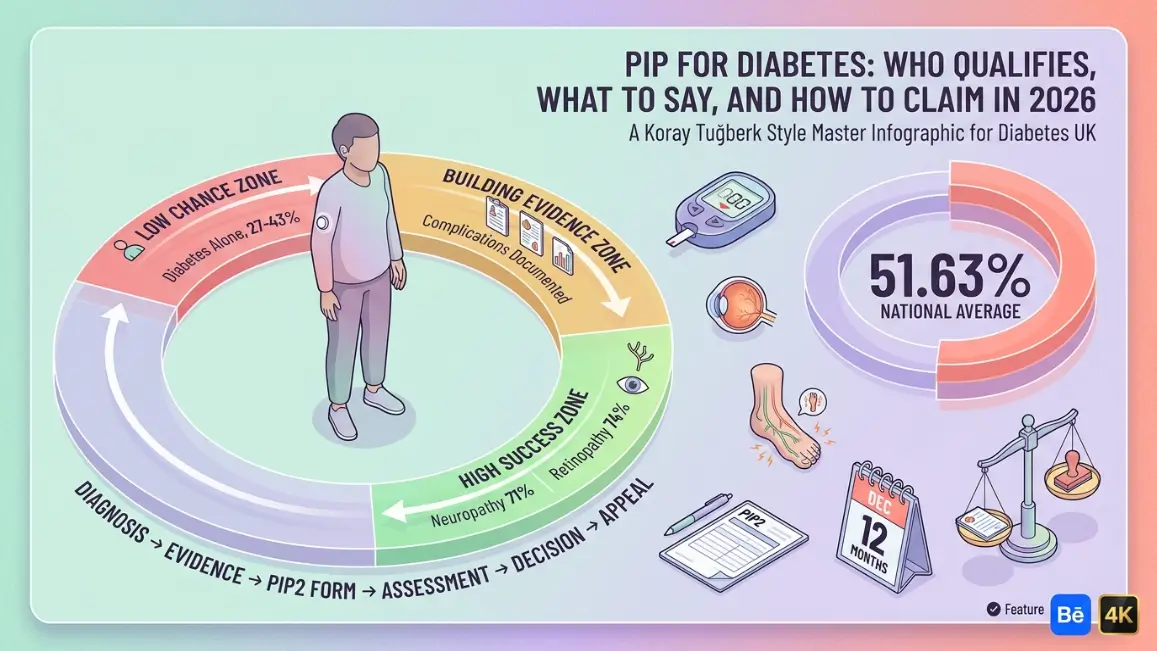
PIP Personal Independence Payment (PIP) is available to people with diabetes in the UK, but eligibility depends entirely on how the condition affects daily living and mobility — not on the diagnosis itself. Both Type 1 and Type 2 diabetes can qualify, but only when complications such as hypoglycaemia, neuropathy, or retinopathy significantly limit your ability to perform specific everyday tasks.
On this page:
- Does diabetes automatically qualify you for PIP?
- Does the type of diabetes affect PIP Eligibility?
- How does PIP assess diabetes? The 10 activities and scoring system
- What are the real chances of getting PIP for diabetes?
- What evidence do you need to support a PIP claim for diabetes?
- How to Claim PIP for diabetes — step by step
- How much PIP can you get for diabetes?
- What if your PIP claim for diabetes is refused?
- The current picture: PIP, diabetes, and the Timms Review (June 2026)
- Other support available if you have diabetes
- Frequently asked questions
Does Diabetes Automatically Qualify You for PIP?
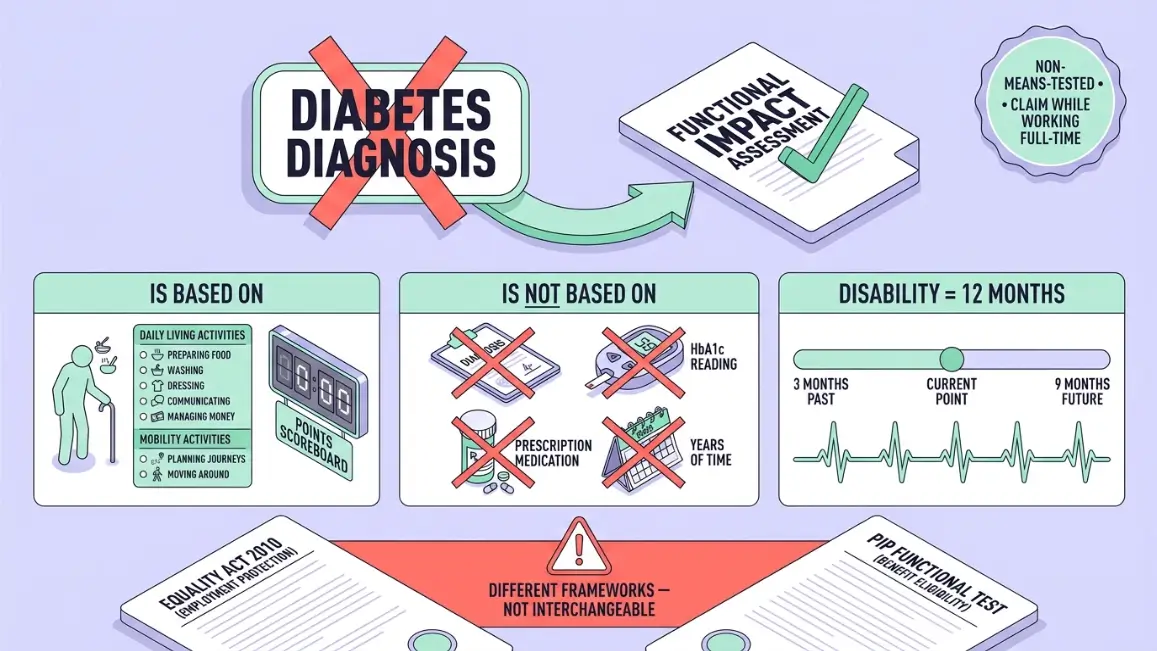
No — a diabetes diagnosis alone does not automatically qualify you for Personal Independence Payment. PIP is awarded based on how your condition limits your ability to carry out specific daily tasks and get around, not on what condition you have been diagnosed with.
Three things determine eligibility:
- What PIP IS based on: The functional impact of your condition on 10 daily living activities and 2 mobility activities, scored using a points-based descriptor system
- What PIP is NOT based on: Your diagnosis, your HbA1c level, the medication you take, or how long you have had diabetes
- What “disability” means in PIP terms: Your difficulties must have lasted at least 3 months and be expected to last at least 9 more months — 12 months in total from when they started
PIP is non-means-tested. Your income, savings, and employment status have no effect on eligibility. You can claim PIP while working full-time.
One important distinction: the Equality Act 2010 defines disability differently from PIP. Under the Equality Act, diabetes that requires medication or treatment is typically classed as a disability, which protects your employment rights. PIP uses a separate functional assessment — passing the Equality Act test does not automatically mean you qualify for PIP. These are two different legal frameworks and several competitors on this topic wrongly conflate them.
Does the Type of Diabetes Affect PIP Eligibility?
The type of diabetes you have is less important than the complications and functional limitations it causes. However, Type 1 and Type 2 diabetes produce different burden profiles, and those profiles map to different PIP activities. Understanding the difference helps you identify where your strongest scoring opportunities lie.
The DWP records PIP claims under specific condition categories. For Type 1, the category is “Diabetes mellitus Type 1 (insulin dependent).” For Type 2, it is “Diabetes mellitus Type 2 (non insulin dependent).” The success rates for these two categories are meaningfully different, and that difference has practical implications for how you build your claim.
Type 1 Diabetes and PIP — What the Data Shows
The PIP success rate for Type 1 diabetes is 27.03%, based on October 2024 DWP figures published in February 2025 by Benefits and Work. The overall average success rate across all conditions is 51.63%. Type 1 diabetes sits nearly 25 percentage points below that average.
This does not mean people with Type 1 diabetes cannot get PIP. It means that managing Type 1 diabetes alone — the blood glucose monitoring, the insulin adjustments, the careful planning around food, activity, and stress — rarely scores enough points under the current descriptor framework. The petition created in June 2026 calling for PIP standards to be amended to clearly include Type 1 diabetics gathered 15,243 signatures precisely because of this gap.
Where Type 1 claimants do succeed is through documented complications. Diabetic neuropathy achieves a 71.63% success rate. Diabetic retinopathy achieves 74.64%. The relentless 24-hour management burden of Type 1 diabetes — the physical exhaustion and mental burnout it causes — is most relevant to PIP under the mental health descriptors: planning and following journeys, and engaging with other people face-to-face.
Young adults transitioning from Disability Living Allowance (DLA) at age 16 face a documented cliff-edge. A child’s parent may have received DLA to cover the extra care burden of managing their child’s Type 1 diabetes. At 16, that same person applies for PIP — and the management demands that qualified the parent for DLA suddenly score 0 under PIP Descriptors. This is a systemic issue that the Timms Review is examining.
Type 2 Diabetes and PIP — What Determines Eligibility
The PIP success rate for Type 2 diabetes is 43.91% — still below the national average but meaningfully higher than for Type 1.
Many people with Type 2 diabetes manage their condition effectively through lifestyle changes, glucose-lowering medicines, or insulin, and experience few functional limitations. For these individuals, PIP eligibility is low and that is an honest reflection of the assessment criteria.
Where Type 2 claimants qualify is through complications. The success rates for complication-specific categories demonstrate this clearly:
| Condition Category | PIP Success Rate | vs. Overall Average (51.63%) |
|---|---|---|
| Type 1 diabetes (insulin dependent) | 27.03% | −24.60 points |
| Type 2 diabetes (non insulin dependent) | 43.91% | −7.72 points |
| Diabetic neuropathy | 71.63% | +20.00 points |
| Diabetic retinopathy | 74.64% | +23.01 points |
Source: Benefits and Work, using October 2024 DWP figures published February 2025
Neuropathy that causes pain, numbness, or reduced dexterity maps directly to the dressing, preparing food, washing, and mobility activities. Retinopathy that causes vision loss maps to reading, preparing meals, choosing clothing, planning journeys, and navigating safely. Fatigue from poorly controlled T2 or from kidney disease maps to washing, bathing, and preparing food. The more clearly you can document these functional impacts, the stronger your claim.
How Does PIP Assess Diabetes? The 10 Activities and Scoring System
PIP uses a points-based system. You are scored across 10 daily living activities and 2 mobility activities. Each activity has a set of descriptors — statements that describe different levels of difficulty. The descriptor that best fits your situation on most days determines your score for that activity.
To receive the daily living component, you need at least 8 points across all 10 activities combined. To receive the enhanced daily living component, you need 12 or more points. The mobility component uses the same thresholds, assessed separately across its 2 activities.
The frequency rule — the threshold no competitor explains
A descriptor only applies to you if it describes your situation on more than half of all days. This is the most misunderstood element of PIP for people with episodic conditions like diabetes. If severe hypos affect you on three days per week, the hypo-related descriptor applies. If they affect you on one day per week, it may not — even if those days are genuinely debilitating.
This matters enormously for how you document your condition. You need to show not just that you struggle, but that you struggle consistently and frequently.
The reliability test — four questions the assessor applies to every activity
For each activity, the assessor asks whether you can complete it:
- Safely — without risk of harm to yourself or others
- To an acceptable standard — the result is good enough
- Repeatedly — as many times as required throughout the day
- Within a reasonable time — no more than twice as long as a person without your condition
If your diabetes means you cannot meet any one of these four criteria for an activity, you may score points for that activity even if you can technically attempt it.
How diabetes maps to each PIP activity
| PIP Activity | Example Diabetes Impact | Key Complication |
|---|---|---|
| Preparing food | Cannot safely chop food due to loss of depth perception; cannot read cooking instructions | Retinopathy |
| Taking nutrition | Needs prompting to eat at appropriate times; cannot recognise hunger during a hypo | Hypoglycaemia |
| Managing therapy or monitoring health condition | Cannot reliably monitor blood glucose without supervision due to hypo unawareness | Hypo unawareness |
| Washing and bathing | Cannot wash independently due to fatigue or reduced grip; cannot safely use a shower alone | Neuropathy, fatigue |
| Managing toilet needs | Cannot manage continence due to damage to the autonomic nervous system | Autonomic neuropathy |
| Dressing and undressing | Cannot fasten buttons or manage zips due to reduced dexterity in hands and fingers | Peripheral neuropathy |
| Communicating verbally | Confusion during a severe hypo affects ability to speak or be understood | Severe hypoglycaemia |
| Reading and understanding signs, symbols, words | Cannot read food labels, medication packaging, or signage | Retinopathy |
| Engaging with other people face-to-face | Anxiety about having an unsupervised hypo prevents going out or interacting socially | Diabetes-related anxiety |
| Making budgeting decisions | Cannot make financial decisions safely due to cognitive impact of recurrent severe hypos | Cognitive impairment |
| Planning and following a journey | Cannot travel independently due to risk of an unrecognised hypo away from home | Hypo unawareness |
| Moving around | Cannot walk more than 50 metres due to neuropathic pain or vascular damage | Peripheral neuropathy, peripheral vascular disease |
A scoring anomaly that directly affects diabetes claimants
Multiple diabetes claimants have reported scoring zero points on the “managing therapy or monitoring a health condition” activity — despite using insulin and a continuous glucose monitor (CGM) daily. The assessor’s reasoning, in these cases, is that the technology exists and therefore the person can manage their condition independently.
This misapplies the reliability criteria. The correct question is not whether insulin or CGM exists — it is whether you can manage your condition safely, to an acceptable standard, repeatedly, and within a reasonable time without prompting or supervision. If you cannot consistently identify a hypo without your CGM alerting you, or if you need someone to remind you to check your readings, you are not managing your condition independently. State this explicitly in your PIP2 form.
The most common scoring mistake: Describing what you can do on a good day instead of what you struggle to do on your worst typical days. Assessors score based on your worst typical day — the day that represents how you function more than half the time. If you describe your average Tuesday when your blood glucose has been stable, and say nothing about the two days each week when a hypo leaves you exhausted and unable to cook, those two days will not be counted.
What Are the Real Chances of Getting PIP for Diabetes?
The honest answer is that it depends almost entirely on whether you have documented complications — and on how clearly those complications are mapped to specific PIP activities in your application.
The DWP records the outcome of every PIP claim by primary disabling condition. The October 2024 figures, published in February 2025 by Benefits and Work, show the following success rates for diabetes-related categories:
| Condition | PIP Success Rate | What This Means |
|---|---|---|
| Type 1 diabetes (insulin dependent) | 27.03% | Well below the national average; management burden alone rarely scores sufficient points |
| Type 2 diabetes (non insulin dependent) | 43.91% | Below average; complications are the primary driver of successful claims |
| Diabetic neuropathy | 71.63% | Well above average; documented nerve damage maps directly to multiple descriptor activities |
| Diabetic retinopathy | 74.64% | Well above average; vision loss scores across daily living and mobility activities |
| All conditions (overall average) | 51.63% | National benchmark |
The data shows a clear pattern. Claiming PIP with diabetes alone — without documented complications — produces success rates far below average. Claiming PIP with documented neuropathy or retinopathy produces success rates far above average. The claim you make as a person with diabetes and neuropathy is fundamentally different from the claim made by a person with diabetes alone, and your evidence and PIP2 form must reflect that.
What the community says
People with Type 1 diabetes who have successfully received PIP are consistent in their accounts: almost none of their points come from managing Type 1 diabetes directly. Points come from comorbid conditions and documented complications. This is consistent with the DWP data.
A petition created in June 2026 — calling on Parliament to amend PIP standards to clearly include Type 1 diabetics — gathered 15,243 signatures within weeks of publication. The government responded on 22 June 2026. The response confirms the current position: PIP is functional, not condition-based, and assessors are trained to consider T1 impacts. The response also confirmed that the Timms Review — the first full review of PIP ever conducted — is underway and will report in autumn 2026.
Initial refusal is common — but not the end
An initial PIP refusal for diabetes is not an indication that you are ineligible. It is a common starting point. The Mandatory Reconsideration and tribunal appeal route exists precisely because initial decisions are frequently overturned. If your claim is refused, the next step is mandatory reconsideration — not acceptance of the decision.
What Evidence Do You Need to Support a PIP Claim for Diabetes?
The DWP does not make its decision based on your diagnosis. It makes its decision based on documented evidence of how your diabetes limits your ability to function. The quality of your evidence is one of the most controllable factors in the outcome of your claim.
| Evidence Type | What It Should State | Priority |
|---|---|---|
| GP letter or report | Diagnosis, current treatment, complications, functional limitations in daily life | Essential |
| Diabetes specialist nurse or consultant letter | Management complexity, hypo frequency and severity, monitoring technology in use, any episodes requiring third-party assistance | Essential |
| Hospital letters or discharge summaries | Emergency admissions, diabetes clinic reviews, eye clinic reports, nephrology letters | High |
| Prescription list | Insulin, all diabetes medications, CGM supplies, insulin pump clinic letters | High |
| Hypo diary | Dates, frequency, blood glucose level recorded, severity, whether third-party assistance was needed | High |
| Personal statement | Specific daily examples — what you cannot do, how often, and what help you need | Essential |
| Carer or family member statement | Third-party corroboration of the assistance they provide and how often | High |
| HbA1c records | Demonstrates glycaemic control over time and clinical complexity | Medium |
| Care plan | Written diabetes management plan showing the level of support required | Medium |
| Occupational health report | If diabetes has affected your capacity to work | If applicable |
How to describe your worst typical day
Every description you write on the PIP2 form should answer three questions: what specifically you cannot do, how often you cannot do it, and what help you need when you cannot do it.
Do not write: “I get tired and sometimes struggle to cook.”
Write instead: “On approximately four days per week, fatigue from my diabetes means I cannot stand at the hob for more than five minutes without needing to sit down. On these days, my partner prepares my meals because I cannot safely do so myself.”
The second version scores points. The first does not.
Include your diabetes technology on your prescription list
People with Type 1 diabetes who use a CGM or an insulin pump now receive these devices through NHS prescription. Your CGM clinic letters and insulin pump clinic correspondence form part of your formal medical record. Include them. They demonstrate the clinical complexity of your management regime and support the evidence for the “managing therapy or monitoring a health condition” activity.
Go to your assessment with support
You are entitled to bring someone to your PIP assessment — a family member, a carer, or an advocate. Community evidence is consistent: people who attend their assessment alone are more likely to score lower than those who have someone present to help them describe their needs accurately and challenge any inaccuracies in real time. Request a recorded assessment in advance. This is a reasonable adjustment the DWP must accommodate if you ask for it.
Do not describe what you manage to do. Describe what you struggle to do, how often you struggle, and what help you need when you do.
How to Claim PIP for Diabetes — Step by Step
You start a PIP claim by contacting the DWP. The process has five stages.
Step 1: Start your claim
Call the PIP new claims line on 0800 917 2222 (textphone: 0800 917 7777) or apply online — the online route is available to residents of England and Wales.
Have the following ready before you call or apply:
- Your National Insurance number
- Your bank account details
- The name, address, and telephone number of your GP, consultant, and any other healthcare professionals involved in your diabetes care
Scottish residents: PIP in Scotland is being replaced by Adult Disability Payment (ADP), administered by Social Security Scotland. Apply via the mygov.scot website. The eligibility rules are the same.
If you are at or above State Pension age: You cannot make a new PIP claim. Apply for Attendance Allowance instead.
Step 2: Complete the PIP2 form — “How your disability affects you”
Once you have registered your claim, the DWP sends you the PIP2 form. You have one month to complete and return it.
Work through each activity section with the following in mind:
- Describe your worst typical days, not your best
- For each activity, state what you cannot do, how often, and what help you need
- If your condition varies, describe the pattern — for example, “on four out of seven days”
- Include supporting letters and documents with the form
- Keep a photocopy of the completed form before you send it
Step 3: Attend your assessment
Most applicants are invited to an assessment — face-to-face, by telephone, or by video call. You can request a home visit if attending in person is difficult due to your diabetes or its complications. Request a recorded assessment — this is your right and the recording protects both you and the assessor.
Bring someone with you. Bring your list of medications and any aids you use.
The assessor is a health professional employed by an assessment provider contracted by the DWP. They write a report based on what you tell them — but the DWP makes the final decision. The assessment is not a medical examination. It is a structured conversation about how your diabetes and its complications affect your daily life.
Describe both good days and bad days. Do not assume the assessor knows what hypoglycaemia feels like or what the consequences of a severe hypo are. Explain it specifically.
Step 4: Receive the decision
The assessor sends their report to the DWP. The DWP makes the award decision and sends you a decision letter. The letter states:
- Whether you have been awarded PIP
- Which components you have received (daily living, mobility, or both)
- At which rate (standard or enhanced)
- The award period (a fixed term or an ongoing award)
Step 5: If you are refused — request mandatory reconsideration, then appeal
If your claim is refused or you disagree with the award level, you can challenge it.
- Request mandatory reconsideration within one month of the date on your decision letter. The DWP reviews its own decision. Submit any additional evidence not included in your original claim — new hospital letters, an updated hypo diary, or a more detailed personal statement.
- If mandatory reconsideration fails, appeal to an independent tribunal. Complete form SSCS1. Free representation is available through law centres, welfare rights organisations, and advice agencies — seek it. Represented claimants have better outcomes at tribunal than those who appear alone.
- The one-month deadline for mandatory reconsideration can be extended if you have a good reason for the delay. Contact the DWP to explain before the deadline passes.
Do not accept an initial refusal as the final answer. For diabetes PIP claims, the appeal route is a legitimate and frequently successful next step.
How Much PIP Can You Get for Diabetes?
PIP is paid weekly, is completely free of income tax, and does not count as income for Universal Credit purposes. You can receive the daily living component, the mobility component, or both — at different rates if your needs differ between the two.
The amount you receive depends on how many points you score across the activities for each component:
| Component | Rate | Points Required | Weekly Amount (2025/26) |
|---|---|---|---|
| Daily Living | Standard | 8–11 points | Verify current rate at GOV.UK |
| Daily Living | Enhanced | 12+ points | Verify current rate at GOV.UK |
| Mobility | Standard | 8–11 points | Verify current rate at GOV.UK |
| Mobility | Enhanced | 12+ points | Verify current rate at GOV.UK |
The DWP uprates PIP amounts every April. Always check the current rates on the GOV.UK PIP page before calculating a potential award — the figures change annually and any rates published more than 12 months ago are likely to be stale.
You can receive both components simultaneously. For example, a person with diabetic retinopathy may score 12 points on daily living activities (enhanced rate) and 10 points on mobility activities (standard rate) — receiving both components at different levels.
What If My PIP Claim for Diabetes Is Refused?
An initial refusal is common for diabetes PIP claims and is not the end of the process. The system provides two formal routes to challenge a decision.
Stage 1: Mandatory reconsideration
You must request mandatory reconsideration within one month of the date on your decision letter. If you have a good reason for missing this deadline — for example, a hospital admission or a severe hypoglycaemic episode — contact the DWP and explain before the deadline passes. The deadline can be extended.
At mandatory reconsideration, the DWP looks at your claim again. Submit any additional evidence that was not included in your original application. A more detailed personal statement, an updated letter from your consultant, or documented hypo episodes since your original application are all useful additions.
Stage 2: Independent tribunal appeal
If mandatory reconsideration does not change the decision, you can appeal to an independent tribunal. Complete form SSCS1 to initiate the appeal.
Seek free representation before your tribunal hearing. Law centres, welfare rights organisations, and some Citizens Advice offices provide free representation for PIP appeals. Claimants who have representation at tribunal have meaningfully better outcomes than those who attend alone.
Keep copies of everything — your original PIP2 form, your decision letter, your mandatory reconsideration request, all correspondence, and all evidence submitted at every stage.
The Current Picture: PIP, Diabetes, and the Timms Review (June 2026)
As of June 2026, PIP is under its first ever full formal review. Anyone with diabetes who is currently considering a claim, mid-way through a claim, or preparing an appeal needs to understand what this means.
What the Timms Review is
The Timms Review is a comprehensive review of PIP and its assessment framework, launched by the UK government. It is being co-produced with disabled people, the organisations that represent them, and other experts. The steering group, almost all of whom are disabled, is examining whether the current assessment framework “effectively captures the impact of long-term health conditions in the modern world.” The review will report to the Secretary of State for Work and Pensions in autumn 2026, with an interim update expected in summer 2026.
The Type 1 diabetes petition
In June 2026, a petition to Parliament titled “Amend standards for PIP to clearly include type 1 diabetics” gathered more than 15,243 signatures. The petition was created by Emily Jones and closes on 2 December 2026.
The government responded on 22 June 2026. The response states:
“PIP is not condition-based. Individuals are assessed by disability experts who focus on functional needs. The Timms Review will ensure PIP is fair and fit for the future and will report in the autumn.”
The response confirms that PIP assessors have access to detailed clinical guidance on Type 1 diabetes and are trained to assess its functional impacts. It also confirms that the Timms Review steering group is examining whether the current descriptors adequately capture the impact of conditions like Type 1 diabetes on modern daily life.
What this means if you are claiming now
The Timms Review does not change the current PIP rules. Claims submitted today are assessed under the existing descriptor framework. There is no indication that a changed framework would result in retrospective awards for people who were previously refused.
Do not delay your claim while waiting for the review to report. If you meet the current functional criteria, apply now under the current rules. This page will be updated when the Timms Review publishes its interim update and its final report.
Other Support Available If You Have Diabetes
PIP is the primary disability benefit for working-age adults with diabetes. Several other forms of support exist depending on your age, employment status, and where you live. These are signposted here — each has its own eligibility rules and belongs on a separate page.
| Support | Who It Is For | Where to Find Out More |
|---|---|---|
| Attendance Allowance | People with diabetes at or above State Pension age | GOV.UK — apply instead of PIP |
| Disability Living Allowance (DLA) for children | Children under 16 with diabetes (England, Wales, Northern Ireland) | GOV.UK + Diabetes UK benefits page |
| Child Disability Payment | Children under 18 with diabetes in Scotland | mygov.scot |
| Adult Disability Payment (ADP) | People with diabetes in Scotland (replacing PIP) | mygov.scot/adult-disability-payment |
| Free NHS prescriptions (FP92A) | People with diabetes using insulin in England | Ask your GP or pharmacist for the FP92A medical exemption certificate form |
| Blue Badge | People whose diabetes complications limit mobility | Apply via your local council |
| Turn2us benefit calculator | Anyone unsure what they may be entitled to | Turn2us website — use the benefits calculator |
| Citizens Advice | Anyone who needs help with the claims process | Find your nearest Citizens Advice office |
Frequently Asked Questions — PIP for Diabetes
Does having diabetes automatically qualify you for PIP?
No. A diabetes diagnosis — whether Type 1 or Type 2 — does not automatically qualify you for PIP. Eligibility depends entirely on how diabetes and its complications affect your ability to perform specific daily living and mobility activities, assessed against a points-based descriptor framework.
What PIP rate can someone with diabetes realistically expect?
The award depends on your assessment score. You need 8 points in daily living to receive the standard daily living component and 12 points for the enhanced rate. Mobility uses the same thresholds, assessed separately. Most successful diabetes claimants qualify through complications — neuropathy and retinopathy produce the highest success rates in the DWP data.
Is it worth appealing if my PIP claim for diabetes is refused?
Yes. Initial refusals are common for diabetes PIP claims. You can request mandatory reconsideration within one month of the decision, then appeal to an independent tribunal if unsuccessful. Free representation is available. The Type 1 diabetes success rate at initial claim is 27.03% — the appeal route is a legitimate and frequently used next step.
Does Type 1 diabetes qualify for PIP more easily than Type 2?
No — the data shows Type 1 is harder. The DWP success rate for Type 1 diabetes is 27.03% versus 43.91% for Type 2. Both types qualify primarily through complications, not the diagnosis. Diabetic neuropathy achieves 71.63% and retinopathy 74.64% — documented complications drive the award in both types.
What do people with diabetes say about getting PIP?
Community experience is consistent: managing diabetes alone rarely scores sufficient PIP points. Most successful claimants have documented complications — neuropathy, retinopathy, or severe hypoglycaemia requiring third-party assistance. A 15,243-signature petition calling for clearer Type 1 inclusion received a government response on 22 June 2026, with the Timms Review currently underway.
Can I claim PIP for diabetes if I am still working?
Yes. PIP is non-means-tested — your income, savings, and employment status do not affect eligibility. You can receive PIP while working full-time or part-time. Eligibility depends only on how your diabetes and its complications affect your daily living and mobility, not whether you are employed.
This page was published in June 2026. It reflects the PIP rules and DWP guidance current at that date, including the government’s response to Parliament petition 768687 on 22 June 2026. Rates, rules, and the Timms Review outcome will be updated as new information is confirmed. Always check GOV.UK for the most current PIP Rates and eligibility guidance.