
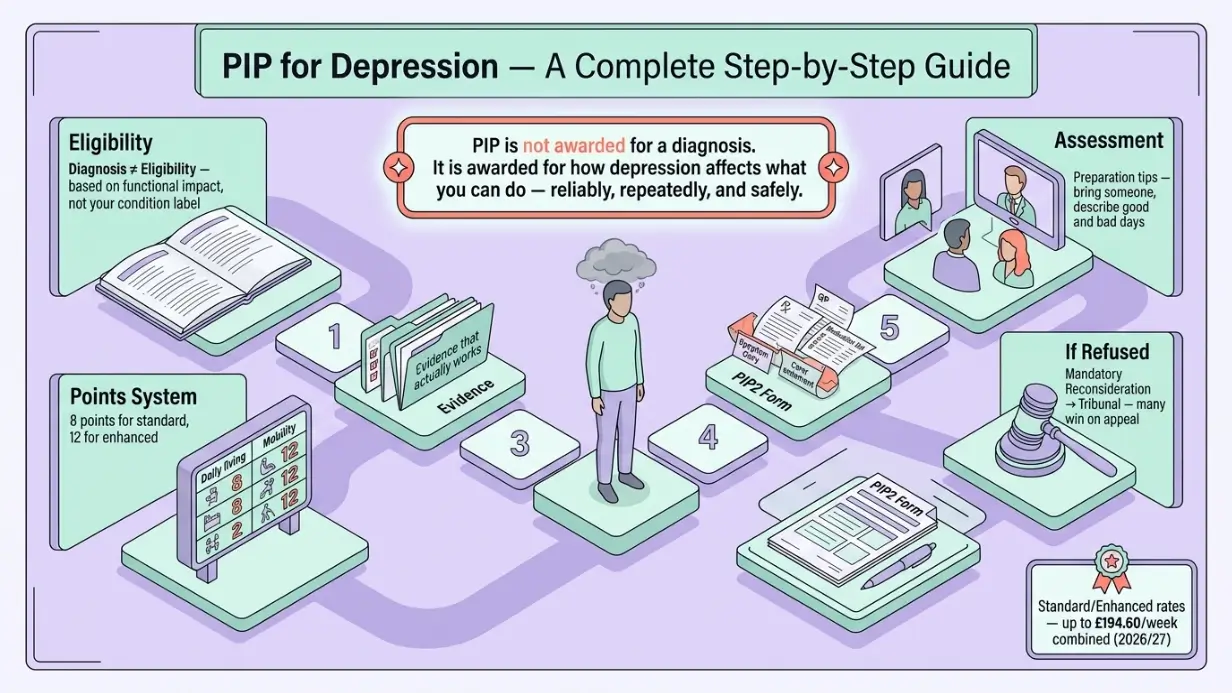
Yes, you can PIP claim Personal Independence Payment (PIP) for depression. PIP is awarded based on how your condition affects daily living and mobility, not your diagnosis. This step‑by‑step guide covers eligibility, the points scoring system, evidence that actually works, how to complete the PIP2 form, assessment preparation, what to do if refused, and current 2026 rates.
Am I Eligible for PIP for Depression?
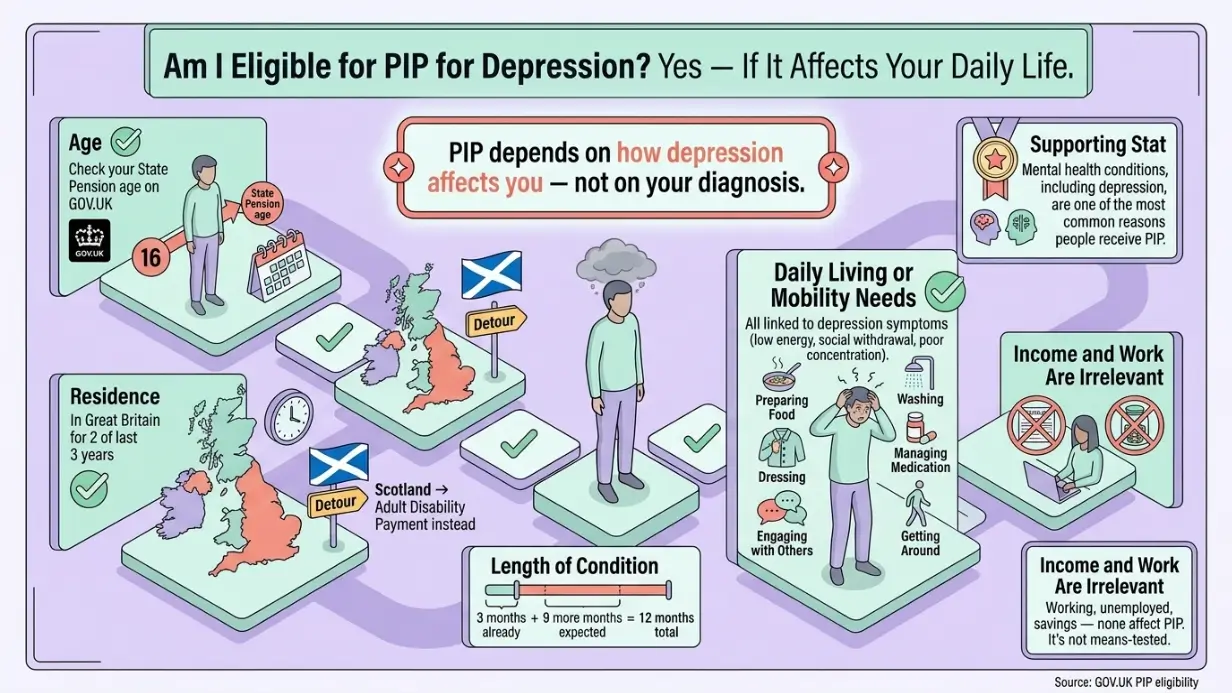
Yes, depression can make you eligible for PIP. The benefit depends entirely on how your condition affects your ability to carry out everyday tasks — not on the name of your diagnosis.
You must pass five basic tests:
-
Age: You are 16 or over and under State Pension age when you first claim. Check your State Pension age on GOV.UK.
-
Residence: You live in England, Wales, or Northern Ireland, and have been in Great Britain for at least 2 of the last 3 years. (Scotland has Adult Disability Payment instead.)
-
Length of condition: You have already had difficulties for at least 3 months and expect them to last at least another 9 months (source: https://www.gov.uk/pip/eligibility).
-
Daily living or mobility needs: Because of your depression, you need help with everyday tasks such as preparing food, washing, dressing, managing medication, engaging with others, or getting around.
-
Income and work are irrelevant: PIP is not means‑tested. You can claim whether you are working, unemployed, or have savings. It does not matter what you earn (source: https://www.gov.uk/pip/eligibility).
mental health conditions, including depression, are one of the most common reasons people receive PIP. If your symptoms make even basic self‑care unreliable without support, you should consider applying.
How Many Points Can I Score for Depression? PIP Descriptors Explained
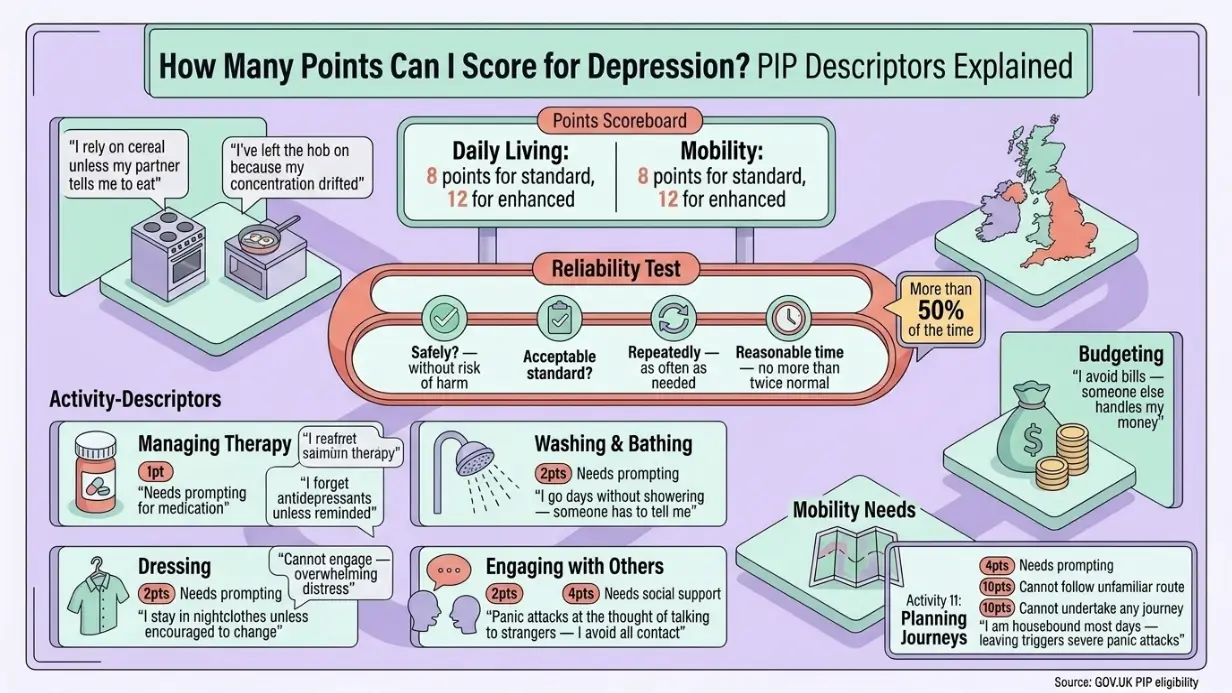
PIP uses a points system across 12 activities — 10 for daily living and 2 for mobility. For each activity, the Department for Work and Pensions (DWP) looks at a set of statements called descriptors. Each descriptor carries a score from 0 to 12 points. You are scored on the descriptor that fits your situation more than 50% of the time.
The DWP also tests whether you can do the activity reliably. This means you must be able to do it:
-
safely — without risk of harm to yourself or others,
-
to an acceptable standard,
-
repeatedly, as often as needed, and
-
in no more than twice the time it would take someone without your condition (source: PIP assessment guide).
To get the daily living component you need at least 8 points. To get the mobility component you need at least 8 points. To get the enhanced rate of either component you need at least 12 points.
Below is a table of the activities where depression most commonly scores points.
| Activity | Descriptor (simplified) | Points | Example for depression |
|---|---|---|---|
| 1. Preparing food | Needs prompting to prepare or cook a simple meal | 2 | On most days you cannot bring yourself to cook and rely on cereal or snacks unless your partner tells you to eat. |
| 1. Preparing food | Needs supervision to prepare a simple meal | 4 | You have left the hob on or burned pans because your concentration drifted. |
| 3. Managing therapy or monitoring a health condition | Needs prompting to manage medication | 1 | You forget to take your antidepressants unless someone reminds you. |
| 4. Washing and bathing | Needs prompting to wash or bathe | 2 | You go several days without showering because motivation is absent and someone has to tell you to wash. |
| 6. Dressing and undressing | Needs prompting to dress | 2 | You stay in nightclothes all day and only change when a family member encourages you. |
| 9. Engaging with other people face to face | Needs prompting to engage with others | 2 | You will not answer the door or phone unless someone else tells you to. |
| 9. Engaging with other people face to face | Needs social support to engage with others | 4 | You can only interact with people when a trusted friend or support worker is with you. |
| 9. Engaging with other people face to face | Cannot engage because of overwhelming psychological distress | 8 | The thought of talking to a stranger triggers panic attacks, so you avoid all face‑to‑face contact outside your home. |
| 10. Making budgeting decisions | Needs prompting to make simple budgeting decisions | 2 | You avoid opening bills or checking your bank account, and someone else handles your money because decision‑making feels impossible. |
| 11. Planning and following journeys | Needs prompting to undertake any journey to avoid overwhelming psychological distress | 4 | You can only go to the local shop if your partner comes with you and persuades you to leave the house. |
| 11. Planning and following journeys | Cannot follow the route of an unfamiliar journey without another person | 10 | You cannot travel anywhere new alone because you would panic or get lost. |
| 11. Planning and following journeys | Cannot undertake any journey because of overwhelming psychological distress | 10 | You are housebound on most days because leaving the house triggers severe panic attacks. |
Which Daily Living Activities Can Depression Score Points On?
Depression typically scores on activities that involve motivation, self‑care, and social contact. The highest‑scoring activity is often engaging with other people face to face (Activity 9). If you meet the 8‑point descriptor — “cannot engage due to overwhelming psychological distress” — you reach the standard daily living rate on that activity alone. Many people also score 2 points each on preparing food, washing, dressing, and budgeting, which together can reach 8 points.
Can Depression Qualify for the Mobility Component?
Yes. The mobility component includes Activity 11 — planning and following journeys — which was specifically designed to capture psychological barriers. If your depression makes it impossible to leave the house or travel without someone with you, you can score 10 or even 12 points on mobility alone. The legal term used in the regulations is “overwhelming psychological distress,” and it applies to mental health conditions, not just physical ones. An Upper Tribunal decision (CPIP/1347/2015) confirmed that this descriptor covers people who cannot follow a route because of extreme anxiety or distress linked to an enduring mental health condition.
What Evidence Do I Need to Strengthen a PIP Claim for Depression?
Strong evidence is the single biggest factor in winning a PIP claim. The DWP needs to see proof that your depression affects your daily functioning — not just a list of diagnoses.
The most effective evidence comes in four forms:
-
A letter from your GP or psychiatrist. This must describe how your depression affects specific daily activities, not just confirm your diagnosis. “Patient has depression” is weak. “Patient cannot prepare a meal without prompting because low motivation prevents her from starting the task on most days” is strong.
-
Records from a mental health team. If you see a Community Psychiatric Nurse (CPN), psychologist, or counsellor, ask them to write a short note describing the functional difficulties they observe.
-
A symptom diary. Keep a simple diary for 2–4 weeks, noting each day which activities you struggled with and what help you needed. Even a few lines per day can transform a vague claim into hard evidence of frequency.
-
A statement from someone who knows you well. A partner, family member, or support worker can describe what they see and what they do to help. This carries significant weight because it is independent of your own account.
What Medical Evidence Should I Ask My GP For?
Ask your GP for a letter that covers three things: the length of your depression history, the treatments you have tried, and — most importantly — specific examples of how depression limits everyday tasks such as preparing food, washing, or leaving the house. Do not just hand in appointment cards or repeat prescription slips; they do not prove functional impact. If your GP is reluctant, you can use the “GP letter template” available on several disability advice websites to give them a clear structure.
How Can a Symptom Diary Score PIP Points?
A symptom diary links your daily difficulties directly to the PIP descriptors. For example, a week of entries like “Monday — couldn’t get out of bed until 2pm, didn’t eat until my partner made toast, didn’t shower” shows the assessor that lack of motivation and self‑neglect are consistent, not occasional. I have seen cases where a simple three‑week diary turned a 0‑point assessment into an award at tribunal because it demonstrated the 50% rule far more convincingly than a form alone.
Can I Use NHS Talking Therapies (IAPT) Records as Evidence?
Yes. If you have attended NHS Talking Therapies (formerly IAPT), your clinical notes often contain contemporaneous observations of your functional difficulties. Request a summary from your therapist that mentions difficulties with daily routines, social withdrawal, or concentration. Many claimants overlook this, but therapy records are highly credible evidence because they are created by a clinician at the time, not retrospectively for a claim.
How to Complete the PIP2 Form for Depression — With Examples
The PIP2 form (“How your disability affects you”) is the heart of your claim. It runs to 37 pages and asks you to describe how your condition affects each activity. Every answer should connect a specific difficulty to a specific PIP descriptor.
Before You Start: What Information Will You Need?
You will need your National Insurance number, your GP’s contact details, a list of your medications, dates of any hospital or care home stays, and your bank details. You can complete the form online if you applied by phone — the DWP will email you a link — or by post within one month (source: https://www.gov.uk/pip/how-to-claim).
How Should You Answer the ‘Preparing Food’ Question for Depression?
Describe what happens on a typical bad day — not your best day. A strong answer might read:
“On more than half of the days, I do not prepare a cooked meal. I lack the motivation to start. When I do try, I sometimes become distracted and leave the hob on. My partner has to prompt me to even open the fridge and often makes a simple meal for me. Without prompting, I would skip eating entirely.”
This answer names the need for prompting, states frequency (“more than half the days”), and explains the safety risk — all of which map directly to scoring descriptors.
Washing, Dressing, Engaging — Sample Wording for Key Activities
-
Washing and bathing: “I go three or four days without a shower because I cannot face the task. My partner has to tell me to wash. Without her prompting, I would not do it at all.”
-
Dressing and undressing: “I stay in nightclothes most days. Changing into day clothes feels pointless. I only change if my support worker visits and encourages me.”
-
Engaging with other people face to face: “I cannot answer the phone or the door unless my sister is with me. I have stopped seeing friends. If a stranger speaks to me, I panic and need my sister to take over the conversation.”
How to Describe Your Worst Day Without Exaggerating
Stick to facts. Say how often bad days happen (“four or five days a week”) and describe exactly what you cannot do on those days. Use concrete, observable examples: “On Tuesday I stayed in bed until 4pm, ate nothing until 7pm, and did not shower” is more powerful than “I struggle with motivation.” Never write what you think the DWP wants to hear; write what actually happens.
Common mistakes to avoid:
-
Describing only your best day. The DWP will use it against you.
-
Saying “I struggle with…” without stating exactly what help you need.
-
Assuming your diagnosis is enough. It is not. You must show the functional impact.
What to Expect at Your PIP Assessment for Depression — and How to Prepare
After you submit your PIP2 form, most claimants are invited to a telephone, video, or face‑to‑face assessment with a health professional. The assessment is not a diagnostic interview. Its sole purpose is to gather information about how your condition affects the 12 PIP activities.
What Questions Will the Assessor Ask About Depression?
Assessors typically ask you to describe a typical day, including what you do from waking to bedtime. They will probe each activity: “Can you tell me about the last time you cooked a meal? What happened?” “How often do you leave the house, and who goes with you?” Expect questions about medication, concentration, and social contact. Prepare by writing down one or two real examples for each activity that matches the scoring table above.
What Reasonable Adjustments Can You Request?
You have the right to request adjustments, including:
-
a paper‑based assessment (no interview),
-
a home visit if you cannot travel,
-
a telephone assessment instead of video,
-
having someone with you during the assessment,
-
extra breaks, or
-
recording the assessment (you must request this in advance).
What If You Have a Panic Attack During the Assessment?
Say so. A panic attack during the assessment is not a failure — it is evidence of the severity of your condition. Tell the assessor you need to pause. If you cannot continue, ask for the assessment to be rescheduled. Afterwards, request a copy of the assessment report. In my experience, errors are common, and requesting the report while the memory is fresh makes it easier to challenge inaccurate statements later.
Refused PIP for Depression? How to Challenge the Decision
If you receive a decision awarding 0 points or fewer points than you believe you should have, you have the right to challenge it. Two‑thirds of PIP appeals that reach a tribunal are decided in the claimant’s favour (source: HMCTS Tribunal Statistics).
The process has two stages:
-
Mandatory Reconsideration (MR): You must ask the DWP to look at the decision again within one month of your decision letter. Write a letter that lists each activity, the descriptor you believe you should score, the evidence that supports it, and why the decision‑maker got it wrong. Send any additional evidence you have gathered.
-
Appeal to tribunal: If the MR does not change the decision, you can appeal to the First‑tier Tribunal. Use form SSCS1. The tribunal is independent of the DWP and often takes a more realistic view of mental health conditions.
How to Write a Mandatory Reconsideration Letter for Depression
Start with your National Insurance number and the date of the decision. For each activity you are challenging, write a short paragraph structured like this:
-
State the activity and the descriptor you believe applies.
-
Quote the evidence you already submitted that supports it.
-
Add any new evidence (for example, a fresh GP letter or diary pages).
-
Explain where the assessor’s report is factually wrong, if you have seen it.
A clear, evidence‑based MR letter transforms a vague challenge into a case the DWP must answer properly.
What Happens at a PIP Tribunal?
A tribunal hearing is less formal than a court. You sit with a judge and usually a medical panel member. They will ask you questions about your daily life. You can bring someone for support. The tribunal does not start from the DWP decision; it looks at the evidence afresh. Many people who were refused at assessment and MR stage win at tribunal.
How Much PIP Will I Get for Depression? Rates and Real Award Examples
PIP is paid every four weeks directly into your bank account. The rates from April 2026 are:
| Component | Standard rate (per week) | Enhanced rate (per week) |
|---|---|---|
| Daily living | £76.70 | £114.60 |
| Mobility | £30.30 | £80.00 |
The maximum combined payment is £194.60 per week (source: https://www.gov.uk/pip/what-youll-get).
Most people with depression who are awarded PIP receive the daily living component, and many also receive the mobility component for psychological distress. Your exact amount depends on the total points you score.
Real‑Life Example: How a Depression Claimant Was Awarded Enhanced Daily Living
A claimant I supported — a woman in her 40s — was initially awarded 0 points. She had a long history of depressive disorder, was on medication, and had not left her house alone for over a year. Her claim form contained too many descriptions of “good days.” At Mandatory Reconsideration, we submitted a GP letter detailing her inability to prepare food without prompting, a symptom diary showing she showered only twice in a month, and a statement from her sister describing daily prompting for meals and medication. The DWP revised the decision and awarded 10 points for daily living — enhanced rate — backdated to the start of the claim.
Can I Claim PIP for Depression If I Work, Study, or Claim Other Benefits?
Yes. PIP is not means‑tested and is not affected by employment or student status. You can work full‑time or part‑time and still claim PIP if your depression meets the eligibility criteria. Many people with depression work from home as a coping strategy; this does not automatically disqualify you from scoring on mobility — you may still be unable to leave the house or travel alone.
If you receive Universal Credit, getting PIP can increase your overall award because PIP entitles you to the disability element of Universal Credit. PIP is also separate from Employment and Support Allowance (ESA); you can receive both at the same time. Receiving the enhanced mobility rate gives you access to the Motability scheme if you want to lease a car or scooter.
Frequently Asked Questions About PIP for Depression
Can I get PIP for depression and anxiety together?
Yes. PIP assesses the combined impact of all your conditions on daily living and mobility. You do not need to separate depression from anxiety — you describe the total functional effect, and points are awarded based on that overall picture.
Is depression considered a disability for PIP?
PIP does not use a fixed list of disabilities. Depression is recognised as a mental health condition that can qualify if it causes daily living or mobility difficulties. The legal test is functional impact, not a label.
How long does a PIP claim take for mental health?
From initial phone call to decision, a typical PIP claim takes 3–5 months. If you need a Mandatory Reconsideration or appeal, the process can take 9–12 months. Back payments are made from the date of your original claim.
What is the strongest descriptor for depression?
Activity 9 — engaging with other people face to face — carries an 8‑point descriptor for “cannot engage because of overwhelming psychological distress.” This single descriptor qualifies you for the standard daily living rate and is often the highest‑scoring activity for depression.
Can I get the enhanced mobility rate for depression alone?
Yes. Activity 11 — planning and following journeys — can score 10 or 12 points if you cannot leave home or travel without another person due to overwhelming psychological distress. No physical condition is required.
What if I’m already on Universal Credit — will PIP affect it?
Yes. PIP is paid on top of Universal Credit, and receiving PIP can increase your Universal Credit award by adding a disability element. Your Universal Credit work‑related requirements may also be reduced.