PIP —
Personal Independence Payment — is available to people with a mental health condition, including depression, anxiety, PTSD, bipolar disorder and OCD. Eligibility is based on how your condition affects daily tasks and getting around, not on your diagnosis or whether you work. In 2026/27, the award ranges from £76.70 to £194.60 per week.
Claiming PIP can feel overwhelming when you are already unwell. You do not have to do it alone — a benefits adviser at Citizens Advice or a local welfare rights service can help you complete the form for free, and your GP or a charity such as Mind can offer support with your mental health while you go through the process.
Can you get PIP for a mental health condition?
Yes — PIP is available to people with a mental health condition. The benefit is not means-tested, not linked to your employment status, and not based on having a specific diagnosis. What matters is how your condition affects your ability to carry out everyday tasks and get around. A person with severe depression who struggles to prepare food or leave the house qualifies on the same terms as someone with a physical disability. For the basics of the benefit, see our guide to what PIP is.
To be eligible for PIP, all of the following must apply:
- You are aged 16 or over and under State Pension age (if you have not claimed PIP before).
- You have a long-term physical or mental health condition or disability.
- Your condition makes it difficult to carry out certain everyday tasks or to get around.
- Your difficulties have lasted at least three months and are expected to continue for at least nine months.
PIP is paid regardless of whether you work; it does not stop if you start a job or increase your hours, because the DWP reviews your award on whether your functional needs have changed, not your employment status — see working while claiming PIP. One important financial point: if you are eligible but have not yet claimed, your payments start from the date you first call the DWP, not from when your condition began — so calling early matters, and you can estimate any arrears with our
PIP back pay calculator.
If you live in Scotland, you cannot claim PIP — new claims are made through Adult Disability Payment (ADP), administered by Social Security Scotland, on the same “not means-tested, based on functional impact” principles.
Which mental health conditions qualify for PIP?
Any long-term mental health condition can qualify. There is no official list of qualifying diagnoses — the DWP assesses how your condition affects your daily life, not what it is called. Conditions people commonly and successfully claim for include:
| Condition |
Commonly scored activities |
| Depression |
Activity 1 (Preparing food), Activity 4 (Washing and bathing), Activity 9 (Engaging with others), Activity 10 (Budgeting decisions) |
| Generalised anxiety disorder |
Activity 9 (Engaging with others), Activity 11 (Planning journeys), Activity 1 (Preparing food) |
| PTSD |
Activity 9 (Engaging with others), Activity 11 (Planning journeys), Activity 4 (Washing and bathing) |
| Bipolar disorder |
Activity 1 (Preparing food), Activity 9 (Engaging with others), Activity 10 (Budgeting decisions) |
| OCD |
Activity 4 (Washing and bathing), Activity 3 (Managing therapy), Activity 9 (Engaging with others) |
| Borderline personality disorder (BPD) / EUPD |
Activity 9 (Engaging with others), Activity 11 (Planning journeys), Activity 4 (Washing and bathing) |
| Psychosis / schizophrenia |
Activity 9 (Engaging with others), Activity 11 (Planning journeys), Activity 8 (Communicating verbally) |
| Agoraphobia / panic disorder |
Activity 11 (Planning journeys — mobility component), Activity 9 (Engaging with others) |
The word “stress” on its own is unlikely to qualify, because PIP requires a condition causing difficulties that have lasted at least three months and are expected to last at least nine more. If you experience severe stress, see your GP to determine whether an underlying condition such as an anxiety disorder or depression is present. To see how a specific condition tends to score, try our condition
calculators — for example the anxiety, PTSD, ADHD and Autism PIP calculators.
Does it matter if I have no formal diagnosis?
No — PIP does not require a confirmed psychiatric diagnosis. The Social Security (PIP) Regulations 2013 assess functional ability, not diagnostic categories. A claimant who has spoken to their GP about their mental health, has a repeat prescription for antidepressants, or has been referred to a crisis service has a documented history of functional impact even without a formal label. If you have no formal diagnosis, ask your GP to write a letter describing how your symptoms affect your daily life — this carries more evidential weight than a diagnosis label alone.
How does the PIP Points System work for mental health?
PIP uses a points-based system to decide whether you qualify and at what rate. Your condition is assessed against two groups of activities — daily living and mobility; for each activity a set of
descriptors describes different levels of difficulty; the DWP awards points for the descriptor that best fits you on most days; and your total in each group decides the rate. The full descriptor tables are in our PIP points system guide.
| Component |
Standard rate |
Enhanced rate |
| Daily Living |
8–11 points |
12 or more points |
| Mobility |
8–11 points |
12 or more points |
The two components are scored and awarded independently. You can receive one without the other, or standard on one and enhanced on the other. Estimate your likely total with our
PIP points calculator.
The 50% of days rule — critical for fluctuating conditions
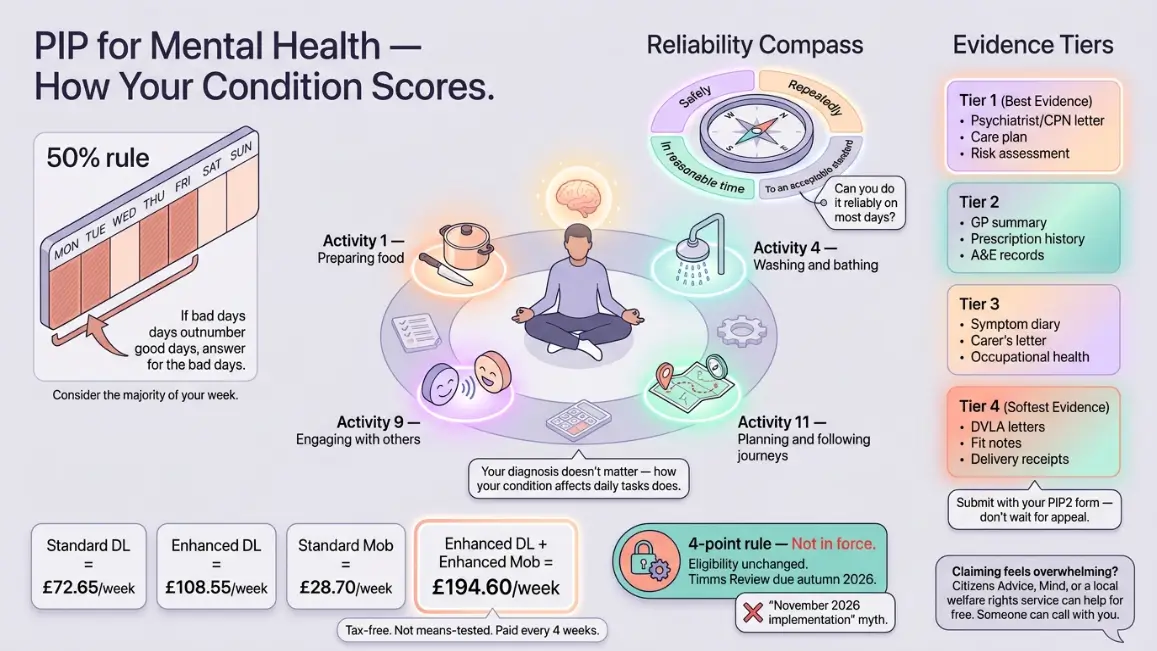
A descriptor applies if your condition affects that activity on more than 50% of days across the assessment period. This is the most important rule for conditions that vary — bipolar disorder, episodic depression, PTSD, BPD. You do not need to be affected every day; if severe bad days outnumber manageable days, the descriptor for those bad days applies. The DWP looks back three months from your claim and forward nine months, considering the full window, not just how you present on the assessment day.
The reliability criteria — what “being able to do” something means
Even if you can technically perform an activity, you may still score points if you cannot do it reliably. An activity only counts as something you can do if you can complete it safely (without risk of harm), repeatedly (as often as needed), to an acceptable standard, and in a reasonable time (within twice the time a non-disabled person would need). For mental health this matters: someone with severe depression may prepare a meal on a good day but cannot do so safely, repeatedly and to an acceptable standard on more than half of days — so they still score on Activity 1.
Which PIP activities score the most points for mental health?
Three daily living activities and one mobility activity are where mental health claimants score most of their points. Understanding how your symptoms map to these descriptors is the single most important factor in a successful claim.
Activity 9: Engaging with other people
Activity 9 covers face-to-face social engagement and produces some of the highest scores available for mental health conditions.
| Descriptor |
Score |
Mental health scenario |
| Can engage with other people unaided |
0 |
No relevant difficulties |
| Needs prompting to engage with other people |
2 |
Needs reminding or encouraging by another person to speak to others |
| Needs social support to engage with other people |
4 |
Needs a person trained or experienced in assisting people in social situations to be present |
| Cannot engage due to overwhelming psychological distress, or would pose a risk of harm |
8 |
Severe anxiety, psychosis or PTSD preventing any face-to-face engagement |
Two definitions matter here.
Prompting means reminding, encouraging or explaining by another person.
Social support is legally distinct: support from a person
trained or experienced in assisting people to engage in social situations — a CPN, social worker, mental health support worker or trained volunteer. It does not simply mean having a family member present for comfort.
Worked example — 4 points: Maria has anxiety and depression. She cannot make phone calls or answer the door without her support worker, who is trained in anxiety management and attends all her appointments; alone, she has panic attacks. Maria scores 4 points for needing social support.
Worked example — 8 points: James has severe social anxiety and PTSD and cannot engage face-to-face with anyone outside his household without overwhelming psychological distress, including dissociation and panic. He scores 8 points.
Activity 11: Planning and following journeys
The mobility component is not only for people who cannot walk. Activity 11 covers the psychological ability to plan and follow a journey — where agoraphobia, severe anxiety, panic disorder and PTSD score points, often at the enhanced rate. This is the most under-claimed activity for mental health: many people assume mobility is “physical only” and never claim it, losing up to £80 a week.
| Descriptor |
Score |
Mental health scenario |
| Can plan and follow the route of a journey unaided |
0 |
No relevant difficulties |
| Needs prompting to undertake any journey to avoid overwhelming psychological distress |
4 |
Needs encouragement before leaving home due to severe anxiety |
| Cannot plan the route of a journey |
8 |
Severe executive-function difficulties; profound depression affecting cognition |
| Cannot follow an unfamiliar journey without another person |
10 |
Anxiety or PTSD in unfamiliar environments |
| Cannot undertake any journey because it would cause overwhelming psychological distress |
10 |
Agoraphobia; severe panic disorder |
| Cannot follow a familiar journey without another person, assistance dog or orientation aid |
12 |
Severe agoraphobia; psychosis affecting orientation |
“Overwhelming psychological distress” is defined in the Social Security (PIP) Regulations 2013 as distress related to an enduring mental health condition or a cognitive impairment. It is
not ordinary nervousness — the distress must be severe enough that the person cannot reasonably be expected to undertake the activity. Upper Tribunal rulings have confirmed that “following a route” means more than navigation and that this activity applies to mental health conditions, not only physical or sensory ones.
Worked example — 10 points: Priya has agoraphobia and panic disorder and has not left her flat unaccompanied in eight months; on the rare occasions she tries to travel alone she has a panic attack within minutes and returns home. She cannot undertake any journey independently because it causes overwhelming psychological distress, scoring 10 points and qualifying for enhanced mobility.
Activities 1, 4 and 10: depression and self-care
Activity 1 — Preparing food: depression reduces motivation, concentration and energy. Someone who can physically use a kitchen but cannot initiate or complete a meal on more than half of days — because of low mood, poor concentration or fatigue — scores points; the reliability criteria apply.
Activity 4 — Washing and bathing: depression and severe anxiety can make hygiene very hard; needing prompting to wash scores 2 points, needing physical assistance scores 4, and washing that causes overwhelming distress or a safety risk may score higher.
Activity 10 — Budgeting decisions: poor concentration and impaired decision-making affect money management; needing assistance to manage any financial decisions scores 6 points.
How much is PIP for mental health in 2026/27?
PIP for mental health is paid at exactly the same rate as PIP for any other condition — the amount depends on your points, not your diagnosis. The 2026/27 rates took effect on 6 April 2026. Monthly figures below are approximate (weekly × 52 ÷ 12), because PIP is paid every 4 weeks; see every combination in our PIP rates guide.
| Award combination |
Weekly |
Every 4 weeks |
Approx. annual |
| Daily Living — standard only |
£76.70 |
£306.80 |
£3,988 |
| Daily Living — enhanced only |
£114.60 |
£458.40 |
£5,959 |
| Mobility — standard only |
£30.30 |
£121.20 |
£1,576 |
| Mobility — enhanced only |
£80.00 |
£320.00 |
£4,160 |
| Daily Living Standard + Mobility Standard |
£107.00 |
£428.00 |
£5,564 |
| Daily Living Standard + Mobility Enhanced |
£156.70 |
£626.80 |
£8,148 |
| Daily Living Enhanced + Mobility Standard |
£144.90 |
£579.60 |
£7,535 |
| Daily Living Enhanced + Mobility Enhanced |
£194.60 |
£778.40 |
£10,119 |
PIP is paid every four weeks (13 payments a year), is tax-free, and does not count as income for means-tested benefits. New awards from 2026 carry a review period of three to five years — see our review changes guide. Being awarded PIP can also unlock extra help, such as a council tax reduction and a Blue Badge.
What evidence do you need to claim PIP for mental health?
Submitting strong evidence with your original PIP2 form significantly increases your chances. The most common reason PIP appeals succeed is that stronger evidence is submitted at appeal than was included originally — evidence that could have been submitted from the start. Gather from as many tiers as apply; Tier 1 carries the most weight.
Tier 1 — highest weight (NHS specialist): a letter from a psychiatrist, psychologist or psychotherapist describing how your condition affects daily functioning (not just confirming diagnosis); a report from your CPN or care coordinator going through each affected activity; a CMHT care plan or crisis plan; risk assessments.
Tier 2 — strong weight (primary care/NHS records): a GP medical summary (free under a Subject Access Request); a GP letter describing daily-life impact; prescription history showing long-term medication; A&E, NHS 24 or home treatment team records.
Tier 3 — corroborating: a symptom diary; a supporting letter from a carer or close friend who witnesses your difficulties; occupational health assessments; university reasonable-adjustment letters; a private GP letter (typically £70–£80) where NHS contact has been limited.
Tier 4 — supplementary: DVLA correspondence about licence surrender; employer fit notes showing time off; delivery receipts showing inability to leave home or prepare meals; a written education/employment history showing long-term impact.
A carer’s letter is not a character reference — it should go through each relevant PIP activity in sequence, give specific examples and frequencies, describe any incidents, name any aids used, and reference your other evidence.
What to do if you have little or no medical evidence
Limited evidence is one of the most common fears, and it is manageable. Being discharged from a community mental health team does not mean you have recovered — it means your funded treatment ended; if discharged, say so on the form: write that the discharge reflected the end of funded treatment, not a change in your functional difficulties. If you have no current specialist involvement, your GP records and prescription history are your primary evidence — request your full summary under a free Subject Access Request, which gives years of documented NHS contact.
A symptom diary is valid evidence even without medical backing. Keep it for at least two weeks (eight is stronger), two to three entries a day, recording your mood (1–10), tasks attempted, tasks you could not start or complete and why, who helped, and any incidents — and note which PIP activity each entry relates to. If your only contact has been your GP and a repeat prescription, book an appointment now and ask them to document your current functional difficulties, creating a contemporaneous record.
How to answer the PIP2 form for mental health
The most common mistake is describing an average day rather than a worst day. The DWP applies the 50% rule, so if your worst days happen more than half the time, describe those. Be specific: name the activity, describe what happens, say how often, and say who helps.
Use this structure to describe your own genuine experience — never write something that is not true for you.
Activity 1 (Preparing food) — weak: “I sometimes find it hard to cook when I’m low.”
Strong: “On my worst days, at least four or five days out of seven, I cannot motivate myself to prepare food. I do not eat, or eat cold food from a packet. My sister prepares my cooked meals when she visits three times a week; on other days I do not eat a proper meal. I cannot do this safely, repeatedly or to an acceptable standard on most days.”
Activity 9 (Engaging with others) — weak: “I get anxious around people.”
Strong: “I cannot engage face-to-face with anyone outside my household without my support worker, who is trained in anxiety management. Without this, I have a full panic attack within minutes. This happens every day I have to engage with someone new. I cannot do this without trained social support.”
You start your claim by calling the DWP PIP new claims line on
0800 917 2222 — the date of this call becomes your claim start date, and any award is backdated to it, so do not delay while gathering evidence. You then complete the PIP2 form (“How your disability affects you”) within one month of the date on the letter, submit your evidence, and usually attend an assessment. The full step-by-step is in our how to claim PIP guide. If phone calls are difficult because of your mental health, you can ask for a reasonable adjustment, or have a carer call on your behalf.
The assessment: mental-health-specific tips
The assessment is a structured conversation with a healthcare professional by phone, video or in person — see what they ask in our PIP assessment guide. Assessors note informal observations (how you arrived, how you communicate), which can appear in the report, so for mental health specifically:
- If today is an unusually good day, say so: “Today is better than most — my typical day involves…”
- Attending the assessment is not evidence you can plan and follow journeys independently — if you needed help getting there or are exhausted afterwards, say so.
- Engaging politely with the assessor is not evidence you can engage socially without difficulty — if the conversation was distressing or took real effort, describe that.
- You are not required to demonstrate distress — describe your difficulties clearly and point to your written evidence and diary.
What if your PIP claim for mental health is refused?
A refusal is not the end. Mental health claims are refused more often at first decision than the average, but around two-thirds of PIP appeals that reach a tribunal hearing are decided in the claimant’s favour — so challenging a wrong decision is worthwhile. In short: request a
Mandatory Reconsideration within one month of the decision letter (and submit new evidence — an MR with no new evidence has a low success rate), and if that fails, appeal to the independent First-tier Tribunal. The full process, time limits and what to say are in our PIP appeal and tribunal guide.
An honest note: not every refused claim can be successfully challenged. If your original application was under-evidenced and you have nothing new to submit, a tribunal may reach the same conclusion. Start by identifying
why you were refused — the decision letter states the points scored per activity — then gather evidence that specifically addresses those activities. If you win, any award is backdated to your original claim date; see
PIP Back Payments for Mental Health conditions.
PIP for mental health: policy update (2026)
Last reviewed: June 2026
In 2025 the government proposed that PIP claimants would need to score at least 4 points in a single activity to qualify for the daily living component (Clause 5 of the Universal Credit and Personal Independence Payment Bill). After a backbench rebellion, Clause 5 was
removed from the bill in July 2025 and is not in force. PIP Eligibility criteria have not changed.
Importantly, the government has said wider eligibility reform is
paused pending the independent Timms Review, which began in early 2026 and is due to report in autumn 2026. That means the position could still change depending on the review’s recommendations — so while the 4-point rule is not currently in force and was not implemented, it would be wrong to treat the question as permanently settled. As of now, nothing has changed to PIP eligibility. If you have read elsewhere that the 4-point rule “comes into force in November 2026,” that is not correct — no such change is in effect.
Why this matters for mental health: people with depression, anxiety, PTSD and bipolar disorder often score 2 points across several activities rather than 4 in a single one, so a single-activity threshold would affect this group disproportionately. No changes to eligibility will take effect before the review reports and the government responds. For the latest, see our PIP review changes guide.
Frequently asked questions
How much is PIP for mental health in 2026/27?
It ranges from £76.70 to £194.60 a week, depending on your points. Daily living is £76.70 (standard) or £114.60 (enhanced); mobility is £30.30 (standard) or £80.00 (enhanced). PIP is paid every four weeks, not monthly.
Which PIP activities score the most points for anxiety and depression?
Activity 9 (engaging with others) scores up to 8 points for overwhelming psychological distress; Activity 11 (planning and following journeys) scores up to 12 and covers agoraphobia and severe anxiety; Activity 1 (preparing food) scores when depression prevents reliable meal preparation.
Can I get PIP for mental health if I have no formal diagnosis?
Yes. PIP assesses functional impact, not diagnostic labels. GP records, a repeat prescription, or any documented contact with mental health services all provide evidence. Ask your GP to write a letter describing how your symptoms affect daily life.
Does working affect my PIP for mental health?
No. PIP is not means-tested and is not affected by employment status — you can work, increase your hours, or earn any amount and keep PIP. See working while claiming PIP.
What should I do if my PIP claim for mental health is refused?
Request a mandatory reconsideration within one month of your decision letter and submit new evidence; if that fails, appeal to the First-tier Tribunal. Around two-thirds of appeals heard at tribunal are decided in the claimant’s favour. See our appeal and tribunal guide.
Can I claim both components for a mental health condition?
Yes. Both are assessed separately and awarded independently. For mental health, the mobility component is most commonly scored through Activity 11 using the “overwhelming psychological distress” descriptor — agoraphobia, severe panic disorder and PTSD are the most frequent routes.
Related PIP guides