 PIP
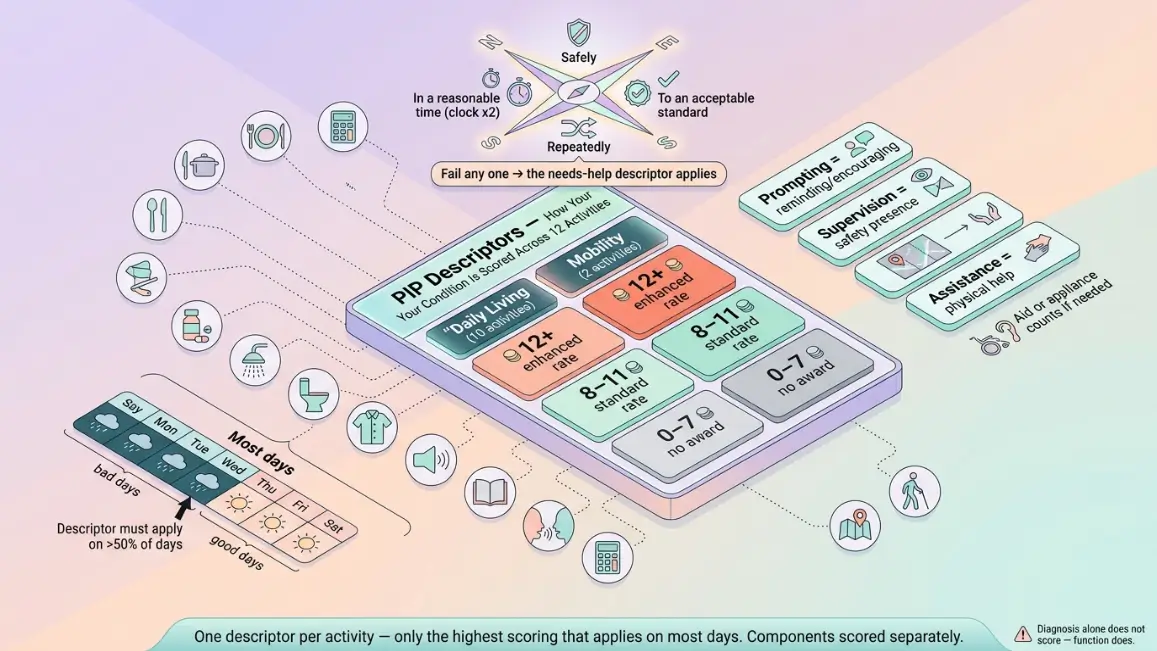
PIP descriptors are the standard statements used to score how your health condition or disability affects 12 daily living and mobility activities. Each descriptor has a points value, and your daily living and mobility totals decide whether you meet the standard or enhanced threshold for each PIP component.
1. What are PIP descriptors?
PIP descriptors are fixed scoring statements used in a
Personal Independence Payment assessment. They describe what you can do, what you cannot do, and what support you need for each PIP activity.
PIP descriptors do not score your diagnosis. They score the effect of your condition on specific tasks.
A health professional looks at your ability to complete daily living and mobility activities. A
DWP decision maker then decides which PIP descriptors apply and how many points you score.
| Term |
Meaning |
| PIP activity |
A task assessed under daily living or mobility. |
| PIP descriptor |
A statement that describes your ability or support needs for that activity. |
| Points |
The score attached to a descriptor. |
| Component |
One of the two PIP parts: daily living or mobility. |
What is a PIP descriptor in plain English?
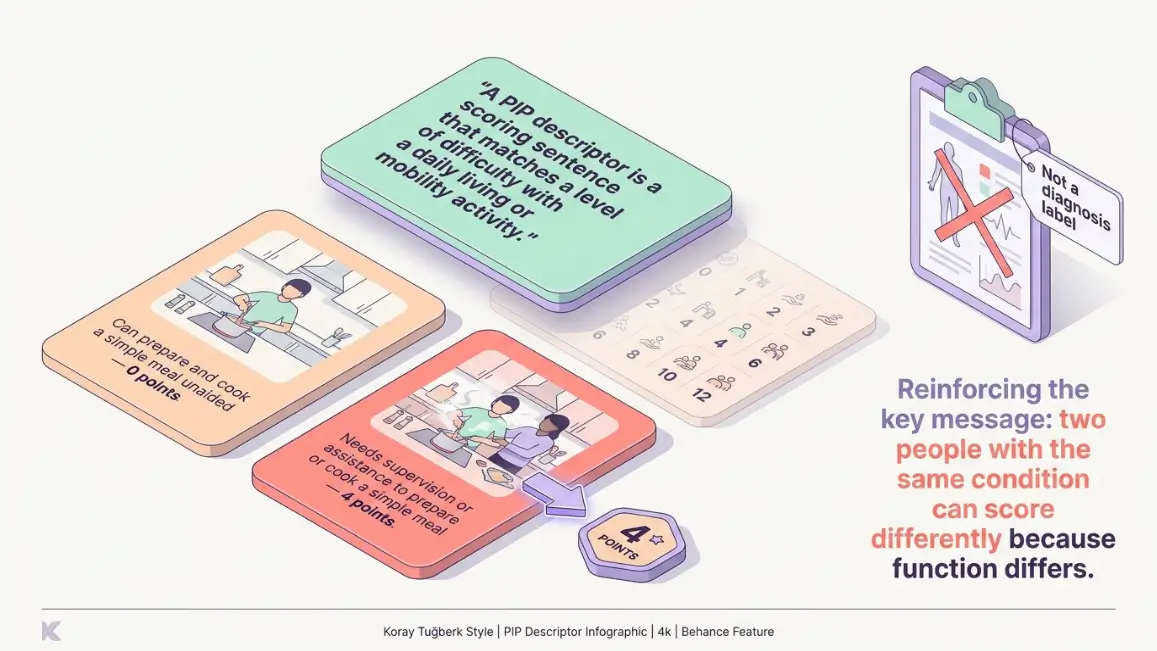
A PIP descriptor is a scoring sentence that matches a level of difficulty with a daily living or mobility activity.
For example, one preparing food descriptor says a person can prepare and cook a simple meal unaided. Another says the person needs supervision or assistance to prepare or cook a simple meal.
The descriptor matters because each one has a points value.
- A descriptor can score 0, 1, 2, 3, 4, 6, 8, 10 or 12 points.
- One activity can have several descriptors.
- You normally score one descriptor for each activity.
A PIP descriptor is not a medical label. A person with the same diagnosis as someone else can score different points because their daily function is different.
Are PIP descriptors current in 2026?
PIP descriptors remain the active scoring framework for PIP assessment in 2026, based on the current official and welfare-rights descriptor structure.
The current structure has
12 PIP activities. It has
10 daily living activities and
2 mobility activities.
There are
67 descriptors across the 12 activities. Daily living has
55 descriptors. Mobility has
12 descriptors.
A 2026 page should use current official or currently reviewed wording. Older PDFs can still appear in search results, but older tables can contain outdated wording or point errors. Where two sources disagree, current official guidance and currently reviewed welfare-rights material take priority.
PIP rules are also under review in 2026. The descriptor table should be checked again before any
claim, review or challenge deadline.
Do PIP descriptors apply across the UK?
PIP descriptors apply to PIP claims, but the department name and local benefit system can differ by UK nation.
England and Wales use DWP PIP materials. Northern Ireland has its own PIP handbook and department names. Scotland has devolved disability-benefit arrangements, so a person in Scotland should check whether their claim is PIP or a Scottish disability benefit before using a PIP-only source.
This page explains the PIP descriptor framework. It does not replace local advice for a live claim, review or dispute.
2. What are the 12 PIP activities and components?
The 12 PIP activities are the tasks used to score the daily living component and the mobility component.
Daily living points and mobility points are counted separately. A daily living score does not get added to a mobility score to create one total.
What are the 10 daily living activities?
The 10 daily living activities assess everyday tasks such as food, washing, dressing, communication, social engagement and budgeting.
| No. |
Official activity name |
Common wording |
What it assesses |
| 1 |
Preparing food |
Cooking or preparing a meal |
Preparing and cooking a simple meal. |
| 2 |
Taking nutrition |
Eating and drinking |
Cutting food, eating, drinking, chewing and swallowing. |
| 3 |
Managing therapy or monitoring a health condition |
Medication, treatment and health monitoring |
Taking medication, managing therapy, or monitoring health. |
| 4 |
Washing and bathing |
Washing, bathing or showering |
Washing the body and getting into or out of an unadapted bath or shower. |
| 5 |
Managing toilet needs or incontinence |
Toilet needs or incontinence |
Getting on/off the toilet, bladder and bowel needs, and cleaning afterwards. |
| 6 |
Dressing and undressing |
Getting dressed |
Putting on and taking off suitable clothing. |
| 7 |
Communicating verbally |
Speaking, hearing and understanding |
Expressing and understanding verbal information. |
| 8 |
Reading and understanding signs, symbols and words |
Reading written information |
Reading and understanding written or printed information. |
| 9 |
Engaging with other people face to face |
Mixing with others |
Interacting face to face, understanding body language and forming relationships. |
| 10 |
Making budgeting decisions |
Managing money |
Making simple or complex money decisions. |
Practitioner note: Claimants often use form wording such as “eating and drinking” or “mixing with others”. The official descriptor names are “Taking nutrition” and “Engaging with other people face to face”, so a wording map prevents missed activities.
What are the 2 mobility activities?
The 2 mobility activities assess going out and physical movement.
| No. |
Official activity name |
Common wording |
What it assesses |
| 1 |
Planning and following journeys |
Going out or planning a journey |
Planning a route, starting a journey, and following a route safely. |
| 2 |
Moving around |
Walking or moving about |
Standing and moving specific distances. |
The mobility component is separate from the daily living component. A person can score mobility points without scoring daily living points, or daily living points without scoring mobility points.
How do PIP Form questions map to official descriptor activity names?
PIP form questions often use simpler wording than the official PIP descriptor names.
Use this table when a form, letter or online guide uses different words.
| Common or form-style wording |
Official descriptor activity name |
Component |
Why the wording matters |
| Preparing food and cooking |
Preparing food |
Daily living |
The official activity tests preparing and cooking a simple meal. |
| Eating and drinking |
Taking nutrition |
Daily living |
The official activity is about taking food and drink into the body. |
| Managing treatments, medication or health |
Managing therapy or monitoring a health condition |
Daily living |
Medication, therapy and monitoring have different descriptor rules. |
| Washing, bathing or showering |
Washing and bathing |
Daily living |
The activity includes getting into or out of an unadapted bath or shower. |
| Toilet needs or incontinence |
Managing toilet needs or incontinence |
Daily living |
The activity separates toilet needs from incontinence support. |
| Getting dressed |
Dressing and undressing |
Daily living |
The activity includes dressing, undressing, socks and shoes. |
| Speaking, hearing and understanding |
Communicating verbally |
Daily living |
Anxiety about face-to-face contact usually belongs under Activity 9, not Activity 7. |
| Reading written information |
Reading and understanding signs, symbols and words |
Daily living |
The activity is about reading and understanding written or printed information. |
| Mixing with others |
Engaging with other people face to face |
Daily living |
The activity is about face-to-face social engagement. |
| Making decisions about money |
Making budgeting decisions |
Daily living |
The activity separates simple and complex budgeting decisions. |
| Going out or planning a journey |
Planning and following journeys |
Mobility |
The activity includes planning, starting and following a route. |
| Walking or moving about |
Moving around |
Mobility |
The activity is about standing and then moving set distances. |
3. What are the current PIP descriptors and points for each activity?
The current PIP descriptors and points cover all 12 PIP activities and assign one point value to each descriptor.
The tables below use official descriptor wording first. The plain-English column explains the meaning, but it does not replace the official wording.
How many points for preparing food?
Preparing food scores
0, 2, 4 or 8 points, depending on whether you can prepare and cook a simple meal reliably and what support you need.
A simple meal means a cooked one-course meal for one person using fresh ingredients. Cook means heating food at or above waist height.
| Descriptor |
Official descriptor wording |
Points |
Plain-English meaning |
Quick reliability prompt |
| A |
Can prepare and cook a simple meal unaided. |
0 |
You can prepare and cook a simple meal without help or aids. |
Can you do it safely, more than once if needed, and in a reasonable time? |
| B |
Needs to use an aid or appliance to be able to either prepare or cook a simple meal. |
2 |
You need equipment such as a perching stool or adapted chopping aid. |
Would the aid let you prepare or cook the meal reliably? |
| C |
Cannot cook a simple meal using a conventional cooker but is able to do so using a microwave. |
2 |
You cannot use a hob or conventional cooker safely, but can use a microwave. |
Is the problem with cooking, not just preference? |
| D |
Needs prompting to be able to either prepare or cook a simple meal. |
2 |
Someone must remind, encourage or explain so you prepare or cook. |
Is prompting needed on more than 50% of days? |
| E |
Needs supervision or assistance to either prepare or cook a simple meal. |
4 |
Someone must watch you for safety or physically help you. |
Are knives, hot pans, food safety or unsafe cooking a real issue? |
| F |
Cannot prepare and cook food. |
8 |
You cannot prepare and cook food even with the lower levels of support. |
Can you do either part reliably, even with help? |
Counts / does not count: Preparing food includes opening packaging, peeling, chopping, serving food onto a plate, and using a hob or microwave. Carrying food to where it will be eaten is not the core activity. Not knowing how to cook because you were never taught is not the same as functional inability.
How many points for taking nutrition?
Taking nutrition scores
0, 2, 4, 6 or 10 points, depending on whether you can eat and drink reliably and what support you need.
This activity is about eating and drinking. It is not about whether your diet is healthy.
| Descriptor |
Official descriptor wording |
Points |
Plain-English meaning |
Quick reliability prompt |
| A |
Can take nutrition unaided. |
0 |
You can eat and drink without help or aids. |
Can you cut, chew, swallow and drink reliably? |
| B |
Needs to use an aid or appliance to be able to take nutrition; or supervision to be able to take nutrition; or assistance to be able to cut up food. |
2 |
You need an aid, safety supervision, or help cutting food. |
Is there choking risk, tremor, grip difficulty or spilling? |
| C |
Needs a therapeutic source to be able to take nutrition. |
2 |
You use tube feeding or a similar therapeutic source without help. |
Can you manage the source yourself? |
| D |
Needs prompting to be able to take nutrition. |
4 |
Someone must remind, encourage or explain so you eat or drink. |
Do you forget or lack motivation to eat because of your condition? |
| E |
Needs assistance to be able to manage a therapeutic source to take nutrition. |
6 |
Someone physically helps you manage tube feeding or related equipment. |
What help is needed with the equipment? |
| F |
Cannot convey food and drink to their mouth and needs another person to do so. |
10 |
Someone else must bring food and drink to your mouth. |
Can you move food or drink to your mouth at all? |
Counts / does not count: Taking nutrition includes cutting food into pieces, taking food or drink to the mouth, chewing and swallowing. Preparing raw ingredients belongs under preparing food.
How many points for managing therapy, medication or monitoring a health condition?
Managing therapy or monitoring a health condition scores
0, 1, 2, 4, 6 or 8 points, depending on the support needed for medication, therapy or health monitoring.
Medication, therapy and monitoring are separate ideas. Medication means medicine taken at home. Therapy means non-medicine treatment at home. Monitoring means detecting significant changes in health and taking advised action.
| Descriptor |
Official descriptor wording |
Points |
Plain-English meaning |
Quick reliability prompt |
| A |
Either does not receive medication or therapy or need to monitor a health condition; or can manage medication or therapy or monitor a health condition unaided. |
0 |
You do not need this activity, or you can do it without help. |
Can you manage the task safely and on time? |
| B |
Needs any one or more of the following: to use an aid or appliance to be able to manage medication; supervision, prompting or assistance to be able to manage medication; supervision, prompting or assistance to be able to monitor a health condition. |
1 |
You need a medication aid, reminders, supervision, help, or support monitoring health. |
Do you need alarms, a dosette box, reminders or physical help? |
| C |
Needs supervision, prompting or assistance to be able to manage therapy that takes no more than 3.5 hours a week. |
2 |
You need support with therapy for up to 3.5 hours a week. |
Count the support time, not the whole day. |
| D |
Needs supervision, prompting or assistance to be able to manage therapy that takes more than 3.5 but no more than 7 hours a week. |
4 |
You need support with therapy for over 3.5 hours and up to 7 hours a week. |
Keep a weekly total. |
| E |
Needs supervision, prompting or assistance to be able to manage therapy that takes more than 7 but no more than 14 hours a week. |
6 |
You need support with therapy for over 7 hours and up to 14 hours a week. |
Record how many minutes are supported each time. |
| F |
Needs supervision, prompting or assistance to be able to manage therapy that takes more than 14 hours a week. |
8 |
You need support with therapy for more than 14 hours a week. |
The support must relate to managing therapy. |
Counts / does not count: A dosette box or alarm can be an aid for managing medication. Support for therapy is counted by the time another person supervises, prompts or assists you with the therapy. Older tables can show errors for this activity, so current sources take priority.
How many points for washing and bathing?
Washing and bathing scores
0, 2, 3, 4 or 8 points, depending on whether you can wash, bathe and get in or out of an unadapted bath or shower reliably.
Washing means cleaning the whole body. Bathing includes getting into or out of an unadapted bath or shower.
| Descriptor |
Official descriptor wording |
Points |
Plain-English meaning |
Quick reliability prompt |
| A |
Can wash and bathe unaided. |
0 |
You can wash and bathe without help or aids. |
Can you do it safely and in a reasonable time? |
| B |
Needs to use an aid or appliance to be able to wash or bathe. |
2 |
You need equipment such as a shower seat, grab rail or long-handled sponge. |
Is the aid needed, not just convenient? |
| C |
Needs supervision or prompting to be able to wash or bathe. |
2 |
Someone must watch you for safety or remind/encourage you. |
Is there a fall risk, distress, memory issue or motivation issue? |
| D |
Needs assistance to be able to wash either their hair or body below the waist. |
2 |
Someone physically helps with hair or the body below the waist. |
Can you reach and clean those areas properly? |
| E |
Needs assistance to be able to get in or out of a bath or shower. |
3 |
Someone physically helps you get into or out of a bath or shower. |
Can you enter and leave an unadapted bath or shower safely? |
| F |
Needs assistance to be able to wash their body between the shoulders and waist. |
4 |
Someone physically helps wash the upper body area between shoulders and waist. |
Is the help needed for that body area? |
| G |
Cannot wash and bathe at all and needs another person to wash their entire body. |
8 |
Someone else must wash your whole body. |
Can any part be done reliably by you? |
Counts / does not count: Shaving and drying yourself are not the core washing and bathing activity. A wet room is not an unadapted shower, but needing one can show difficulty with an unadapted bath or shower.
How many points for managing toilet needs or incontinence?
Managing toilet needs or incontinence scores
0, 2, 4, 6 or 8 points, depending on the aid, prompting, supervision or assistance needed.
Toilet needs means getting on and off an unadapted toilet, evacuating the bladder and bowel, and cleaning yourself afterwards.
| Descriptor |
Official descriptor wording |
Points |
Plain-English meaning |
Quick reliability prompt |
| A |
Can manage toilet needs or incontinence unaided. |
0 |
You can manage toilet needs or incontinence without help or aids. |
Can you do all parts safely and cleanly? |
| B |
Needs to use an aid or appliance to be able to manage toilet needs or incontinence. |
2 |
You need an aid such as a commode, raised seat, pads or stoma equipment. |
Is the aid needed for toilet needs or incontinence? |
| C |
Needs supervision or prompting to be able to manage toilet needs. |
2 |
Someone must watch for safety or remind/explain. |
Is prompting or supervision needed on most days? |
| D |
Needs assistance to be able to manage toilet needs. |
4 |
Someone physically helps with getting on/off, evacuating or cleaning. |
Which part needs physical help? |
| E |
Needs assistance to be able to manage incontinence of either bladder or bowel. |
6 |
Someone physically helps manage bladder or bowel incontinence. |
Is the support for bladder or bowel incontinence? |
| F |
Needs assistance to be able to manage incontinence of both bladder and bowel. |
8 |
Someone physically helps manage both bladder and bowel incontinence. |
Does the need apply to both? |
Counts / does not count: Managing clothing is not the same as toilet needs. Walking to the toilet is not the same as toilet needs. Mobility problems may be considered under moving around unless the toilet or incontinence activity itself is affected.
How many points for dressing and undressing?
Dressing and undressing scores
0, 2, 4 or 8 points, depending on the aid, prompting or assistance needed.
Dressing and undressing includes putting on and taking off socks and shoes.
| Descriptor |
Official descriptor wording |
Points |
Plain-English meaning |
Quick reliability prompt |
| A |
Can dress and undress unaided. |
0 |
You can dress and undress without help or aids. |
Can you do it to an acceptable standard and in time? |
| B |
Needs to use an aid or appliance to be able to dress or undress. |
2 |
You need an aid such as a sock aid or button hook. |
Is the aid needed for dressing, not just easier? |
| C |
Needs either prompting to be able to dress, undress or determine appropriate circumstances for remaining clothed; or prompting or assistance to be able to select appropriate clothing. |
2 |
Someone must remind, encourage, explain or help choose suitable clothing. |
Do you need help choosing clothes for weather, time or situation? |
| D |
Needs assistance to be able to dress or undress their lower body. |
2 |
Someone physically helps with lower-body clothing. |
Can you manage trousers, underwear, socks or shoes? |
| E |
Needs assistance to be able to dress or undress their upper body. |
4 |
Someone physically helps with upper-body clothing. |
Can you manage shirts, jumpers, bras or fastenings? |
| F |
Cannot dress or undress at all. |
8 |
You cannot dress or undress and need another person to do it. |
Can you do any part reliably? |
Counts / does not count: The activity looks at functional ability, not fashion choice. It includes stretching, reaching, bending, gripping and selecting appropriate clothing where relevant.
How many points for communicating verbally?
Communicating verbally scores
0, 2, 4, 8 or 12 points, depending on whether you can express and understand verbal information.
This activity is about speech, hearing and understanding verbal information. Anxiety about face-to-face contact usually belongs under engaging with other people face to face.
| Descriptor |
Official descriptor wording |
Points |
Plain-English meaning |
Quick reliability prompt |
| A |
Can express and understand verbal information unaided. |
0 |
You can speak, hear and understand verbal information without help or aids. |
Can another person understand you, and can you understand them? |
| B |
Needs to use an aid or appliance to be able to speak or hear. |
2 |
You need an aid such as a hearing aid or speech device. |
Does the aid let you communicate reliably? |
| C |
Needs communication support to be able to express or understand complex verbal information. |
4 |
You need trained or experienced support for longer or complicated speech. |
Can you manage simple verbal information without that support? |
| D |
Needs communication support to be able to express or understand basic verbal information. |
8 |
You need support even for simple verbal information. |
Can you understand or express a simple sentence? |
| E |
Cannot express or understand verbal information at all even with communication support. |
12 |
Communication support does not make verbal communication possible. |
Can any verbal information be exchanged reliably? |
Counts / does not count: Basic verbal information is a simple sentence. Complex verbal information is more than one sentence or one complicated sentence. Communication support can include someone trained or experienced in communicating with your needs.
How many points for reading and understanding signs, symbols and words?
Reading and understanding signs, symbols and words scores
0, 2, 4 or 8 points, depending on whether you can read and understand written or printed information.
This activity is about reading in your native language. Braille does not count as reading for this PIP activity.
| Descriptor |
Official descriptor wording |
Points |
Plain-English meaning |
Quick reliability prompt |
| A |
Can read and understand basic and complex written information either unaided or using spectacles or contact lenses. |
0 |
You can read and understand written information with no aid beyond glasses or contact lenses. |
Can you read both simple and longer information? |
| B |
Needs to use an aid or appliance, other than spectacles or contact lenses, to be able to read or understand either basic or complex written information. |
2 |
You need another aid, such as magnification equipment. |
Is the aid needed indoors, outdoors or both? |
| C |
Needs prompting to be able to read or understand complex written information. |
2 |
Someone must remind, encourage or explain longer written information. |
Can you read but not understand longer information without prompting? |
| D |
Needs prompting to be able to read or understand basic written information. |
4 |
Someone must help you understand simple signs, symbols or dates. |
Can you understand basic signs without help? |
| E |
Cannot read or understand signs, symbols or words at all. |
8 |
You cannot read or understand written information at all. |
Is this due to a health condition or impairment? |
Counts / does not count: Basic written information includes signs, symbols and dates. Complex written information means more than one sentence of standard-size text. Illiteracy alone is not the same as a health-condition-related reading impairment.
How many points for engaging with other people face to face?
Engaging with other people face to face scores
0, 2, 4 or 8 points, depending on the prompting or social support needed.
This activity is often called “mixing with others”. It is about face-to-face interaction, understanding body language and establishing relationships.
| Descriptor |
Official descriptor wording |
Points |
Plain-English meaning |
Quick reliability prompt |
| A |
Can engage with other people unaided. |
0 |
You can interact face to face without help. |
Can you engage with people beyond close family or familiar professionals? |
| B |
Needs prompting to be able to engage with other people. |
2 |
Someone must remind, encourage, reassure or explain. |
Is simple prompting enough? |
| C |
Needs social support to be able to engage with other people. |
4 |
You need support from someone trained or experienced in helping you engage socially. |
Does the support need skill or direct experience of your needs? |
| D |
Cannot engage with other people due to such engagement causing either overwhelming psychological distress to the claimant; or the claimant to exhibit behaviour which would result in a substantial risk of harm to the claimant or another person. |
8 |
Face-to-face engagement causes severe distress or serious behaviour risk despite lower support. |
Would prompting or social support overcome the problem? |
Counts / does not count: Preference to avoid people is not enough. The difficulty must come from an impairment. Social support can be professional support or support from someone directly experienced in helping you engage.
How many points for making budgeting decisions?
Making budgeting decisions scores
0, 2, 4 or 6 points, depending on whether you can make complex or simple budgeting decisions.
This activity is about functional ability to handle money decisions. It is not general debt advice or money-saving advice.
| Descriptor |
Official descriptor wording |
Points |
Plain-English meaning |
Quick reliability prompt |
| A |
Can manage complex budgeting decisions unaided. |
0 |
You can make complex money decisions without help. |
Can you manage bills, budgets and future costs? |
| B |
Needs prompting or assistance to be able to make complex budgeting decisions. |
2 |
You need reminders, explanation or help with complex budgeting. |
Can you manage simple money choices but not bills or planning? |
| C |
Needs prompting or assistance to be able to make simple budgeting decisions. |
4 |
You need reminders, explanation or help with basic purchases and change. |
Can you work out cost and change? |
| D |
Cannot make any budgeting decisions at all. |
6 |
You cannot make simple or complex budgeting decisions. |
Can you make any money decision reliably? |
| Type of budgeting decision |
Meaning |
| Simple budgeting decision |
Calculating the cost of goods and the change required after a purchase. |
| Complex budgeting decision |
Calculating household or personal budgets, managing and paying bills, and planning future purchases. |
How many points for planning and following journeys?
Planning and following journeys scores
0, 4, 8, 10 or 12 points, depending on whether you can plan, start and follow journeys reliably.
This activity is about going out, route planning and following a route. It covers mental, cognitive, sensory and orientation-related barriers.
| Descriptor |
Official descriptor wording |
Points |
Plain-English meaning |
Quick reliability prompt |
| A |
Can plan and follow the route of a journey unaided. |
0 |
You can plan and follow journeys without help, prompting, an assistance dog or orientation aid. |
Can you plan, start and follow the route safely? |
| B |
Needs prompting to be able to undertake any journey to avoid overwhelming psychological distress to the claimant. |
4 |
Someone must encourage or reassure you to start any journey. |
Do you need prompting for every journey on most days? |
| C |
Cannot plan the route of a journey. |
8 |
You cannot work out a route in advance. |
Can you use simple route information, maps, apps or timetables? |
| D |
Cannot follow the route of an unfamiliar journey without another person, assistance dog or orientation aid. |
10 |
You need support to follow an unfamiliar route. |
Is the problem with following the route, not only planning it? |
| E |
Cannot undertake any journey because it would cause overwhelming psychological distress to the claimant. |
10 |
You cannot start any journey on most days because distress is overwhelming. |
Can you complete even one journey that day? |
| F |
Cannot follow the route of a familiar journey without another person, an assistance dog or an orientation aid. |
12 |
You need support even on familiar routes. |
Do you need support for familiar journeys on most days? |
| Journey term |
Meaning |
| Any journey |
Every journey on that day. If one journey is possible, this term may not be met for that day. |
| Unfamiliar journey |
A route you do not normally know. |
| Familiar journey |
A route you already know. |
| Orientation aid |
A specialist aid designed to help a disabled person follow a route safely. |
Counts / does not count: Ordinary mobile-phone satnav is not the same as a specialist orientation aid. Needing another person by preference is not enough. The need must come from the impairment and the reliability of the journey.
How many points for moving around?
Moving around scores
0, 4, 8, 10 or 12 points, depending on how far you can stand and then move reliably.
This activity is about physical movement. It considers pain, breathlessness, fatigue, falls, speed, gait and repeatability.
| Descriptor |
Official descriptor wording |
Points |
Plain-English meaning |
Quick reliability prompt |
| A |
Can stand and then move more than 200 metres, either aided or unaided. |
0 |
You can stand and move over 200 metres reliably. |
Can you repeat it without unsafe pain, fatigue or falls? |
| B |
Can stand and then move more than 50 metres but no more than 200 metres, either aided or unaided. |
4 |
You can stand and move over 50 metres but not over 200 metres. |
Can you do that distance repeatedly and in time? |
| C |
Can stand and then move unaided more than 20 metres but no more than 50 metres. |
8 |
Without an aid, you can move over 20 metres but not over 50 metres. |
Does unaided movement meet all reliability tests? |
| D |
Can stand and then move using an aid or appliance more than 20 metres but no more than 50 metres. |
10 |
With an aid, you can move over 20 metres but not over 50 metres. |
What aid is used and what distance is reliable? |
| E |
Can stand and then move more than 1 metre but no more than 20 metres, either aided or unaided. |
12 |
You can move over 1 metre but not over 20 metres. |
Can you repeat 20 metres safely and without severe discomfort? |
| F |
Cannot, either aided or unaided, stand; or move more than 1 metre. |
12 |
You cannot stand, or cannot move more than 1 metre. |
Can you stand and move while remaining standing? |
| Distance band |
Descriptor outcome |
| More than 200 metres |
0 points |
| More than 50 metres but no more than 200 metres |
4 points |
| More than 20 metres but no more than 50 metres, unaided |
8 points |
| More than 20 metres but no more than 50 metres, using an aid or appliance |
10 points |
| More than 1 metre but no more than 20 metres |
12 points |
| Cannot stand or cannot move more than 1 metre |
12 points |
Counts / does not count: “Stand and then move” means standing and moving while still standing. Standing and then transferring into a wheelchair is not standing and moving that distance. The activity is judged on surfaces normally expected outdoors, such as flat pavements and kerbs.
4. How does the DWP choose which PIP descriptor applies?
The DWP chooses the PIP descriptor that best describes your ability to complete each activity under the reliability and most-days rules.
The health professional considers evidence and functional ability. The decision maker then decides which points apply.
How do you choose the right PIP descriptor?
You choose the right PIP descriptor by matching your real functional ability to the activity, then applying the reliability and more-than-50%-of-days rules.
Use these steps:
- Choose the activity.
Match the problem to the correct PIP activity, not just the form wording.
- Check the more-than-50%-of-days rule.
Ask whether the descriptor describes what happens on most days.
- Apply the four reliability tests.
Ask whether you can do the activity safely, to an acceptable standard, repeatedly and within a reasonable time period.
- Choose the highest-scoring descriptor that applies.
If more than one descriptor applies on most days, use the highest-scoring one.
- Add points separately for each component.
Total daily living points separately from mobility points.
Practitioner note: Claimants often say they “can” do an activity. The deciding detail is often whether they can do it safely, repeatedly, to an acceptable standard and within the required time.
Can you score more than one descriptor in the same activity?
No, you score one descriptor in the same activity.
You do not add several descriptors from one activity together. If two descriptors sound partly true, the chosen descriptor is the one that applies under the scoring rules.
Example: In washing and bathing, a person may need an aid and also need help getting into a shower. Those points are not added together. The applicable descriptor with the correct highest score is chosen for that activity.
If two PIP descriptors apply, which one is chosen?
If two PIP descriptors apply on more than 50% of days, the highest-scoring applicable descriptor is chosen.
The rule protects people whose needs overlap. It also stops double counting within one activity.
Example: A person needs prompting to prepare food on most days and needs supervision on most days because they leave pans unattended. The supervision descriptor scores higher than prompting, so the supervision descriptor is the better match if it applies reliably.
How many points do you need for standard or enhanced PIP?
You need
8–11 points for the standard rate of a component and
12 or more points for the enhanced rate of a component.
| Component |
Standard rate threshold |
Enhanced rate threshold |
| Daily living component |
8–11 points |
12 or more points |
| Mobility component |
8–11 points |
12 or more points |
This page explains point thresholds. It does not cover weekly payment amounts, payment dates or
back pay.
Are daily living and mobility points added together?
No, daily living and mobility points are not added together.
Daily living points decide the daily living component. Mobility points decide the mobility component.
| Component subtotal |
Add these activities |
| Daily living total |
Activities 1 to 10 |
| Mobility total |
Mobility Activities 1 and 2 |
Example: A person can score 10 daily living points and 4 mobility points. That means daily living is assessed against the daily living threshold, and mobility is assessed against the mobility threshold. The total is not treated as 14 combined points.
5. What does “reliably” mean for PIP descriptors?
Reliably means you can complete the activity safely, to an acceptable standard, repeatedly and within a reasonable time period.
A descriptor does not apply just because you can do something once. The way you complete it matters.
What are the four PIP reliability tests?
The four PIP reliability tests are safely, to an acceptable standard, repeatedly and within a reasonable time period.
| Reliability test |
Meaning |
Question to ask yourself |
Example |
| Safely |
You are unlikely to harm yourself or another person during or after the activity. |
Is there a real safety risk linked to your condition? |
Burning yourself while cooking. |
| To an acceptable standard |
The result is good enough for the activity. |
Is the task completed properly enough? |
Food is cooked through, not unsafe to eat. |
| Repeatedly |
You can do it as often as reasonably required. |
Can you do it again when needed? |
Preparing lunch after making breakfast. |
| Within a reasonable time period |
You take no more than twice as long as a person without the relevant condition. |
Does the task take more than twice the usual time? |
Taking two hours to wash and dress. |
Reliability applies to every activity. It affects physical, mental, cognitive and sensory difficulties.
What does “safely” mean in PIP descriptors?
Safely means the activity is unlikely to cause harm to you or another person during or after completion.
Safety looks at both likelihood and severity. A rare but severe risk can still matter. A minor risk usually needs to happen more often before it changes the descriptor.
Examples include:
- cutting or burning yourself while preparing food
- choking while taking nutrition
- falling while bathing or moving around
- getting lost or entering danger during a journey
- taking medication incorrectly because of memory or cognitive issues
A normal everyday risk is not enough by itself. The risk must be higher because of your health condition or impairment.
What does “repeatedly” mean in PIP descriptors?
Repeatedly means you can do the activity as often as it is reasonably required.
A person may complete a task once but be unable to repeat it when needed. That can change the PIP descriptor.
Example: A person can prepare breakfast, but the effort leaves them unable to prepare lunch. If preparing another meal by lunchtime is reasonably required, the breakfast alone does not prove they can prepare food repeatedly.
Pain, fatigue, breathlessness, nausea and anxiety can all affect repeatability.
What does “reasonable time period” mean for PIP?
Reasonable time period means the activity takes no more than twice as long as it would normally take a person without the relevant condition.
A task can look possible but still fail this test. If washing, dressing or preparing food takes far longer because of symptoms, rituals, fatigue or pain, the activity may not be completed within a reasonable time period.
How do fluctuating conditions affect PIP descriptors?
Fluctuating conditions affect PIP descriptors through the more-than-50%-of-days rule.
The descriptor should describe what applies on the majority of days in the relevant period. It should not be based only on your best days or only on your worst days.
| Pattern |
Likely scoring effect |
| You need prompting to wash on 4 days out of 7 and wash unaided on 3 days out of 7. |
The prompting descriptor is likely to be considered because it applies on more than 50% of days. |
| You can move 50 metres on 3 days out of 7, but only 20 metres on 4 days out of 7. |
The shorter reliable distance is likely to matter more. |
| You need different types of help on different days, and scoring descriptors together apply on most days. |
The descriptor that applies for the highest proportion of days is considered. If equal, the higher-scoring descriptor can matter. |
Keep a simple weekly record if your condition changes. Record what happened, what help was needed, and whether the activity was safe, repeatable, acceptable and timely.
6. What do key PIP descriptor terms mean?
Key PIP descriptor terms define the support, aids and activity limits used to decide points.
Small wording differences matter. Prompting, supervision and assistance do not mean the same thing.
What is the difference between prompting, supervision and assistance?
Prompting, supervision and assistance are different types of support from another person.
| Term |
Meaning |
Counts as |
Does not count as |
| Prompting |
Reminding, encouraging or explaining by another person. |
Reminding someone to wash, eat or take medication. |
Physically helping them complete the task. |
| Supervision |
Continuous presence of another person for safety. |
Staying present while someone cooks because of fire risk. |
Checking in after the task is done. |
| Assistance |
Physical intervention by another person. |
Helping someone wash, dress, cut food or get into a shower. |
Verbal reassurance alone. |
Prompting can be needed for only part of an activity. Supervision must be needed for safety during the activity. Assistance involves physical help.
What counts as an aid or appliance?
An aid or appliance counts if it improves, provides or replaces an impaired physical or mental function and is needed to complete the activity reliably.
An aid can be specialist equipment or an everyday item used because of an impairment.
| Aid or appliance |
Activity example |
Why it can matter |
| Perching stool |
Preparing food |
Helps a person cook when standing is limited. |
| Spiked chopping board |
Preparing food |
Helps with chopping when grip or dexterity is impaired. |
| Dosette box |
Managing medication |
Helps organise medication reliably. |
| Alarm or reminder |
Managing medication |
Helps a person remember medication. |
| Grab rail |
Washing, bathing or toilet needs |
Helps with balance or transfers. |
| Shower seat |
Washing and bathing |
Helps a person wash when standing is unreliable. |
| Raised toilet seat |
Toilet needs |
Helps a person get on or off the toilet. |
| Sock aid |
Dressing and undressing |
Helps put on socks. |
| Hearing aid |
Communicating verbally |
Helps a person hear verbal information. |
| Walking stick |
Moving around |
Helps a person stand and move. |
Aids must be needed, not merely preferred. A person can also be assessed as needing a reasonable aid even if they do not currently use it.
What do journey terms such as assistance dog and orientation aid mean?
Journey terms explain what support counts for planning and following journeys.
| Term |
Meaning |
| Assistance dog |
A dog trained to guide or assist a person with sensory impairment. |
| Orientation aid |
A specialist aid designed to help a disabled person follow a route safely. |
| Another person |
A person whose support is needed to follow the route reliably. |
| Familiar journey |
A journey along a route the person already knows. |
| Unfamiliar journey |
A journey along a route the person does not normally know. |
| Any journey |
Every journey on that day for descriptors that use “any journey”. |
Ordinary mobile-phone satnav is not the same as a specialist orientation aid. A route list, map or standard navigation app should not be treated as a specialist orientation aid.
What do activity-specific terms like simple meal, therapeutic source and toilet needs mean?
Activity-specific terms set the boundaries for the PIP descriptors.
| Term |
Meaning |
Activity |
| Simple meal |
A cooked one-course meal for one person using fresh ingredients. |
Preparing food |
| Prepare |
Make food ready for cooking or eating. |
Preparing food |
| Cook |
Heat food at or above waist height. |
Preparing food |
| Taking nutrition |
Cutting food, taking food and drink to the mouth, chewing, swallowing, or using a therapeutic source. |
Taking nutrition |
| Therapeutic source |
Parenteral or enteral tube feeding using a rate-limiting device such as a delivery system or feed pump. |
Taking nutrition |
| Medication |
Medication taken at home and prescribed or recommended by a relevant professional. |
Managing therapy or monitoring health |
| Therapy |
Prescribed or recommended therapy undertaken at home, excluding medication and health monitoring. |
Managing therapy or monitoring health |
| Toilet needs |
Getting on and off an unadapted toilet, evacuating bladder and bowel, and cleaning afterwards. |
Toilet needs or incontinence |
| Simple budgeting decisions |
Calculating the cost of goods and change after a purchase. |
Making budgeting decisions |
| Complex budgeting decisions |
Household and personal budgets, bills, and planning future purchases. |
Making budgeting decisions |
7. How should you match your difficulties to PIP descriptors accurately?
You should match your difficulties to PIP descriptors by recording what happens, how often it happens, what support you need and which reliability test is affected.
The aim is accuracy. The descriptor must reflect real functional difficulty.
What should you write in notes beside a PIP descriptor?
You should write notes that show the activity, the descriptor, the frequency, the support needed, the reliability issue and the evidence.
Blank notes such as “I struggle” are weak. Specific notes are stronger.
| Field |
What to write |
| Activity |
The official activity name, such as “Preparing food”. |
| Descriptor you think applies |
The descriptor letter or wording. |
| Points |
The points attached to that descriptor. |
| What happens |
A short factual description of the difficulty. |
| How often it happens |
How many days per week or month it applies. |
| Help, prompting, supervision or aids needed |
The exact support needed. |
| Reliability issue |
Safety, acceptable standard, repeatability or time. |
| Evidence or example |
A recent example, supporting document or person who knows the difficulty. |
Practitioner note: Blank note boxes often produce vague notes. Useful notes record what happened, how often, what help was needed, what risk existed and what evidence supports the account.
Example note:
| Field |
Example |
| Activity |
Preparing food |
| Descriptor |
Needs supervision or assistance |
| Points |
4 |
| What happens |
I lose track of pans and leave heat on. |
| Frequency |
5 days a week |
| Support |
My partner stays in the kitchen when I cook. |
| Reliability issue |
Safety and acceptable standard |
| Evidence |
Two recent burnt pans and partner’s statement |
Does needing help count if nobody currently helps you?
Yes, needing help can count even if nobody currently helps you.
PIP descriptors look at the support you need to complete an activity reliably. They do not only look at the support you receive.
Example: A person may need supervision to cook safely, but live alone and therefore avoid cooking. The issue is whether supervision is needed for reliable cooking, not whether someone is available.
Can an aid count if you do not currently use it?
Yes, an aid can count if it is reasonable to expect you to use it and it would help you complete the activity reliably.
The key issue is need. The aid must be linked to the impaired function.
Use this short check:
| Question |
Why it matters |
| Is the aid medically or practically reasonable? |
Unreasonable aids should not be assumed. |
| Is the aid available or commonly available? |
Access and cost can matter. |
| Can you use and store it? |
An aid does not help if you cannot use it safely. |
| Would it remove the need for another person? |
This can change the descriptor. |
| Is the aid needed, not just preferred? |
Preference does not usually score. |
What mistakes should you avoid when using PIP descriptors?
You should avoid using PIP descriptors in a way that ignores official wording, reliability or evidence.
Common mistakes include:
- Adding several descriptors in one activity.
You score one descriptor per activity.
- Describing only a diagnosis.
A diagnosis does not show which PIP descriptor applies. Describe the functional impact.
- Ignoring reliability.
“I can do it” is incomplete if the task is unsafe, too slow, not repeatable or not done to an acceptable standard.
- Using an outdated table.
Older PDFs can rank in search results. Use current official or currently reviewed descriptor wording.
- Writing vague notes.
“I struggle with washing” is weaker than “I need prompting to wash on 5 days a week because I do not start the task without reminders.”
- Copying sample answers.
PIP descriptors must match your real limitations. Copied wording can be inaccurate and can damage credibility.
- Confusing common wording with official activity names.
“Mixing with others” means “Engaging with other people face to face”. “Eating and drinking” means “Taking nutrition”.
Honest tradeoff: A descriptor table can help you estimate points, but it does not guarantee an award. The decision depends on the descriptor wording, the reliability rules, the more-than-50%-of-days rule and the evidence.
8. What should you do if your expected descriptors do not match the DWP decision?
You should compare the DWP decision against the descriptor wording, points, reliability rules, frequency rule and evidence.
Keep this step narrow. Descriptor checking is not the same as a full appeal guide.
Use this 3-step check:
- Compare the activity.
Check whether the decision used the right activity and descriptor.
- Compare the reliability facts.
Check whether the decision considered safety, acceptable standard, repeatability and time.
- Compare the evidence.
Check whether the decision reflects the form, assessment report and supporting evidence.
If you are considering a challenge, get advice from a qualified welfare-rights adviser or suitable advice service.
Mandatory Reconsideration and tribunal appeals need a separate guide because they involve deadlines, evidence rules and procedure.
9. FAQs about PIP descriptors and points
Can you score more than one PIP descriptor in one activity?
No. You score one descriptor for each PIP activity. If more than one descriptor seems to apply, the highest-scoring descriptor that applies under the reliability and most-days rules is the one used for that activity.
What does “most days” mean for PIP descriptors?
“Most days” means more than 50% of days in the relevant assessment period. If your condition fluctuates, the descriptor should reflect what applies on the majority of days, not only your best days or worst days.
Are daily living and mobility points added together?
No. Daily living points and mobility points are totalled separately. Daily living points decide the daily living component, and mobility points decide the mobility component. Each component has its own standard and enhanced thresholds.
Does needing help count if nobody actually helps me?
Yes, the descriptor test looks at the help you need to complete the activity reliably, not only the help you currently receive. If you need prompting, supervision, assistance or an aid to complete an activity reliably, that need can matter.
Does a walking stick count as an aid for PIP?
A walking stick can count as an aid or appliance if it helps you stand and move reliably. For moving around, the points depend on the distance you can stand and move, whether you use an aid, and whether you can do it reliably.
Are PIP descriptors different in Northern Ireland?
Northern Ireland has its own PIP handbook and department names, but the descriptor framework is closely aligned with the PIP assessment structure. A UK-wide descriptor page should still include a jurisdiction note so readers know which source applies to them.
Related PIP guides