You claim PIP
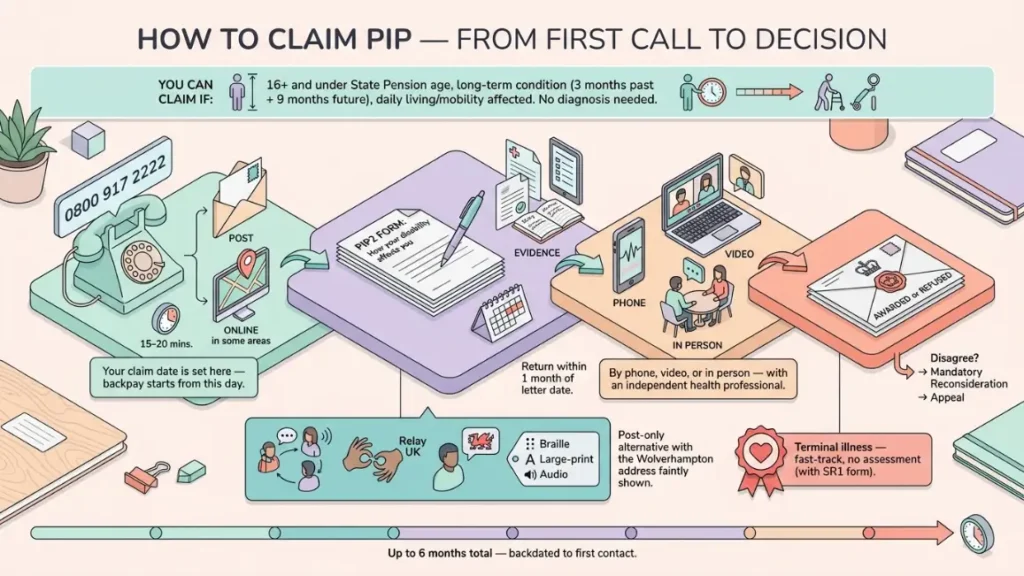
Personal Independence Payment (PIP) by phoning the Department for Work and Pensions (DWP) on the PIP new claims line (
0800 917 2222) to start your claim, then completing the PIP2 form, “How your disability affects you,” and returning it within one month of the date on the letter. You can also start by post, or online in some areas. If you are not sure whether you qualify first, see our guide to what PIP is and who it’s for.
Who can claim PIP?
You can claim PIP if you are aged 16 or over, under State Pension age, and have a long-term physical or mental health condition that affects your daily living or how you get around. PIP is not means-tested, so your income, savings and National Insurance contributions do not affect whether you qualify — you can claim while working, claiming other benefits, or owning a home.
You meet the basic test for PIP if all of these apply:
- You are at least 16 years old and under State Pension age.
- You have a long-term physical or mental health condition or disability.
- You have had difficulty with daily living, getting around, or both, for the past 3 months.
- You expect that difficulty to continue for at least the next 9 months.
You do not need a formal diagnosis to claim. PIP looks at how your condition affects you, not the name of the condition. Some guidance describes the timescale as a single 12-month test rather than 3 months back and 9 months forward; both mean the same thing — your difficulties must be long-term, not short-lived. State Pension age changes over time, so check your own State Pension age before assuming you are too old to claim.
How do you claim PIP?
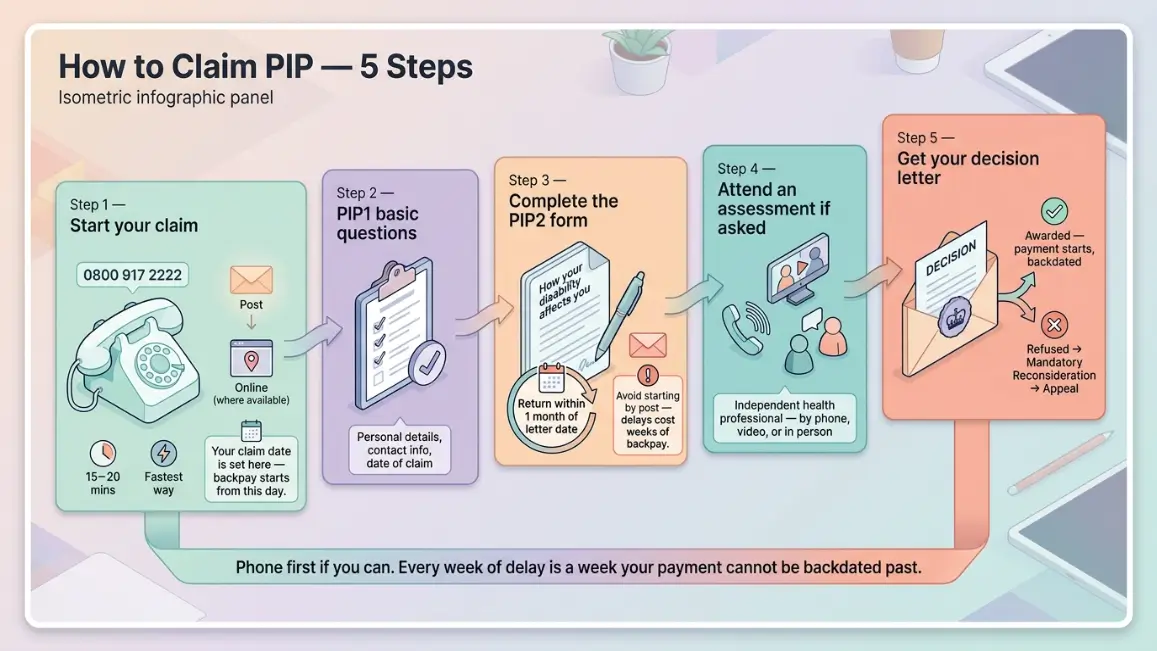
You claim PIP by contacting the DWP to start your claim, completing the forms they send you, and attending an assessment if one is needed. Phoning is the fastest way to start.
- Start your claim. Call the PIP new claims phone line. You can also start by post, or online if your postcode is covered.
- Answer the basic questions (PIP1). The DWP asks for your personal and contact details and sets your date of claim.
- Complete the PIP2 form. The DWP sends you the form “How your disability affects you.” Fill it in and return it within one month of the date printed on the letter.
- Attend an assessment if asked. An independent health professional may ask you about your daily life by phone, video call or in person — see what to expect in our PIP assessment guide.
- Get your decision letter. The DWP writes to tell you if you have been awarded PIP, how much, and for how long. If you disagree, you can request a Mandatory Reconsideration and appeal.
Avoid starting your claim by post if you can manage a call. Claimants report that postal requests can sit unopened for weeks, and every week of delay is a week your payment cannot be backdated past.
What number do you call to claim PIP?
You call the PIP new claims phone line on
0800 917 2222 to start a new claim. The line is open Monday to Friday, and calls are free from landlines and mobiles.
| Contact route |
Details |
| PIP new claims line |
0800 917 2222 |
| Textphone |
0800 917 7777 |
| Relay UK (if you cannot hear or speak on the phone) |
18001 then 0800 917 2222 |
| British Sign Language |
BSL video relay service |
| Calling from abroad |
+44 191 218 7766 |
| Opening hours |
Monday to Friday, 8am to 5pm |
The call usually takes around 15 to 20 minutes. Official sources give slightly different lengths, so allow 20 minutes to be safe. If you already have a PIP claim and need to ask about it, that is a different number from the new claims line — use the existing-claim enquiry line (0800 121 4433) for questions about a claim you have already started.
Can you claim PIP online?
You can claim PIP online in some areas of Great Britain, but it is not available everywhere. When you start an online application, the service checks your postcode to see if you are covered. Online claims are not available in Northern Ireland.
There are two separate things people mean by “online.” The first is starting your whole claim online, which is postcode-restricted. The second is completing the PIP2 form online after you have started by phone — if you start by phone, the DWP can email you a link to fill in the PIP2 online, and text you a security code to open it.
Some claimants report that even when the online checker says their area is not covered, they can ask the adviser during the call to email them the online form link, and the adviser agrees. This is claimant-reported and not stated as official policy, so treat it as worth asking about rather than a guaranteed option.
How do you get or request a PIP Form?
You get a PIP form by starting your claim with the DWP. The DWP issues the form to you directly after you make contact by phone or post. You cannot pick one up or order a blank one in advance.
To request a form by post, write a letter saying you want to claim PIP, and include your name and address. Send it to:
Personal Independence Payment New Claims, Post Handling Site B, Wolverhampton, WV99 1AH
You do not need a stamp or a postcode on the envelope. After the DWP receives your request, the form usually arrives within 2 weeks. If your form does not arrive within the expected time, phone the PIP new claims line again to chase it. In one documented case a claimant waited three months with no form despite repeated requests; if chasing the line does not work, ask your local MP to help move it along.
Can you download or print a blank PIP form?
No, you cannot download or print a blank PIP claim form. The PIP2 form, “How your disability affects you,” is personalised to you and issued by the DWP only after you start your claim. Stocks of blank forms are not available to order, and any website offering a “printable PIP form” is not giving you the real claim form the DWP will accept. Start your claim by phone or post, and the correct personalised form will be sent to you.
What evidence should you send with your PIP claim?
Send
copies, never originals, of any evidence that shows how your condition affects you — GP or consultant letters, prescription lists, care plans, and a daily diary of your tasks. Evidence that describes your
functional impact (what you cannot do safely, reliably or repeatedly) is far more valuable than evidence that only confirms a diagnosis. The PIP2 form maps to the 12 activities used to score your claim, so it helps to frame your answers around those activities — see how scoring works in our
PIP Points System guide, and estimate your likely score with our
calculators/pip-points-
calculator PIP points calculator.
How long does it take to claim PIP?
Claiming PIP can take up to 6 months from your first contact with the DWP to your decision letter. Individual stages are much shorter, but waits between stages add up.
| Stage |
Typical time |
| Phone call to start your claim |
15 to 20 minutes |
| PIP2 form arrives |
Within 2 weeks |
| You return the PIP2 form |
Within 1 month of the letter date |
| Assessment appointment |
About 1 hour |
| Decision letter after assessment |
Around 6 weeks |
| Whole process, start to finish |
Up to 6 months |
These timeframes are typical, not guaranteed, and delays are common. Your claim starts on the date you first contact the DWP, and any payment you are awarded is backdated to that date. PIP is not backdated to before you claimed, so starting sooner protects your money. To estimate any arrears you may be owed, use our
PIP back pay calculator, and see how PIP back payments work.
Claiming PIP with a terminal illness
If you are nearing the end of life, PIP is fast-tracked under special rules. There is no qualifying period and no assessment, and you automatically receive the enhanced daily living component. To use the fast-track, call the PIP new claims line and ask your doctor or consultant to send the DWP an
SR1 form. You may also receive the mobility component depending on your needs.
What if you need help or can’t use the phone?
You can claim PIP even if you cannot face phoning. Phone anxiety is one of the most common reasons people delay claiming, and the DWP offers several alternatives so you do not have to call alone.
- Someone calls with you. A friend, family member or support worker can join the call. You must be present to give permission for them to speak.
- Someone calls for you. An appointee or a person with power of attorney can act on your behalf, and you do not have to be present.
- Claim by post. Write to the new claims address instead of phoning.
- Relay UK and BSL video relay. Use these if you cannot hear or speak on the phone, or if you use British Sign Language.
- Welsh speaker. You can ask for the call to continue in Welsh.
- Accessible formats. Ask on the call for the form in braille, large print or audio.
A common approach for claimants with anxiety is to have a trusted person start the call and complete the identity check, then hand the phone over once the hardest part is done. You can also ask the DWP about a home visit if you cannot manage a call at all.
Where do you live? Claiming PIP in England, Wales, Scotland and Northern Ireland
How you claim PIP depends on where you live. England and Wales use the same DWP route. Northern Ireland runs its own service, and Scotland has replaced PIP with a different benefit.
| Where you live |
Who runs it |
How to start |
Key contact |
| England and Wales |
DWP |
Phone, post, or online (some areas) |
0800 917 2222 |
| Wales |
DWP |
Same as England; you can ask for a Welsh speaker |
0800 917 2222 |
| Northern Ireland |
Department for Communities (PIP Centre) |
Phone or post |
0800 012 1573 (textphone 0800 587 0937), Mon–Fri 9am–4pm |
| Scotland |
Social Security Scotland |
Apply for Adult Disability Payment (ADP) instead |
Not PIP |
If you live in Northern Ireland, claim through the PIP Centre rather than the DWP. The correct postal address for Northern Ireland should be taken from the current official source, as more than one address is in circulation and using the wrong one can delay your claim.
Frequently asked questions
Do you need a diagnosis to claim PIP?
No. PIP is based on how your condition affects your daily living and mobility, not on a specific diagnosis. You can claim without a formal diagnosis, though medical evidence showing how you are affected will support your claim.
Why do they ask for your GP’s details if you rarely see a doctor?
They ask whether you have a GP, not whether you attend. Having little or no contact with your GP does not stop your claim. Many claimants are in the same position, so you do not need to worry about this question.
Can someone else claim PIP for you?
Yes. Someone can call on your behalf, but you must be present to give permission. An appointee or a person with power of attorney can act for you, and in that case you do not need to be present during the call.
When does your PIP claim officially start?
Your claim starts on the date you first contact the DWP. If you are awarded PIP, your payment is backdated to that date. PIP cannot be backdated to before you made contact, so the earlier you start, the better.
What happens after you send back the PIP2 form?
After you return the form, the DWP reviews it and may invite you to an assessment with an independent health professional, by phone, video call or in person, with a decision letter following afterwards. See our PIP assessment guide for what they ask.
What happens if my PIP claim is refused?
If you are refused or under-awarded, you can challenge the decision — request a Mandatory Reconsideration within one month of the decision letter, and if that is unsuccessful, appeal to an independent tribunal. Around two-thirds of appeals that reach a tribunal succeed; see our PIP appeal and tribunal guide.
Can you get the PIP form in another format?
Yes. You can ask the DWP during your phone call for the form in braille, large print or audio. Tell them what you need at the start, so the form arrives in a format you can read and complete.
Related PIP guides