
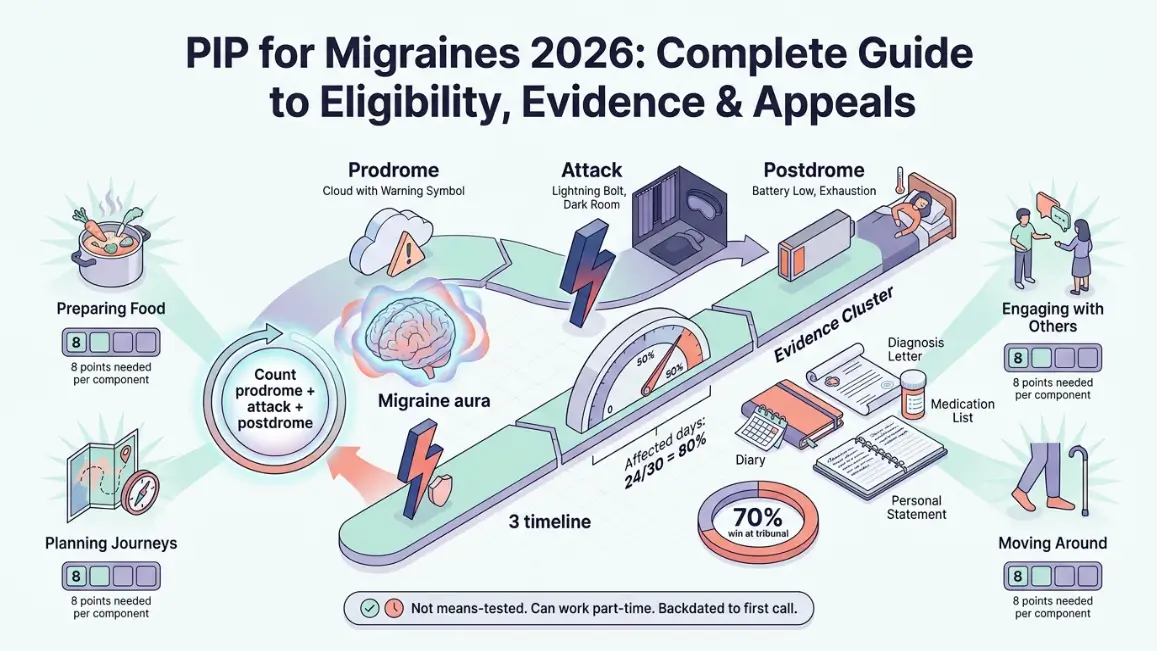
Personal Independence Payment (PIP) is a UK benefit for migraine sufferers when attacks prevent you from carrying out daily activities on more than half the days. PIP does not depend on your diagnosis – it depends on how your migraines affect your ability to cook, engage with others, plan journeys, and move around safely. This guide covers the points system, evidence, application steps, and what to do if refused.
Can You Get PIP for Migraines? – Eligibility Threshold Explained
Yes, you can get PIP for migraines. PIP has no list of qualifying conditions. The test is always the same: do your migraines stop you from doing everyday tasks safely, to an acceptable standard, repeatedly, and in a reasonable time, on more than half the days each month?
The DWP awards points for two components: daily living (12 activities) and mobility (2 activities). You need 8 points in either component to receive PIP. For migraines, the most common activities that score points are preparing food, engaging with people, planning journeys, and moving around. We explain these in detail in the next section.
How to count affected days
This is where most claims fail. You must count not just the day of the migraine attack, but also the prodrome (warning phase, often 1 day before) and the postdrome (recovery phase, often 1 day after). For example, a person with 8 migraine days per month may actually be affected for 24 days when you add prodrome and postdrome. That is 80% of the month – well over the 50% threshold.
Chronic vs episodic
If you have 15 or more headache days per month with at least 8 migraine days, you have chronic migraine. Chronic migraine almost always qualifies because the frequency alone meets the majority-of-days test. If you have episodic migraine (fewer than 15 headache days), you can still qualify if the full cycle (prodrome + attack + postdrome) pushes you past the 50% mark. For instance, 6 migraine days per month with 1-day prodrome and 1-day postdrome gives 18 affected days – still over 50%.
Proposed benefit changes
The government has announced plans to change PIP Eligibility. These proposals are still under consultation and are unlikely to take effect before 2027. As of June 2026, the rules above remain in force. For the latest updates, see our PIP review changes page.
Red‑flag checklist
Before you apply, check these signs that your claim might be weak. If you recognise any, address them in your application:
-
You have fewer than 3 migraine days per month and no aura, drop attacks, or severe postdrome.
-
You drive yourself during attacks.
-
You have no migraine diary covering at least 4 weeks.
-
You can cook, wash, and leave the house without assistance on most days, even during the postdrome.
-
Your GP has not diagnosed migraine or has not referred you to a neurologist.
If any of these apply, you can still claim – but you must gather stronger evidence and explain your limitations carefully.
For the full general eligibility criteria and the points system, refer to our PIP eligibility guide and our PIP points system page. Here, we focus on migraine-specific details.
How Do Migraine Symptoms Map to PIP Activities?
Migraine symptoms affect four PIP activities most strongly. The table below shows which migraine subtypes typically score points on each activity.
| PIP Activity | Migraine subtype | How it affects you | Sample descriptor level |
|---|---|---|---|
| Preparing food (Activity 1) | Chronic, vestibular, hemiplegic | Light, smell, and nausea make the kitchen impossible; you cannot stand at a cooker safely. | 4–8 points (needs supervision or cannot cook) |
| Engaging with people (Activity 9) | All types, especially with aura | Bright lights, loud noise, and social pressure trigger attacks; you cancel plans unpredictably and isolate. | 4 points (needs social support) |
| Planning journeys (Activity 11) | Vestibular, hemiplegic, aura | Public transport triggers attacks; visual aura makes driving unsafe; you cannot guarantee completing any journey. | 4–8 points (cannot follow journeys) |
| Moving around (Activity 12) | Vestibular, hemiplegic | Vertigo, drop attacks, or temporary weakness stop you from walking safely. | 4–8 points (cannot move around safely) |
How the reliability criteria work
The DWP tests whether you can do each activity safely, to an acceptable standard, repeatedly, and in a reasonable time. For example:
-
Safely: If you have drop attacks, standing at a cooker is unsafe. That counts as unable to prepare food.
-
Repeatedly: If you need to lie down for 2 hours after taking a triptan, you cannot cook three meals in a day – that means you cannot repeat the activity.
-
Acceptable standard: If you can only make a microwave meal because you cannot chop or stand, that is not an acceptable standard for most people.
-
Reasonable time: If you take 30 minutes to walk to the shop but would normally take 10, that fails the time test.
Specific migraine subtypes
Your diagnosis matters only as evidence. The DWP does not award points for the diagnosis itself. However, certain subtypes give you stronger arguments:
-
Hemiplegic migraine – causes stroke-like weakness. You can argue safety risks for cooking, dressing, and walking.
-
Vestibular migraine – causes vertigo. This directly affects mobility (Activity 12) and journey planning (Activity 11).
-
Menstrual migraine – occurs only around your period. If it is pure menstrual (5–7 days per month), you will rarely meet the majority-of-days test. But if you also have non-menstrual attacks, combine them to reach 15+ headache days.
For the full list of all 12 daily living and 2 mobility activities, see our PIP descriptors page. We focus here only on the ones most relevant to migraine.
What Evidence Do You Need for a Migraine PIP Claim?
You need four core pieces of evidence. Without these, your claim will likely fail.
-
A migraine diary – record at least 4 weeks of data. Include date, severity (1–10), duration of attack, prodrome and postdrome times, triggers, medications taken, and specifically which activities you could not do. This diary proves frequency and functional impact.
-
A formal diagnosis letter – from your GP or neurologist. The letter should state your migraine type (e.g., chronic migraine with aura) and any treatments you have tried (e.g., Botox, CGRP injections).
-
Medication records – list all your preventatives (propranolol, topiramate, amitriptyline, candesartan) and acute treatments (triptans, anti-sickness). Include dates and dosages. If you have Botox every 12 weeks or monthly CGRP injections, include those appointment records.
-
A personal statement – describe in your own words how migraines affect your daily life. Use the full-cycle counting method. Focus on the majority of days, not your best days.
Extra evidence – a statement from your partner, carer, or family member can strengthen your case. They can describe how they have to help you during attacks (e.g., take over cooking, drive you to appointments). If you have a care plan from your neurologist, include that too.
How to use a migraine app – you can use apps like Migraine Buddy. Export a summary report for the DWP. The summary must show the same information as a paper diary: dates, severity, duration, and activities missed. The DWP accepts digital evidence as long as it is legible and covers at least 4 weeks.
We provide a ready-to-use migraine diary template in the Migraine Diary Templates section below.
What Are Your Chances of Getting PIP for Migraines?
Your chances depend heavily on your specific symptoms and the quality of your evidence. Many migraine claims are initially refused – but a significant proportion succeed at the Mandatory Reconsideration or tribunal stage.
Realistic outcomes – the DWP initially awards points in about 40% of migraine claims, according to anecdotal data from benefits advisers. However, among those who appeal to tribunal, around 70% win some award. That means persistence pays off.
Enhanced vs standard rate – if you score 8–11 points in a component, you get the standard rate. If you score 12 points or more, you get the enhanced rate. The rates for 2026 are: daily living standard £72.65 per week, enhanced £108.55; mobility standard £28.70, enhanced £75.75. (These figures are correct as of April 2026.) For current rates, see our PIP rates 2026 page.
Why many claims are refused – assessors often dismiss migraines with phrases like “migraines are common” or “most people manage.” They may also ignore your prodrome and postdrome days, counting only the attack day. That is why you must explicitly state your full-cycle count in your application.
Honest trade-off – the process can feel dehumanising. Many applicants report that assessors twist their words. You will need emotional resilience. But if you have strong evidence and you are willing to appeal, your chances improve significantly.
Real examples – we have seen applicants with 6–8 migraine days per month succeed after they documented the full cycle and showed that they could not cook, engage, or travel safely on those days. We have also seen applicants with 15+ chronic migraine days receive the enhanced rate on both components. The common factor in all successful claims is a detailed diary and a clear personal statement.
How Do You Apply for PIP with Migraines? – Step‑by‑Step Process
The application process has three main steps. For a complete, detailed walkthrough, see our How to claim PIP guide. Here we give the essential steps with migraine-specific advice.
Step 1: Call the PIP claim line – dial 0800 917 2222. Have your National Insurance number, date of birth, bank details, and your GP’s name and address ready. Say: “I would like to request a PIP claim pack for my migraine condition.” The agent will send you the PIP2 form by post. You can also apply online, but the paper form gives you more room to explain your limitations. The claim is backdated to the date of this call.
Step 2: Complete the PIP2 form – you have 1 month from the date you receive the form to return it. Do not fill it in on a good day. Fill it in on a typical day when your migraines affect you. For each activity, answer how you are on the majority of days, not your best day. Use the full-cycle count (prodrome + attack + postdrome). For example, if you have 8 attacks per month, write: “Counting the warning day, the attack day, and the recovery day, I am affected on 24 days per month. On those days, I cannot cook, I cannot engage with people, and I cannot plan journeys.”
Step 3: Submit your form and attend the health assessment – post the form within 1 month. The DWP will then invite you to a health assessment, either by phone, video call, or in person. During the assessment, describe your worst typical day. Do not minimise your symptoms. If you have a migraine diary, take it with you or send it beforehand.
Phone script for the initial call – if you are anxious, say: “I have chronic migraines and I would like to claim PIP. Could you please send me the PIP2 form? My National Insurance number is [number].” The agent will ask for your details – have them ready. Do not let them talk you into a phone application if you prefer paper.
Timeline – from your first call to the initial decision typically takes 8–12 weeks. If you appeal to MR and then tribunal, the total process can take 12–18 months. Your award, if granted, is backdated to your first call.
What If You Are Refused PIP? – Mandatory Reconsideration and Tribunal
If the DWP gives you 0 points, you do not have to accept that decision. You have two formal appeal stages.
Mandatory Reconsideration (MR)
You have 1 month from the date of the decision letter to request MR. Write to the DWP and ask them to review their decision. Include a rebuttal table that addresses each reason they gave for refusal. For example:
| Assessor’s statement | Your rebuttal |
|---|---|
| “You can cook a simple meal.” | “On most days, I cannot stand at the cooker because of nausea and light sensitivity. I only use a microwave, and even then I need my partner to serve me.” |
| “Migraines are common and most people manage.” | “Chronic migraine is a neurological condition recognised by NICE as significantly disabling. My diary shows 24 affected days per month – this is not ‘common’ in the sense of being manageable.” |
You can also request MR online or by phone. The DWP has 6 weeks to respond. If they still refuse, you can go to tribunal.
Tribunal
You have 1 month from the MR decision to appeal to an independent tribunal. Submit your appeal online or by post. At the tribunal, a judge and two assessors will review your case. You can attend in person or by video. Bring all your evidence – diary, medical letters, and any supporting statements.
Tribunal success rate – in 2025, around 70% of appeals for neurological conditions were successful at tribunal. That means the odds are in your favour if you have strong evidence and you present it clearly.
Sample MR letter template – we have prepared a full template that you can adapt. It includes a header, your details, the decision date, a table of rebuttals, and a closing request for reconsideration. You can download it from our PIP appeal tribunal page, which also covers the full appeals process in detail.
Tips for tribunal – write a personal statement that tells your story in chronological order. Describe how your migraines have changed over time. Include statements from people who help you. Be honest about your worst days and your average days. The tribunal judges are independent – they will listen.
How Does PIP Interact with Other Benefits and Work?
PIP and work – you can work and claim PIP. PIP is not means-tested. Your employment status, savings, or your partner’s income do not affect your PIP award. However, if you work, you must still show that your migraines affect your daily activities on the majority of days. Working part-time does not disqualify you.
PIP and Universal Credit (UC) – you can claim PIP alongside UC. If you have Limited Capability for Work (LCW) or Limited Capability for Work-Related Activity (LCWRA), you may receive an extra amount in your UC payment. However, LCWRA is assessed separately – getting PIP does not automatically give you LCWRA. You must apply for UC and go through a separate Work Capability Assessment.
PIP and ESA – you can also claim PIP with Employment Support Allowance (ESA) if you meet ESA’s rules. ESA is based on National Insurance contributions, not means-tested.
Passported benefits – if you receive PIP daily living component, you automatically qualify for free NHS prescriptions. You may also get help with travel costs for NHS appointments and with housing costs through your local council.
Important – PIP does not affect your entitlement to other benefits such as Carer’s Allowance, but it can affect the amount your carer receives. For specific interactions, see our Can you work and claim PIP page, which explains all the rules in detail.
Migraine Diary Templates and Sample Answers to Save Time
Migraine diary template – copy the table below into a notebook or spreadsheet. For each day, fill in one row. Keep this diary for at least 4 weeks before you send your PIP2 form.
| Date | Severity (1‑10) | Prodrome (hours) | Attack (hours) | Postdrome (hours) | Activities you could not do | Triggers | Medication taken |
|---|---|---|---|---|---|---|---|
| 01/06/2026 | 8 | 4 | 6 | 12 | Cooking, driving, working | Bright lights | Sumatriptan 50mg |
| 02/06/2026 | 3 | 0 | 0 | 12 | None (postdrome only) | – | – |
How to tally – at the end of 4 weeks, add up the days where you could not do each activity. For example, if you could not cook on 14 days out of 28, that is 50% – but remember to include the prodrome and postdrome days as affected days. Write a summary statement: “Over the last 4 weeks, I was unable to prepare food on 18 days, unable to engage with people on 15 days, and unable to plan journeys on 12 days.”
Sample answers for the PIP2 form – here are strong examples for three activities.
Activity 1 (Preparing food) – strong answer
“On the majority of days, I cannot cook a simple meal. During the prodrome, I feel nauseous and sensitive to light – standing at the cooker is unsafe. During the attack, I am in a dark room. During the postdrome, I am exhausted and cannot concentrate. Counting all three phases, I am affected on 24 days per month. On those days, my partner cooks for me or I only eat cold food. I cannot cook safely, to an acceptable standard, or repeatedly.”
Activity 9 (Engaging with people) – strong answer
“On most days, I cannot engage with people without support. Bright lights and loud noise trigger my migraines, so I avoid shops, public transport, and social events. I cancel plans at the last minute because attacks are unpredictable. When I do speak to people, I often have brain fog and cannot find words. I need my partner to handle phone calls or explain my condition to others. I cannot engage reliably or to an acceptable standard.”
Activity 11 (Planning journeys) – strong answer
“I cannot plan or follow journeys on the majority of days. My visual aura makes driving unsafe – I have been told by the DVLA not to drive. Public transport exposes me to bright lights, motion, and loud noises, which trigger attacks. Even walking to the local shop is unpredictable because a sudden drop attack could occur. I cannot guarantee that I will reach my destination safely, repeatedly, or in a reasonable time.”
Personalise these – change the exact numbers, triggers, and tasks to match your own experience. Do not copy them word for word – use them as a guide.
Frequently Asked Questions About PIP and Migraines
How do I write a personal statement for the PIP2 form?
Focus on the majority of days, describe your worst typical day, count the full cycle (prodrome + attack + postdrome), and always use the reliability criteria – safety, acceptable standard, repeated, reasonable time.
Can I claim PIP if I am still working part‑time?
Yes – PIP is not means‑tested and is based on your functional limitations, not employment status. Working part‑time does not disqualify you, but you must show you cannot do activities reliably on most days.
How long does the whole PIP process take from first call to final decision?
From first call to initial decision: 8–12 weeks. If you appeal to MR and then tribunal, total time can be 12–18 months. Awards are backdated to your first call.
What if my GP is not supportive – can I still claim?
Yes – a neurologist letter is stronger, but you can also use a migraine diary, pharmacy records, and a personal statement. If your GP refuses, ask for a printout of your medical notes.
Can I use a migraine app (e.g., Migraine Buddy) as evidence?
Yes – export a summary report showing dates, severity, and activities missed. The DWP accepts digital evidence as long as it is legible and covers at least 4 weeks.
What is the difference between PIP and DLA?
DLA is for children and those who started claiming before 2013. PIP replaced DLA for working‑age adults (16–64). If you are over 64, you may apply for Attendance Allowance instead.