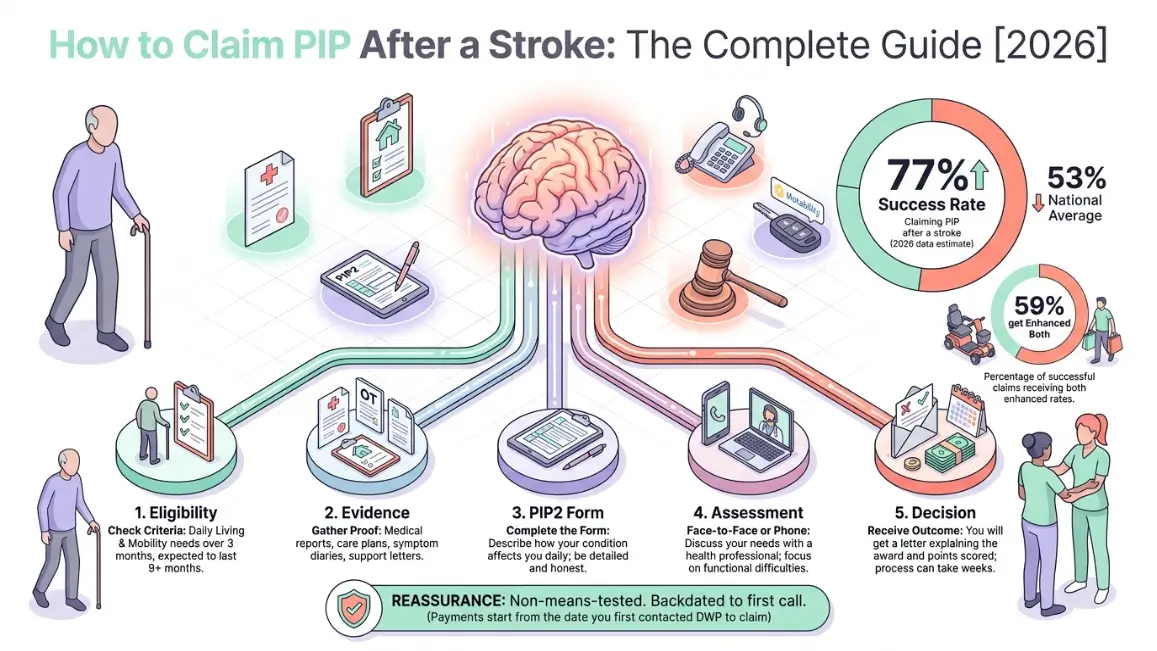
You can PIP claim Personal Independence Payment (PIP) after a stroke if you are aged 16 to State Pension age, your stroke has caused daily living or mobility difficulties for at least 3 months, and those difficulties are expected to last at least another 9 months. PIP is not awarded for the diagnosis alone — it is based on how your stroke affects your ability to carry out specific everyday activities. The claim process starts with a free phone call to the DWP.
Am I eligible for PIP after a stroke?
Yes — most people who have lasting difficulties from a stroke can claim PIP, but not everyone qualifies automatically. Eligibility depends on four conditions. You must satisfy all of them.
The four eligibility conditions:
-
Age: You are 16 or over and under State Pension age when you first claim. If you reach State Pension age, you cannot make a new PIP claim — apply for Attendance Allowance instead. If you already get PIP before State Pension age, it can continue.
-
Residence: You live in England, Wales, or Northern Ireland. Scotland replaced PIP with Adult Disability Payment (ADP); the rules are very similar, but the claim process differs.
-
Long‑term condition: The difficulties your stroke causes have already lasted 3 months and are expected to last at least another 9 months — a total of 12 months. This is the “required period condition.”
-
Functional impact: Your stroke affects your ability to carry out daily living tasks (like washing or preparing food) or mobility tasks (like walking or planning a journey). The DWP measures this with a points system; a diagnosis alone is not enough.
In 2023, 74,596 people in the UK had PIP awards where stroke was their main disabling condition. The success rate for stroke PIP claims is 77%, compared with an overall PIP success rate of 53%. 59% of those awarded PIP for stroke receive the enhanced rate of both the daily living and mobility components.
A mini‑stroke (transient ischaemic attack, or TIA) is treated the same way as a full stroke for PIP purposes. If your symptoms lasted less than 24 hours but you have ongoing difficulties — like fatigue, cognitive problems, or subtle weakness — you can still qualify. The key is whether you have functional problems that meet the 12‑month test, not the size of the stroke.
How do I claim PIP after a stroke?
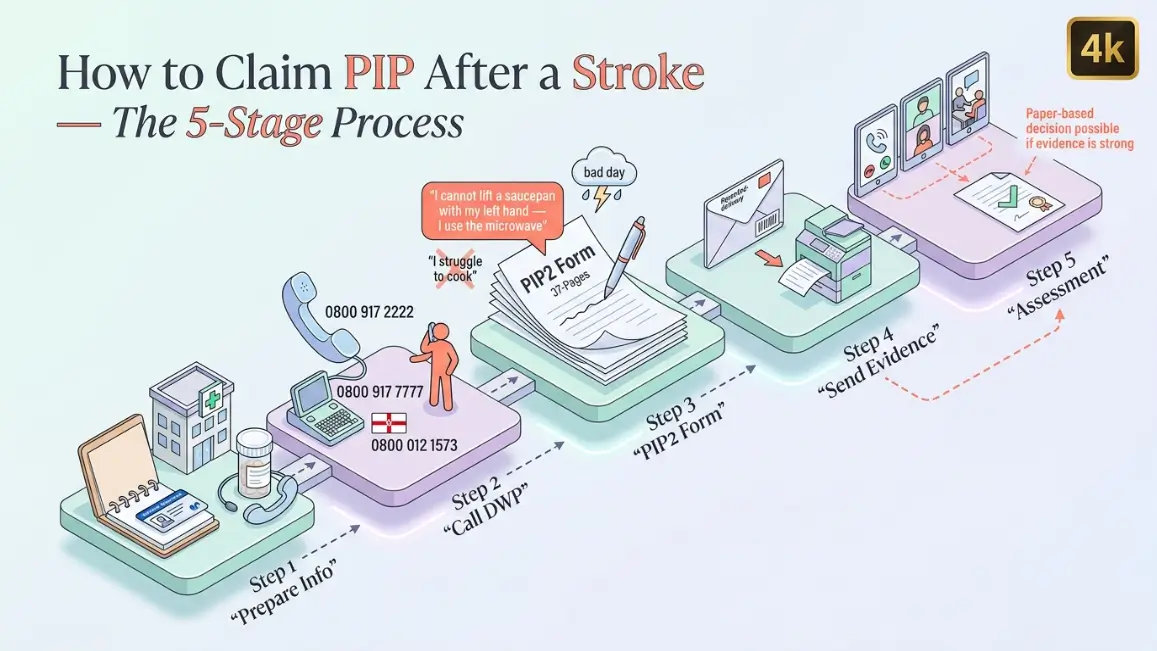
Claiming PIP is a five‑stage process. At each stage, you must describe exactly how your stroke affects you, not just that you had one.
Step 1: Get the information you need before you call.
Have your National Insurance number, your GP’s name and address, a list of your medications, and contact details for any specialists or therapists you see.
Step 2: Contact the DWP to start your claim.
Call the PIP new claims helpline on 0800 917 2222 (textphone 0800 917 7777). If you live in Northern Ireland, call 0800 012 1573. You can also request a paper form by writing to: Personal Independence Payment New Claims, Freepost DWP PIP 1 — but this is slower. The phone call takes about 20 minutes. A friend, family member, or carer can speak for you if you have communication difficulties.
Step 3: Complete the PIP2 form — “How your disability affects you.”
After the call, the DWP sends a 37‑page PIP2 form. This is your main chance to explain how your stroke limits you. You need to fill in the form for each daily living and mobility activity. Describe what happens on a typical bad day, not only on your best day. Write in plain English, but be specific: “I cannot lift a full saucepan with my left hand because of weakness, so I use the microwave to heat ready meals” scores points. “I struggle to cook” does not.
Step 4: Send the form back with your evidence.
Attach copies of all the supporting documents you have gathered. Send everything by recorded delivery so you have proof of posting. Keep a photocopy of the entire form and all evidence for your own records — you will need it if you later appeal.
Step 5: Wait for an assessment appointment.
The DWP will write to tell you if you need an assessment. This is usually a phone, video, or face‑to‑face meeting with a health professional. Not everyone needs one — if your written evidence is strong and clearly shows you meet the points threshold, you might get a paper‑based decision.
What evidence do I need to support my PIP claim for stroke?
Evidence is what turns a description of your difficulties into a provable case. Without it, the DWP often makes a decision based on a short assessment alone. The right evidence makes refusal far less likely.
Stroke‑specific evidence: the most important documents
| Evidence | Why it matters | How to get it |
|---|---|---|
| Hospital discharge summary | Lists your diagnosis, stroke type, and initial impairments. It is the earliest official record of your condition. | Request from the hospital’s medical records department; you have a legal right to a copy. |
| Occupational therapist (OT) home assessment | Describes exactly how you manage daily tasks at home — washing, dressing, kitchen safety. This directly mirrors PIP Descriptors. | Ask your local authority adult social services or your stroke team for a copy. |
| Speech and language therapist (SALT) report | Documents any aphasia, communication difficulties, or swallowing problems. Critical for the communicating and eating descriptors. | Request from your NHS speech therapy service. |
| Physiotherapy notes | Show mobility limitations, walking distance, balance problems, and falls risk. | Ask your physiotherapist for a summary letter. |
| GP or consultant letter | Provides a medical overview, prognosis, and lists ongoing symptoms like fatigue, cognitive impairment, and medication side effects. | Book an appointment and explain it’s for a PIP claim; GPs can charge a small fee for letters. |
| Prescription list | Demonstrates ongoing treatment and can imply condition severity. | Print from your NHS app or ask your GP reception. |
| Carer or family statement | Describes what you need help with day to day, including prompting and supervision. | Written by the person helping you; should include real examples and be dated and signed. |
| Brain scan results (CT/MRI) | Provides objective evidence of brain damage. | Ask your hospital for a copy of the report; you may be charged a small fee for the disc. |
How to document good days and bad days
Stroke symptoms often fluctuate. You might manage a task one day and be completely unable the next. The PIP assessment must consider your worst days, but you need to prove they happen. Keep a simple diary for one week. Each day, note:
-
What tasks you attempted (e.g., made a sandwich, showered, walked to the car).
-
What help you needed (physical help, reminders, supervision, or aids).
-
How long it took compared to before your stroke.
-
Any symptoms that stopped you (fatigue, pain, dizziness, confusion).
-
Whether you felt safe.
If you cannot write the diary yourself, a carer can do it for you. Attach the diary to your PIP2 form. It shows the assessor the pattern of your difficulties, not a single snapshot.
How does the PIP assessment work for stroke survivors?
The PIP assessment is not a medical examination. It is a conversation with a health professional who is trained to score your abilities against fixed descriptors. You earn points for each activity based on how much help you need.
The points system at a glance
There are 10 daily living activities and 2 mobility activities. Each activity has a set of descriptors — statements like “needs prompting to be able to prepare a simple meal” — and each descriptor is worth a set number of points. You need at least 8 points in the daily living group to get the standard rate, or 12 for the enhanced rate. The same thresholds apply to the mobility group.
The reliability rule applies to every activity: you must be able to do the task safely, repeatedly, to an acceptable standard, and in no more than twice the time it would take a person without a disability. If you can walk 50 metres but then need a two‑hour rest, you do not meet the reliability standard for moving around.
Stroke‑specific assessment tips
-
Describe your worst day. Start every answer with your most difficult day. You can add “on a better day I might manage a little more, but on a bad day this is what happens.” Assessors are trained to consider variability only if you actively explain it.
-
Don’t hide the help you use. If you use a walking stick, a grab rail, a raised toilet seat, or a perching stool, say so. Aids count as evidence that you cannot do the task unaided.
-
Talk about fatigue and hidden symptoms directly. Say “After preparing a meal I am so exhausted I cannot do anything else for hours” rather than just “I get tired.” Stroke fatigue is real and must be scored.
-
Bring someone with you. A family member or carer can describe what they see. This is especially valuable if you have aphasia or cognitive issues and struggle to express yourself.
-
Request the assessor’s report. After the assessment, you can ask the DWP for a copy of the PA4 or PA5 report — the assessor’s notes and scores. Phone the DWP and request it. This shows you what the assessor recorded and lets you spot errors before the decision arrives.
Many claimants assume the assessor will understand what a stroke means. In practice, assessors often know little about neurological conditions. You must connect your symptoms to the specific descriptors yourself.
How much PIP can I get after a stroke, and how is it paid?
PIP is made up of two components. You can get one or both, depending on your points score.
| Component | Standard weekly rate | Enhanced weekly rate |
|---|---|---|
| Daily Living | £76.70 | £114.60 |
| Mobility | £30.30 | £80.00 |
From April 2026, a person awarded enhanced rates for both components receives £194.60 per week.
PIP is paid directly into your bank account every 4 weeks in arrears. The first payment is backdated to the date of your initial phone call, so you do not lose money even if the decision takes months.
If you receive the enhanced mobility rate, you can use it to access the Motability scheme and lease a car, scooter, or powered wheelchair. PIP is tax‑free and is paid on top of most other benefits, including Employment and Support Allowance and Universal Credit. It can also increase your entitlement to means‑tested benefits and trigger additional support like a severe disability premium.
Can I claim PIP while in hospital, a care home, or during rehabilitation?
Yes, but the rules on payment depend on where you are staying and who funds it.
If you are in hospital as an NHS inpatient:
The daily living component of PIP stops after you have been in hospital for 28 days. The mobility component continues to be paid. If you are still in hospital when your PIP claim is decided, the daily living part will not start until after you are discharged. The 28‑day count includes time in a rehabilitation unit that is part of the NHS.
If you move into a care home:
When the local authority funds your care placement, the daily living component stops after 28 days, just as it does in hospital. The mobility component is not affected. If you pay for the care home entirely yourself (self‑funding), both components continue as normal.
What happens on discharge:
You must notify the DWP of any change in your circumstances, including leaving hospital or a care home. Once you return home, your daily living component can be reinstated from the date of discharge if it was previously suspended.
These rules catch many stroke survivors off guard. If you start a claim while still on the ward, do not expect payments to begin until after you go home.
How long does a PIP claim take after a stroke?
A realistic timeline from first phone call to receiving a decision letter is 12 to 16 weeks, though some claims take longer.
-
Initial call to PIP2 form arrival: about 2 weeks.
-
Form submission to assessment appointment: 8 to 10 weeks, depending on demand in your area.
-
Assessment to decision letter: 2 to 4 weeks.
Your first payment is backdated to the date you called the DWP, so a long wait does not reduce the total amount you receive. If your claim takes longer than expected, you can call the DWP to check progress, but backdating protects you financially.
What can I do if my PIP claim for stroke is refused or I get a lower award?
A refusal is not the end. Two‑thirds of PIP appeals succeed at tribunal. The key is acting quickly and adding new evidence.
Stage 1: Mandatory Reconsideration (MR)
You have one month from the date of the decision letter to request a mandatory reconsideration. Phone the DWP or write, stating you disagree with the decision and want it looked at again. Do not simply repeat what you wrote before. The MR succeeds best when you:
-
Include new evidence you did not send the first time — a consultant’s letter, a carer’s diary, or a therapist’s report.
-
Address specific errors in the assessor’s report. If the assessor wrote “can walk 200 metres” but you cannot safely cross a room, state that clearly and attach proof.
The DWP will send a Mandatory Reconsideration Notice. Most MRs do not change the decision, but you cannot appeal without one.
Stage 2: Appeal to the First‑tier Tribunal
If the MR is unsuccessful, you can lodge an appeal with HM Courts & Tribunals Service. You have one month from the date of the MR notice. The tribunal is independent and makes its own decision. You can attend in person, by video, or on paper. Many stroke survivors find in‑person hearings difficult but worthwhile: the panel sees your difficulties firsthand.
Over 70% of PIP appeals that reach a tribunal hearing result in a higher award. You can bring a representative — Citizens Advice, a welfare rights service, or the Stroke Association can often provide free help.
Where to get free support
-
Citizens Advice: helps with MR forms and appeals.
-
Local welfare rights services: often based in council offices or disability charities.
-
Stroke Association: can provide benefit advisers and sometimes representation at tribunal.
Do not give up after a refusal. A high proportion of stroke claimants who persist receive what they should have been awarded first time. The system expects you to challenge.
Frequently Asked Questions About PIP and Stroke
Does a stroke automatically qualify you for PIP?
No. PIP is awarded based on how your stroke affects specific daily living and mobility activities, not on the diagnosis. Many stroke survivors qualify, but you must score enough points under the PIP descriptors to receive an award.
Can I get PIP for a mini‑stroke (TIA)?
Yes, if your mini‑stroke left ongoing difficulties that meet the 12‑month duration test. Fatigue, cognitive changes, and subtle physical weakness can still score points. The DWP considers the functional impact, not how long the stroke symptoms lasted acutely.
What hidden stroke symptoms count for PIP?
Fatigue, cognitive problems (memory, concentration, planning), aphasia, low mood, and anxiety all count. You must explain how they prevent you from carrying out the PIP activities reliably. For example, say “I forget to eat unless someone reminds me” rather than only mentioning weakness.
Will my PIP be stopped if I go into a care home after a stroke?
The daily living component usually stops after 28 days if the care home is publicly funded. The mobility component continues. If you self‑fund your placement, both components continue as normal.
How do I complain about a poor PIP assessment?
You can complain to the assessment provider (such as Capita or IAS) and to the DWP. A complaint does not change the decision, but it can support a mandatory reconsideration. Take notes immediately after the assessment and record what the assessor said or did that was unfair.
Can I claim PIP under special rules if my stroke is terminal?
Yes. If a doctor gives a prognosis of 12 months or less, you can claim under the Special Rules for Terminal Illness using form SR1. This fast‑tracks your claim, awards the enhanced daily living rate without a full assessment, and ensures you receive support quickly.
How long will my PIP award last?
PIP awards can be short‑term (awarded for a few years and then reviewed), ongoing (no fixed end date, but with a light‑touch review at some point), or for a fixed period. Stroke survivors often receive awards of 2 to 5 years initially. The DWP will contact you before the award ends to reassess.