
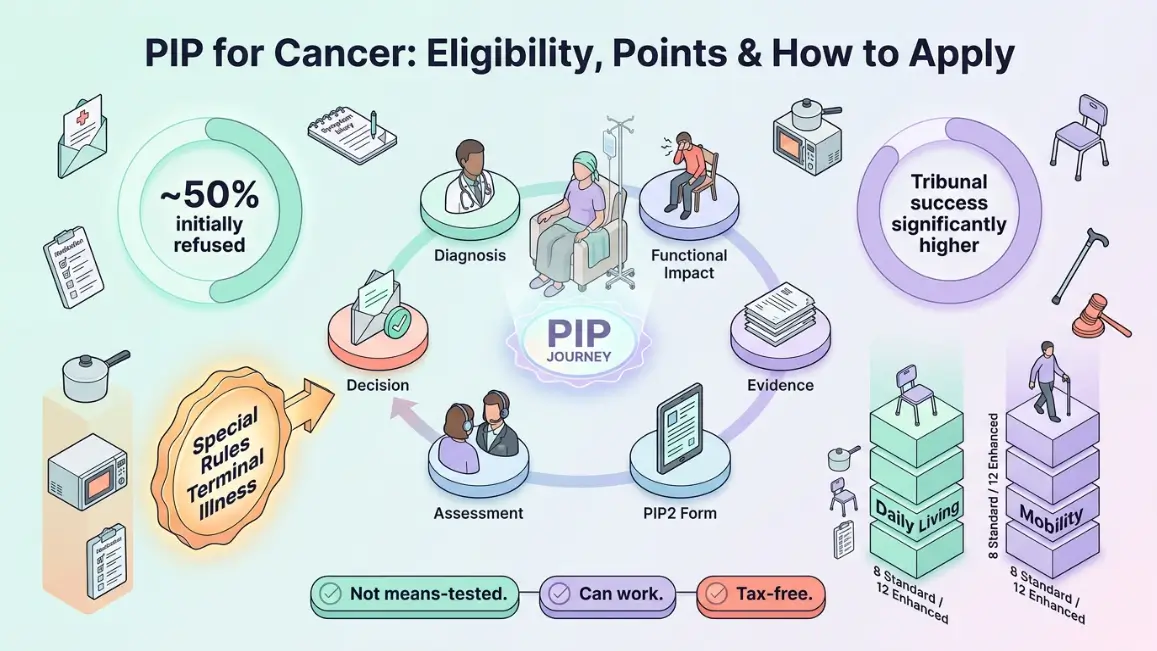
Personal Independence Payment (PIP) is not awarded for a cancer diagnosis alone – it is based on how cancer and its treatment affect your daily living and mobility. You must score at least 8 points in either the Daily Living or Mobility component to get the standard rate, and 12 points for the enhanced rate. This guide explains the full points system, maps common cancer side‑effects to each activity, and walks you through the application, evidence, and appeals process.
Does cancer automatically qualify you for PIP?
No – cancer does not automatically qualify you for PIP. PIP is awarded based on how your condition affects your ability to carry out everyday tasks, not on the diagnosis itself. The Department for Work and Pensions (DWP) looks at your functional limitations, not your medical label.
You can claim PIP at any stage – during treatment, after treatment, or if you are in remission – as long as you have difficulties with daily living or mobility. The Equality Act 2010 recognises cancer as a disability from the point of diagnosis, but that legal protection does not guarantee PIP. You still need to prove that your cancer or its treatment limits what you can do safely, reliably, and repeatedly.
General PIP eligibility requires you to be aged 16 to State Pension age, live in England, Wales, or Northern Ireland (apply for Adult Disability Payment if you live in Scotland), and have had difficulties for at least 3 months – with an expectation that they will last for at least 9 more months. These time rules do not apply if you are terminally ill. Your income, savings, employment status, and National Insurance contributions do not affect your claim.
What are the Daily Living and Mobility components?
PIP has two separate parts: the Daily Living component and the Mobility component. You can receive one or both, and each is paid at either the standard rate or the enhanced rate.
The Daily Living component covers 10 activities. You score points based on how much help or supervision you need to do each one reliably. The activities are:
-
Preparing or eating food
-
Eating and drinking
-
Taking medicines and managing treatments
-
Monitoring your health condition
-
Washing and bathing
-
Using the toilet or managing incontinence
-
Dressing and undressing
-
Communicating verbally
-
Reading and understanding signs, symbols, and words
-
Engaging with other people face to face
-
Making decisions about money
The Mobility component covers 2 activities:
-
Planning and following a journey (going out)
-
Moving around (walking)
Remember that mental health difficulties – such as anxiety, depression, or memory and concentration problems – can also count towards points. You do not need a physical disability to qualify for the mobility component. For example, if you cannot follow a route because of anxiety or confusion, that may score points.
The key word is reliably. PIP measures what you can do safely, to an acceptable standard, as often as you need to, and within a reasonable time – not just on a good day when you push yourself. You must describe your worst days and your typical days, not your best moments.
How many PIP points do you need – and what are the weekly payment rates?
For each component, your points from all its activities are added together. The total determines which rate you receive.
| Component | Points needed for standard rate | Points needed for enhanced rate | Standard rate (weekly) | Enhanced rate (weekly) |
|---|---|---|---|---|
| Daily Living | 8 – 11 points | 12 or more points | £72.65 [VERIFY] | £114.60 [VERIFY] |
| Mobility | 8 – 11 points | 12 or more points | £30.30 [VERIFY] | £80.00 [VERIFY] |
If you score fewer than 8 points in a component, you do not get that component at all. You may receive only one component if the other falls below 8 points.
Special rules for terminal illness override this: if a doctor confirms you may have 12 months or less to live, you automatically get the enhanced rate for Daily Living, regardless of points. Your mobility component is still assessed, but you will not have a face‑to‑face assessment. We cover that in detail later.
How do cancer side‑effects map to PIP points?
Below is a complete table showing each PIP activity, a sample descriptor, and a real cancer‑specific example. Use this to see how your difficulties translate into PIP points.
| Activity | Sample descriptor (simplified) | Cancer‑specific example | Points |
|---|---|---|---|
| Preparing food | Cannot cook a simple meal using a cooker, but can use a microwave | Severe nausea and fatigue make standing at a hob impossible; you only use microwaved ready meals. | 2 – 4 |
| Eating and drinking | Needs prompting or supervision to eat or drink | Chemo‑induced taste changes and low appetite mean you forget to eat; your partner reminds you at each meal. | 2 – 4 |
| Managing medication/treatments | Needs help with therapy (not just taking pills) | You have a PIC line for home chemotherapy and need a nurse or family member to connect and disconnect it. | 2 – 6 |
| Monitoring health | Needs supervision to avoid danger | You have a brain tumour causing seizures; you need someone to check your blood glucose or observe you. | 1 |
| Washing and bathing | Cannot get in/out of bath without help | Surgery to your arm leaves you unable to grip and pull yourself out of the bath; you need a shower chair and help. | 2 – 4 |
| Using the toilet | Needs an aid or help to clean yourself | Bowel cancer with a stoma bag; you manage the bag yourself (2 points) or need help changing it (6 points). | 2 – 6 |
| Dressing and undressing | Needs an aid (e.g., grabber, Velcro) | Nerve damage (neuropathy) from chemo makes buttoning shirts impossible; you use front‑fastening bras and Velcro trousers. | 2 |
| Communicating | Needs a speech aid or cannot understand single sentences | Head and neck cancer left you with a speech valve; or chemo brain makes it hard to follow a short conversation. | 2 – 4 |
| Reading and understanding | Needs a visual aid or cannot take in written info | Optic nerve damage from radiotherapy means you need large‑print or audio formats. | 2 |
| Engaging with others | Needs encouragement or active support | Low mood and self‑consciousness after surgery mean you avoid social events; a friend must accompany you. | 2 – 4 |
| Budgeting decisions | Needs prompting for simple or complex transactions | Brain fog and anxiety make you avoid opening bills; you need someone to remind you to pay them. | 2 – 4 |
| Planning and following a journey | Needs someone with you in unfamiliar or familiar places | Fatigue and anxiety prevent you from using buses; you cannot follow a route in a new hospital without a companion. | 10 – 12 |
| Moving around (walking) | Cannot walk more than 20 metres without stopping | Breathlessness from lung cancer means you can only walk 15 metres before resting; walking aids help but don’t remove the limit. | 12 |
How to score accurately: The PIP assessor will choose the descriptor that best describes your worst point on a typical day. If your fatigue is worse in the morning, describe your morning ability. If your pain fluctuates, explain how often you have bad days – for example, “3 out of 7 days I cannot dress myself.”
A common mistake is describing what you can do on a good day when you feel motivated. The assessor wants to know what you can do reliably – that means every time you need to do it, without risking injury, and within a reasonable time (not double the normal time).
From our work with cancer claimants, we often see people under‑score because they say “I can manage” when they actually need help, but they are too proud to ask. The PIP test is about what help would make a difference, not whether you currently receive it. If you could do an activity more safely or more often with a piece of equipment or a person’s help, that counts as needing help.
How do you apply for PIP – and what evidence should you gather for cancer?
Apply in three stages. Stage 1 collects your personal details. Stage 2 is the PIP2 form – “How Your Disability Affects You” – which you must return within 4 weeks. Stage 3 is an assessment by a healthcare professional if the DWP needs more information.
How to start:
-
In England or Wales: call the PIP new claims line on 0800 917 2222 (textphone: 0800 917 7777).
-
In Northern Ireland: call 0800 012 1573 (textphone: 0800 587 0937).
-
You can also apply online via GOV.UK if eligible.
What to have ready: your National Insurance number, bank account details, and your GP’s name and address. Someone else can call on your behalf, but you must be with them when they call.
Evidence checklist – specific to cancer: Gather these documents before you fill in the PIP2 form:
-
Hospital admission and discharge letters
-
Oncology consultation summaries
-
Chemotherapy or radiotherapy schedules (with dates)
-
Surgery reports (including post‑operative complications)
-
Pain or symptom diaries – keep one for at least 2 weeks
-
Letters from your clinical nurse specialist or consultant
-
Prescription lists for any painkillers, anti‑nausea, or other symptom‑management medications
-
Any letter about mobility aids (walking stick, wheelchair, shower chair)
PIP2 Form Cheat Sheet – cancer edition: For each activity, use this template:
“On a typical day, I cannot [activity] without [specific help/supervision]. I have [side‑effect] which makes it [unsafe / too slow / impossible] to do reliably. For example, on a bad day, I need [person/equipment] to [describe exact action].”
Example: “On a typical day, I cannot prepare a meal without sitting down every 2 minutes due to chemo fatigue. I use a microwave and ready meals because I cannot stand at a hob. On bad days, I need my partner to finish cooking because I cannot concentrate on timings.”
If you are too unwell to travel to an assessment centre: You can request a home visit. Call the assessment centre on the number in your appointment letter and say: “I am unable to travel because of my cancer treatment – please arrange a home assessment.” You may need a letter from your GP or consultant to support this.
3 common mistakes to avoid:
-
Describing only your good days – always include your worst day examples.
-
Sending only a diagnosis letter – the DWP needs evidence of functional limitation, not just “cancer”.
-
Missing the 4‑week deadline for the PIP2 form – if you cannot complete it in time, call the PIP line and ask for an extension.
Can you claim PIP while working or receiving other benefits?
Yes – you can claim PIP whether you are working or not. Your income, savings, and National Insurance record do not affect PIP. PIP is tax‑free.
PIP does not reduce your other benefits. In fact, receiving PIP can increase some means‑tested benefits such as Universal Credit or Employment and Support Allowance (ESA). For example, if you receive the enhanced rate of PIP daily living, your Universal Credit may increase by an extra amount depending on your circumstances.
Universal Credit itself has a separate fast‑track process for cancer patients – you may get the Limited Capability for Work and Work‑Related Activity (LCWRA) element automatically during chemotherapy or radiotherapy. But that is a different benefit and does not affect your PIP claim.
If you have a carer, they may be able to claim Carer’s Allowance if they spend at least 35 hours a week caring for you. PIP does not reduce Carer’s Allowance.
What is the 3‑month and 9‑month qualifying rule – and does it apply to cancer?
Yes, the time rules apply to most cancer claims. You must have had difficulties for 3 months before you claim, and you must expect them to last for at least another 9 months. That means your difficulties must be ongoing for a total of 12 months from when they started.
But there are two important cancer‑specific exceptions:
-
Terminal illness – if a doctor believes you have 12 months or less to live, you do not need to meet the 3‑month or 9‑month rules. You can claim under special rules immediately.
-
Uncertain prognosis – if you are not sure whether your difficulties will last 9 months, you can still claim. The DWP allows you to make a claim and then withdraw it if the assessment shows you do not meet the time condition. This is safer than waiting because the 3‑month counting starts from the date of your claim, not from when your treatment started. If you wait, you may lose weeks of potential payment.
For someone in remission but with long‑term side‑effects (like neuropathy or fatigue), the 9‑month rule still applies. If your side‑effects have lasted 3 months and you expect them to last at least 9 more months, you qualify. If you are unsure, claim anyway and explain the uncertainty – you can withdraw later.
Decision‑flow for the time rules:
-
Are you terminally ill? → Yes → use special rules (no time limits).
-
No → Have you had difficulties for 3 months? → No → wait until the 3‑month mark, then claim.
-
Yes → Do you expect difficulties to last 9 more months? → Yes → claim now.
-
Not sure → claim now and withdraw later if needed.
What can you do if your PIP claim is refused?
About half of all PIP claims are refused initially, but many are overturned on appeal. If you are refused, you have two formal options.
Step 1 – Mandatory Reconsideration: You have 1 month from the date of the decision letter to ask the DWP (or DfC in Northern Ireland) to reconsider. Write or call them and explain why you disagree. Include any additional evidence – for example, a more detailed diary, or a letter from your consultant. The DWP will review the decision, usually without a new assessment. This step is free.
Step 2 – Appeal to a Tribunal: If the reconsideration does not change the decision, you have another 1 month to appeal to an independent tribunal. You do not need a lawyer, but you must submit your appeal within the time limit. Tribunals have a higher success rate for cancer claimants – many win because they bring better evidence and personal statements.
Common reasons for refusal – and how to fix them:
-
“You do not meet the 3‑month/9‑month rule.” – Check your dates. If your treatment just started, wait and re‑apply. If you have a poor prognosis, ask for special rules.
-
“Your description of impact was not detailed enough.” – Submit a new personal statement with daily examples and a diary.
-
“You did not provide medical evidence.” – Get a letter from your GP or oncology team, not just a diagnosis letter.
You can get free help from a welfare rights adviser at Macmillan (0808 808 00 00), Citizens Advice, or Scope. They can help you write your reconsideration request and prepare for a PIP appeal tribunal.
Frequently asked questions about PIP and cancer
Can I get PIP if I am in remission?
Yes – if you still have functional limitations from the cancer or its treatment, such as fatigue, neuropathy, or breathlessness. PIP is based on ongoing impact, not active disease. You must still meet the 3‑month/9‑month rule unless you are terminally ill.
Do I need a face‑to‑face assessment for PIP?
Not always. For cancer patients, the DWP often attempts a paper‑based assessment. You may have a short phone call. You can request a home visit if you are too unwell to travel to an assessment centre.
What if my cancer treatment ends in less than 9 months – can I still get PIP?
Possibly – if you expect your difficulties to last 9 months. If treatment ends but side‑effects persist, you can still qualify. If you are unsure, you can claim and withdraw later if the assessment shows you do not meet the 9‑month rule.
How long does a PIP claim take for cancer patients?
There are significant delays – often several months unless you are under special rules (then you get a payment within 2 weeks). You can ask your MP to challenge severe delays.
Will I lose PIP if I go back to work?
No – PIP is not an out‑of‑work benefit. You can claim it while working, and it is not affected by your income or savings.
How do I prove my cancer affects my daily life?
Keep a daily diary of good and bad days, collect hospital/oncology letters, and ask your GP or consultant to provide a supporting statement. Be honest about how you manage (or cannot manage) each of the 12 PIP activities on your worst days.