A PIP/
Personal Independence Payment (PIP) tribunal appeal is an independent review by HM Courts and Tribunals Service (HMCTS), separate from the DWP. Request a
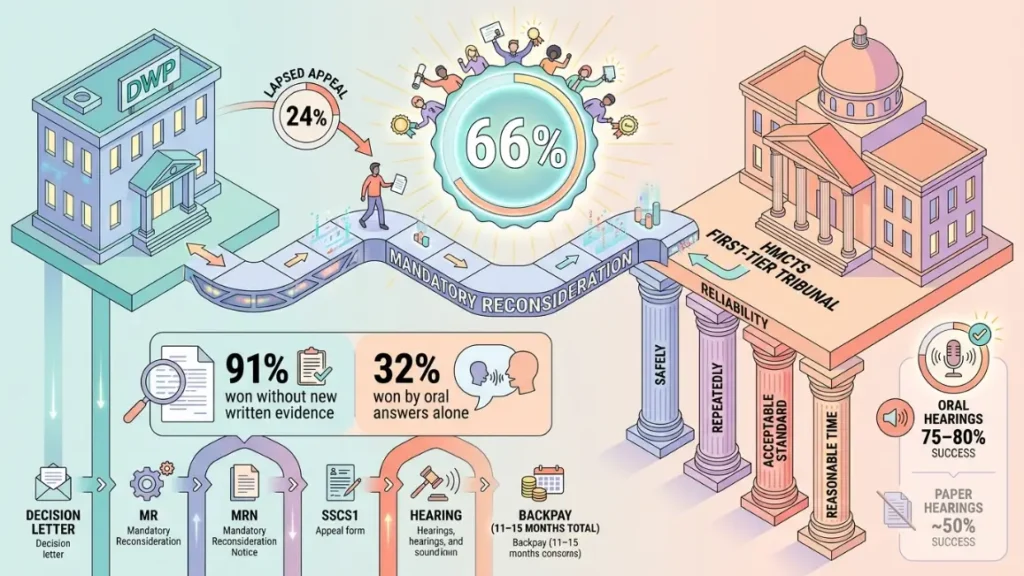
Mandatory Reconsideration within one calendar month of the decision letter. If upheld, lodge an SSCS1 appeal with HMCTS within one month of the Mandatory Reconsideration Notice. Around 66% of PIP appeals succeed.
Is It Worth Appealing a PIP Decision?
Yes. Around 66% of PIP tribunal appeals succeed. The most common reason claimants give up is the wait, not the odds. Most appeals win because oral evidence reframes what the assessor wrote, not because new medical evidence is added.
PIP Tribunal Success Rate in 2026 (What the Data Says)
The headline figure is 66% of decided PIP tribunal hearings ending in the claimant’s favour (HMCTS Tribunal Statistics, January–March 2025). The variation is small and the direction is consistent: most appellants who reach tribunal win.
A second figure changes how most people prepare. Around 91% of successful PIP appeals were won without any new written evidence being provided (DWP data, 2021 parliamentary question).
In roughly 59% of successful cases, the tribunal simply reached a different conclusion from the same facts the DWP already had. In a further 32%, the claimant’s oral answers at the hearing made the difference.
Around 65% of claimants who request a Mandatory Reconsideration give up before lodging the tribunal appeal. That figure is the strongest argument for appealing: most eligible claimants never reach the stage where they actually win.
Can You Lose Your Existing PIP by Appealing?
Yes, but rarely. The First-tier Tribunal reviews the whole award afresh, so a higher-rate appeal could in theory be reduced if the panel disagrees with part of your evidence. In practice, published HMCTS data show that reductions of an existing award are uncommon compared with awards being increased or upheld.
The safer framing is in three probabilities: higher award, same award, or lower award. The tribunal cannot reduce a nil award to anything other than a higher award.
If you are currently refused PIP, you have nothing to lose by appealing. If you already receive the standard rate and are appealing for the enhanced rate, the practical risk is low but not zero.
Lapsed Appeals: When the DWP Concedes Before the Hearing
A lapsed appeal is one where the DWP changes its own decision in your favour after you lodge the appeal but before the hearing. About 24% of PIP appeals lapse over a five-year average. The rate differs by claim type: roughly 20% of initial decision appeals lapse, and roughly 51% of award-review appeals lapse.
A lapse usually follows a strong written submission. If you lodge an SSCS1 with a clear Section 5 grounds statement and supporting evidence, the DWP may decide its original decision was wrong and offer you an award before the hearing date.
Common Mistakes That Cost PIP Appeals
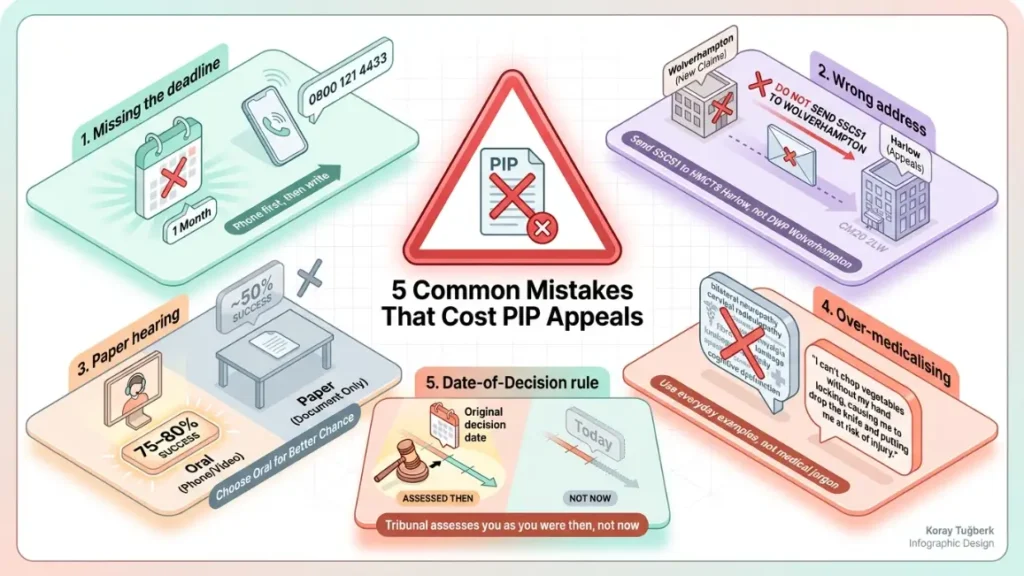
Five mistakes cost more appeals than any others:
- Missing the one-month deadline. Phone 0800 121 4433 first if the deadline is close, then follow up in writing.
- Sending the SSCS1 to the wrong address. The new-claims postal address is in Wolverhampton. The appeals address is in Harlow (see H2 #5 below).
- Choosing a paper hearing unnecessarily. Oral hearings succeed at roughly twice the rate of paper hearings.
- Over-medicalising answers with clinical jargon. The panel wants to hear how your condition affects daily life in your own words.
- Failing to address the Date-of-Decision rule. The tribunal assesses how you were at the date of the original DWP decision, not how you are today.
What Is the Mandatory Reconsideration Step Before a Tribunal?
Mandatory Reconsideration (MR) is the mandatory first step before you can lodge a tribunal appeal. You ask the Department for Work and Pensions (DWP) to look at its own decision again. If MR upholds the decision, you then have one calendar month from the Mandatory Reconsideration Notice (MRN) to lodge an SSCS appeal with HMCTS.
How to Request Mandatory Reconsideration (Phone, Letter, or CRMR)
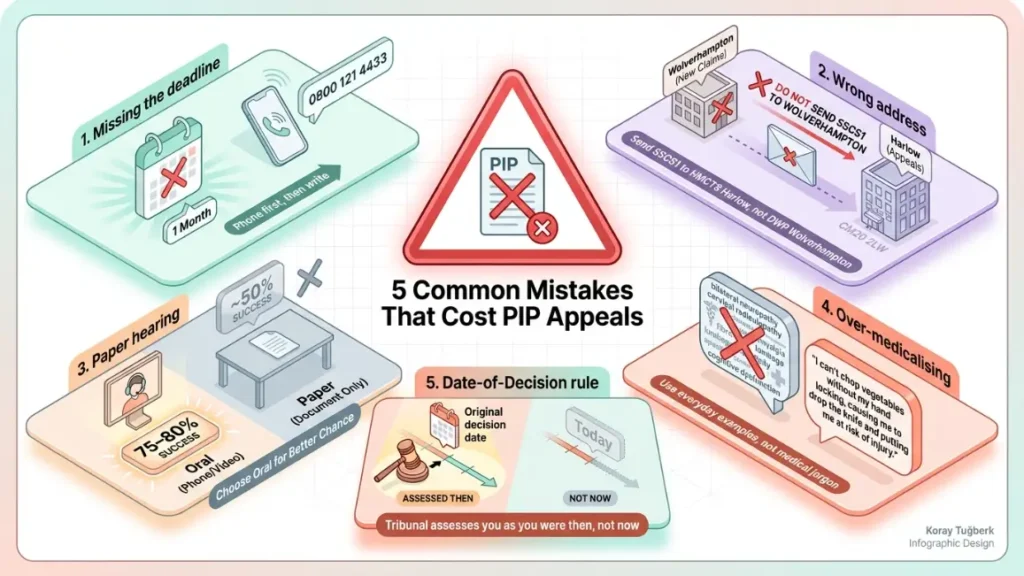
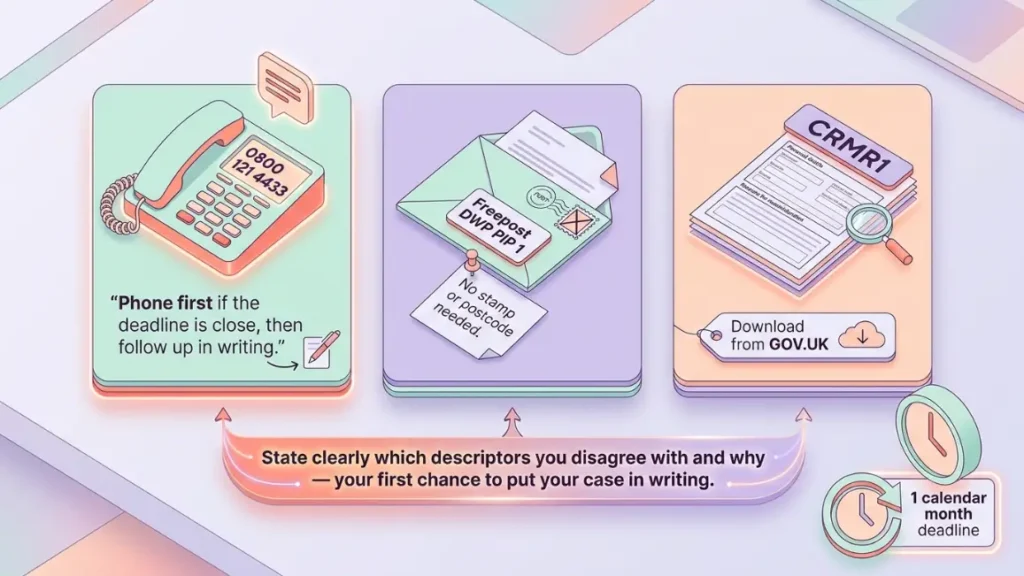
You can request an MR in three ways:
- Phone the PIP enquiry line on 0800 121 4433. Phone first if the deadline is close, then follow up in writing.
- Write to the address printed at the top of your decision letter, or to Freepost DWP PIP 1 (no stamp or postcode needed).
- Complete form CRMR1, available from GOV.UK.
State clearly which descriptors you disagree with and why. The MR request is your first chance to put your case in writing.
The Mandatory Reconsideration Phone Call: What to Say
The MR phone call is the route most searchers choose when the deadline is close. The DWP decision-maker will ask you to summarise why you disagree with the decision. The call usually lasts 10 to 20 minutes.
Prepare for these questions: which activities you think should have scored more points, what is wrong with the assessor’s report, and whether any new evidence has become available since the assessment. State the descriptors by name — for example, “Preparing food” or “Managing medication” — and the points you believe you should have received.
After the call, follow up in writing. Send a short letter confirming what you said, attach any new evidence, and keep a copy. The phone call records your disagreement; the letter creates the paper trail.
CRMR1 Form Sections Explained
CRMR1 has four main sections: your personal details, the decision you are challenging, your reasons for disagreeing, and the supporting evidence you are sending. Section 3 (reasons) is the load-bearing part. Use the same structure as you will use later in SSCS1 Section 5 — identify the descriptors, explain your functional limitations, and reference any supporting evidence by document name.
What Happens After MR: Getting Your Mandatory Reconsideration Notice (MRN)
The DWP aims to complete an MR within two weeks. The July 2025 DWP statistics show an actual average of 75 days. There is no legal deadline for the DWP to complete an MR.
Once complete, you receive the Mandatory Reconsideration Notice (MRN). This letter sets out the DWP’s revised decision and the reasons. If the decision is unchanged, the MRN carries the date from which your one-month window to lodge the tribunal appeal begins.
Northern Ireland: How MR Differs
In Northern Ireland, the
MR process is administered through a different DWP contact and the appeals tribunal is the Appeals Service rather than HMCTS. The form used for the next stage is NOA1(SS), not SSCS1.
How Long Does a PIP Tribunal Appeal Take?
A complete PIP tribunal appeal takes 8 to 12 months from the original DWP decision to backdated payment. The longest single wait is the tribunal listing stage, which currently averages 33 weeks (HMCTS, July–September 2025). With roughly 53,000 PIP appeals in the queue, regional variance is significant.
Stage-by-Stage Timeline Table [FEATURED SNIPPET]
| Stage |
What happens |
Typical timeframe |
Running total |
What you should be doing now |
| 1. Receive decision letter |
DWP issues decision |
Day 0 |
— |
Read carefully; note the one-month deadline |
| 2. Request MR |
Phone, write, or use CRMR1 |
Within one month of letter |
One month |
Submit before deadline; phone first if close |
| 3. DWP completes MR |
Different DWP decision-maker reviews |
2–10 weeks |
3–4 months |
Gather additional evidence; prepare SSCS1 |
| 4. Submit SSCS1 |
Online or by post to HMCTS |
Within one month of MRN |
4–5 months |
Section 5 wording is load-bearing |
| 5. DWP responds |
Sends evidence bundle to tribunal |
4–8 weeks |
5–6 months |
Read the bundle; identify errors |
| 6. Wait for hearing |
Tribunal listing |
4–7 months |
10–14 months |
Use Manage Your Appeal; gather more evidence |
| 7. Tribunal hearing |
Attend oral or paper hearing |
30–60 minutes |
10–14 months |
Prepare answers; bring notes |
| 8. Decision |
Verbal same day, or posted |
Same day to one week |
10–14 months |
— |
| 9. Backdated payment |
DWP processes arrears |
4–6 weeks |
11–15 months |
Notify council, UC, Carer’s Allowance |
Regional Wait Time Breakdown
HMCTS publishes quarterly statistics that show significant regional variance. London and the South East have the shortest average waits. The North West, the Midlands, and parts of Scotland have the longest.
If your hearing is listed far from home, you can request a telephone or video hearing to avoid travel. Expenses for travel to in-person hearings are reclaimable from HMCTS.
Total Time from Decision to Backpay: The Headline Number
The aggregate range is 11 to 15 months from original DWP decision to backdated payment landing in your bank account.
The MR stage adds 2 to 3 months on average. The tribunal listing adds 6 to 9 months.
The decision itself is fast — usually the same day as the hearing. The DWP’s payment processing adds another 4 to 6 weeks after the decision.
Yes. You can appeal late up to 13 months after the decision date if you have a good reason. The tribunal has discretion to accept late appeals under Rule 22 of the Tribunal Procedure (First-tier Tribunal) (Social Entitlement Chamber) Rules 2008.
The 13-Month Late Appeal Window Explained
The standard deadlines are one calendar month for an MR (from the decision letter) and one calendar month for an SSCS1 appeal (from the MRN). Outside those windows, the tribunal may still accept your appeal if two conditions are met: the decision date is less than 13 months ago, and you have a good reason for the delay.
Common acceptable reasons include: receiving wrong information from an adviser, a close relative being seriously ill, you yourself being seriously unwell, or postal problems at your address. Vague reasons such as “I forgot” or “I was busy” are usually rejected.
How to Submit a Late PIP Appeal (SSCS1 Section 5 Late Explanation)
In SSCS1 Section 5, tick the box indicating your appeal is late. Explain the reason in writing in the same box. Attach supporting evidence where you can — for example, a hospital discharge letter, a letter from your GP, or a Royal Mail redirection history.
What Happens If Your Late Appeal Is Refused
If HMCTS refuses your late appeal, the only remaining route is a fresh PIP claim. A fresh claim is not backdated to the original decision date, so the trade-off is significant.
How Do You Submit a PIP Appeal (SSCS1 Form)?
You submit a PIP appeal using form SSCS1, either online at GOV.UK or by post to HMCTS. You need your National Insurance number, your Mandatory Reconsideration Notice (MRN), and the details of any representative helping you. This is called “direct lodgement” — you send the appeal to HMCTS, not to the DWP.
Form SSCS1: Step-by-Step Submission Guide
- Gather your documents: National Insurance number, MRN, representative details if applicable.
- Choose your submission route: online via the GOV.UK Appeal a Benefit Decision service, or paper form downloaded from GOV.UK.
- Complete Section 5 (grounds for appeal) — see H2 #5 #5.2 below.
- Choose your hearing type in Section 6: oral (in-person, phone, or video) is strongly recommended.
- Add any dates you cannot attend in Section 7 and any access needs (sign language interpreter, step-free venue).
- Submit. Online submissions generate a reference number instantly. Paper submissions should be sent by recorded delivery.
The DWP has a target of 28 days to respond to a tribunal appeal after it is lodged. The actual average is 4 to 8 weeks.
SSCS1 Section 5: What to Write (With Template)
Section 5 is the load-bearing part of the SSCS1. The rest of the form is administrative. Section 5 is where you say why the DWP’s decision is wrong.
A strong Section 5 has four parts:
- Restate the decision you are challenging — for example: “I am appealing the decision dated 12 March 2026 which awarded me 4 points for daily living and refused me a mobility component.”
- Identify the descriptors you disagree with — name each one. For example: “Preparing food (descriptor b, 4 points) — I should score descriptor d (8 points).”
- Explain why using the four reliability criteria. For each descriptor, write one sentence that addresses safely, repeatedly, to an acceptable standard, and in a reasonable time.
- Reference supporting evidence by document name — for example: “See attached GP letter dated 5 April 2026 and supporting statement from my sister, Jane Smith.”
A short original example for one descriptor:
“I disagree with the descriptor awarded for Preparing food. I cannot prepare a meal from scratch safely — I have dropped boiling water twice and scalded my foot, requiring a dressing for two weeks. I cannot prepare food repeatedly — if I cook lunch, I cannot cook dinner.
I cannot prepare food to an acceptable standard — I rely on microwave meals. Preparing a meal from scratch takes me 50 minutes, more than twice the typical time.”
Online vs Paper Submission
Online submission is faster — you receive a reference number immediately, your appeal enters the queue straight away, and you can track it through the Manage Your Appeal service. Paper submission is appropriate if you have no reliable internet access or if you prefer to keep a physical copy of everything you send. We Are Group (03300 160 051, Mon–Fri 9am–5pm) provides free digital-help support if you need assistance completing the online form.
PIP Appeal Address: Where to Send SSCS1 (Including NI)
The correct postal addresses:
- England and Wales: HMCTS Benefit Appeals, PO Box 12626, Harlow, CM20 9QF .
- Scotland: HMCTS SSCS Appeals Centre, PO Box 13150, Harlow, CM20 9TT .
- Northern Ireland: NOA1(SS) form to The Appeals Service, PO Box 2202, Belfast, BT1 9YJ.
Many searchers send their appeal to the wrong address. The Wolverhampton address (Post Handling Site B, Wolverhampton, WV99 1AH) is for new PIP claims, not for appeals. Sending your SSCS1 there will cost you time. The correct appeals address is HMCTS in Harlow for England, Wales, and Scotland; the Appeals Service in Belfast for Northern Ireland.
Tracking Your Appeal After Submission
After submission, you can track your appeal through the HMCTS Manage Your Appeal service if you applied online. You receive email or text updates at each stage. The status changes move through five steps: “Appeal received,” “DWP response received,” “Bundle sent to you,” “Hearing listed,” and “Decision issued.” Before the hearing you will receive the appeal bundle — the full case papers the tribunal will use.
If you applied by post, you can ask HMCTS for text-message updates by calling 0300 123 1142 (England and Wales) or 0300 790 6234 (Scotland). Northern Ireland has no equivalent digital tracking service — contact the Appeals Service directly.
Help With Your Appeal (Free and Paid Options)
Free help is widely available. Citizens Advice, the Turn2Us Find an Adviser tool, Advicenow’s PIP guides, and local welfare rights offices can all help with form completion and preparation.
Paid options include solicitors (typically 40% plus VAT of any backdated award) and specialist drafting services. Most claimants succeed without paid representation.
The PIP tribunal system is designed to be accessible without legal qualifications.
What Evidence Wins a PIP Tribunal Appeal?
Evidence wins a PIP tribunal appeal when it explains your functional limitations in the language of the four reliability criteria, supported by medical evidence and a day-in-the-life written statement. The strongest evidence is specific, dated, and addresses the descriptors you are challenging by name.
The Reliability Criteria: The Legal Test for Every Descriptor
Regulation 4(2A) of the Social Security (Personal Independence Payment) Regulations 2013 sets the four reliability criteria. A claimant can be assessed as able to do an activity only if they meet all four of these criteria.
The criteria are: safely, repeatedly, to an acceptable standard, and in a reasonable time. Failure on any one means the claimant cannot do that activity at the relevant descriptor level.
“Safely” means without risk of injury, significant pain, fatigue, breathlessness, or making the condition worse. “Repeatedly” means as often as reasonably required throughout the day.
“To an acceptable standard” means correctly and completely — not half-done. “In a reasonable time” means no more than twice as long as someone without the condition.
Every piece of evidence you submit and every answer you give at the hearing should weave these four words in. If you say “I can cook a meal,” the panel hears a descriptor failure.
If you say you cannot cook from scratch safely, cannot cook repeatedly, and cannot cook to an acceptable standard, the panel hears a descriptor success. Add the details: “I have scalded myself twice, and I cannot manage both lunch and dinner.”
Medical Evidence: GP Letters, Consultant Reports, OT Assessments
The strongest medical evidence is a letter from a clinician who knows you. The letter must explain your functional limitations, not just your diagnosis, and be addressed specifically to “the tribunal.”
A weak letter says only “Mrs X has
calculators/
calculator/”>Fibromyalgia-pip-calculator/”>Fibromyalgia.” A strong letter describes the functional impact. For example: “her pain prevents her from standing for more than ten minutes, and on bad days she cannot prepare a meal without supervision.”
Your GP may charge for writing a tribunal-specific letter — typically £30 to £50. The tribunal cannot reimburse this.
If cost is a barrier, ask your consultant, practice nurse, or occupational therapist instead. NHS appointment letters and prescription records are weak evidence — they show you attended, not how your condition affects daily life.
Written Statements: Your Day-in-the-Life Narrative
A written statement is your own account of how your condition affects you, written for the tribunal to read before the hearing. The eight-part structure that wins appeals:
- Why you are writing.
- The award you believe you should receive (for example, enhanced rate daily living and enhanced rate mobility).
- Your main symptoms and how they affect you.
- Variable days — what help you need on bad days versus better days, and how often each occurs.
- The descriptors you meet, with the reliability criteria addressed for each.
- Any harm you have experienced, or could experience, because of your condition.
- What you do not do because you do not have help.
- Any supporting evidence you are referring to.
A short original example for the “Managing medication” descriptor:
“I take four medications daily. I cannot manage them safely — I have forgotten doses and doubled doses, both of which have triggered seizures. I cannot manage them repeatedly — if I take morning medication, I often forget the evening dose.
I cannot manage them to an acceptable standard — I rely on my sister to phone me each evening to remind me. Managing my medication takes roughly twice as long as it should because I read the labels repeatedly to make sure I have the right tablets.”
Supporting Statements From Family, Carers, Friends
A supporting statement from someone who knows you adds third-party corroboration. Format requirements: it must be signed, dated, and state the writer’s relationship to you. The writer must describe their own observations, not what you have told them.
The most powerful supporting statements describe specific incidents with dates — for example: “On 14 March 2026, I watched the claimant attempt to climb the stairs. She had to stop after six steps, was breathing heavily, and needed to sit on the landing for ten minutes before continuing.” General statements (“She has trouble with stairs”) add little.
Mental Health Evidence Checklist
Mental health appeals succeed most often when the evidence addresses three specific legal tests:
- Mobility Activity 1 (planning and following journeys): The legal threshold is “overwhelming psychological distress” — not Anxiety, not worry. Document panic attacks, dissociation, and the inability to complete a journey at all.
- Daily Living Activity 9 (engaging with others): Document social withdrawal, the inability to attend appointments alone, and the support required from a third party.
- Variable-day documentation: A symptom diary across a typical month, dated and signed, is the strongest single piece of mental health evidence.
Mental health claimants are also the group most likely to choose a paper hearing because attending in person is difficult. The success-rate gap between oral and paper hearings is largest for this group, so attending in some form — phone or video — usually improves the outcome.
Photographs and Other Evidence
Photographs are admissible for showing home modifications (grab rails, stair lifts, ramps) and mobility aids (walking stick, wheelchair). Photographs of your body are not appropriate.
Other admissible evidence includes occupational therapy assessments, care plans from your local authority, letters from social workers, prescription records showing medication changes, and letters from employers confirming reduced hours or sick leave.
What Happens at a PIP Tribunal Hearing?
A PIP tribunal hearing is an informal 30 to 60-minute meeting with an independent three-person panel — a judge, a medical member, and a disability-qualified member — completely separate from the DWP. You attend, answer questions about how your condition affects daily life, and usually receive the decision on the same day.
Who Is on the Tribunal Panel
The First-tier Tribunal (Social Security and Child Support), sitting in its Social Entitlement Chamber, hears PIP appeals. The tribunal is inquisitorial — the panel asks the questions rather than hearing two sides argue against each other.
The panel has three members. None of them work for the DWP. None of them saw your original assessment.
The judge is legally qualified — usually a solicitor or barrister with at least five years’ experience. They chair the hearing, apply the correct law, and ensure the process is fair.
The medical member is a registered medical practitioner, often a GP or consultant. They ask clinical questions and help the panel understand your condition from a medical perspective.
The disability-qualified member has professional or personal experience of disability. They may be an occupational therapist, a social worker, or someone with lived experience of disability. They tend to lead on the practical daily-living questions.
A tribunal clerk attends in an administrative role only — they do not participate in the decision. The tribunal will call you “the appellant” and the DWP “the respondent”.
The tribunal decides on the balance of probabilities — meaning something counts as a fact if the tribunal thinks it is more likely than not.
The Three Hearing Formats: In-Person, Phone, and Video
You can choose oral (in person, by phone, or by video) or paper. Oral hearings succeed at approximately 75% to 80%; paper-only hearings succeed at approximately 50% to 55%. The gap reflects how much weight the panel places on hearing from you directly.
Phone hearings are the practical middle ground — no travel required, you still give oral evidence, and accessibility is high. Video hearings work well for claimants who want to be seen but cannot travel. In-person hearings remain the default for claimants who live near the venue and have no mobility barriers.
Common Questions and How to Answer Them
The panel will ask roughly four to six questions, focused on how your condition affects you. The most common questions:
“How did you travel here today?” — They want to know if the journey was difficult. Answer honestly. If someone drove you, say so. If you had to stop on the way, say so.
“Describe a typical day from waking up to going to bed.” — Walk through your morning routine, midday, afternoon, evening. Use real times, real examples, and the four reliability criteria.
“How far can you walk before you need to stop?” — A specific distance is stronger than “not far.” Address the reliability criteria: “About 30 metres, but only with my stick; after that the pain becomes sharp and I cannot walk at all the next day.”
“The report says you can [activity]. Why do you disagree?” — Address each factual error in the assessor’s report by name. Quote the report. Explain what the assessor missed.
A short original example for the walking-distance question:
“About 30 metres with my stick, but the pain in my hip becomes sharp and I have to stop. If I push past 30 metres, I cannot walk at all the next day. The assessor’s report said I could walk 100 metres, but I was asked the question while sitting down and was not asked to demonstrate.”
The panel is testing whether your oral account matches the documentary evidence.
The Date-of-Decision Rule
The tribunal assesses your condition as it was at the date of the original DWP decision — not how you are on the day of the hearing. The legal basis is Section 12(8)(b) of the Social Security Act 1998. The judge will usually remind you of this at the start.
If your condition has worsened since the decision date, tell the panel. But understand that the worsening is not the basis of the appeal — it is the basis of a fresh claim through supersession. The appeal is about whether the original decision was correct on the original date.
The Observation Rule: What You Should Know Before the Day
Under the case [2015] UKUT 692 (AAC), the tribunal can observe you during the hearing and use those observations as evidence. The assessment begins when you arrive at the tribunal centre — how you walked in, whether you sat comfortably, how you interacted with people around you.
The same case requires the tribunal to put any observation to you before relying on it. You will be asked if you agree with the observation.
The practical implication: go as you normally would. If you normally wear tracksuit bottoms because you cannot manage buttons, wear tracksuit bottoms.
If you drove to the venue rather than walked from the car park, mention it before the panel asks. If someone helped you find the room or read the signs, tell the panel.
The DWP Presenting Officer: What to Expect
A DWP Presenting Officer (PO) sometimes attends the hearing. Their attendance rate is roughly 23% (DWP written parliamentary answer, 2017), with a target of 50%. The PO represents the DWP, explains the DWP’s decision, and may ask you questions.
The PO’s role is officially “friend of the court” — they help the tribunal reach the right decision, not defend the DWP at all costs. They sit on your side of the table, not the panel’s. They have no say in the final decision.
A Presenting Officer will not cross-examine you as if you were a witness in a criminal trial. If they point out something you did not mention on the form, explain why. For example, you may have been having a better day, or the form may not have captured the full picture.
How to Prepare for the Day (Dress, Notes, Support)
Practical preparation:
- Dress as you normally would. Smart clothes will not help your case and may contradict your stated difficulties.
- Bring a copy of your SSCS1, your MRN, any evidence, and your day-in-the-life statement.
- Bring notes covering the points you want to make. You can refer to them during the hearing.
- Bring a friend, family member, support worker, or representative. They can sit beside you and, if invited, add their own observations at the end.
- Bring water and any medication you need. Ask for a break if you need one.
- Tell the panel if someone helped you get there — driving you, helping you find the room, reading signs.
HMCTS must give you at least 14 days’ notice of your hearing date, unless you agree to a shorter window. You can also reclaim expenses for attending the hearing from HMCTS. Reclaimable expenses include: travel by public transport at the cheapest available fare, taxi fare if you cannot use public transport, childcare costs, and loss of earnings for self-employed claimants. Ask the clerk about expenses on arrival.
If you cannot attend the date set, contact the tribunal clerk in advance to request a postponement — the hearing will be moved to a later date. Once the hearing has started, the tribunal can instead adjourn — pause the hearing and resume on a different date.
What Happens After the Hearing
Once the panel has finished asking questions, they usually ask you to wait in a side room while they deliberate. This takes 15 to 30 minutes.
In most cases you are called back in and told the decision on the same day. If the case is complex, the decision is posted within 3 to 5 working days.
A “no decision on the day” outcome is not a loss. It means the panel needs more time. You will receive a letter with the decision and the reasons.
What Happens If You Win or Lose a PIP Tribunal Appeal?
If you win, your PIP award is backdated to the date of the original DWP decision and you receive a lump-sum payment within 4 to 6 weeks. If you lose, you can request a Statement of Reasons within one month. If the tribunal made an error of law, you can apply for permission to appeal to the Upper Tribunal.
Your award is backdated to the date of the original DWP decision, not the date of the tribunal hearing. If you have been waiting eight months for the hearing, you receive eight months of arrears in one payment.
Backdated PIP payments typically arrive within 4 to 6 weeks of the tribunal decision. Ongoing payments restart from your next regular payment date.
A successful tribunal decision triggers updates to other benefits. Tell the DWP, your local council,
Universal Credit (if you receive it), and any Carer’s Allowance claim you have. A higher PIP rate may unlock Severe Disability Premium (SDP), Blue Badge eligibility, or Motability allowance.
If You Lose: Statement of Reasons and Upper Tribunal
If the tribunal decides against you, you have one calendar month to request a Statement of Reasons from HMCTS. The Statement of Reasons sets out the panel’s findings of fact, the law applied, and the reasoning. You need it to assess whether you have grounds to go further.
The Upper Tribunal hears appeals from the First-tier Tribunal — but only on a point of law. A point of law means the tribunal misapplied the legislation, misinterpreted a regulation, or failed to follow procedural rules. A disagreement with the panel’s findings of fact is not a point of law.
If you believe a point of law exists, apply to the First-tier Tribunal for permission to appeal to the Upper Tribunal. You must apply within one month of receiving the Statement of Reasons. Legal aid is available at Upper Tribunal stage. Citizens Advice or a welfare rights solicitor can advise whether your case has arguable grounds.
Lapsed Appeal Decision Framework
In roughly 24% of PIP appeals, the DWP offers you an award before the hearing date — a lapsed appeal. The offer is usually lower than what you asked for in your SSCS1.
Three options:
- Accept the offer. Your award is backdated to the original decision date. The appeal ends. You cannot re-appeal on the same facts.
- Reject the offer. The appeal proceeds to the hearing. You might receive more, the same, or less than the offer. The tribunal reviews your whole award afresh.
- Negotiate. In some cases the DWP will adjust its offer if you provide additional evidence before the hearing date.
The honest trade-off: most claimants should not accept the first offer. A tribunal win can deliver a higher award than the DWP’s pre-hearing compromise. The risk is a lower award — but published HMCTS data show this outcome is uncommon.
When to Make a Fresh PIP Claim Instead
A fresh PIP claim is the right route if your circumstances have materially changed since the original decision. Examples include a new diagnosis, a worsening of an existing condition, or a change in the support you need.
The trade-off: a fresh claim is not backdated to the original decision date. You lose the arrears that the tribunal appeal could have awarded. A fresh claim is a last-resort option after MR refusal and tribunal loss.
Frequently Asked Questions
How do I appeal a PIP decision?
You must first request a Mandatory Reconsideration from the DWP within one calendar month of your decision letter. If the Mandatory Reconsideration Notice upholds the decision, lodge an SSCS1 appeal with HMCTS within one month of the MRN. The whole process is free.
Is it worth appealing a PIP decision?
Yes, statistically. Around 66% of PIP appeals succeed at tribunal (HMCTS, Jan–Mar 2025), and a further ~24% lapse before hearing because the DWP concedes. Only ~20% of mandatory reconsiderations succeed, which is why tribunal is the stage where most claimants win.
What are the chances of winning a PIP tribunal?
Around 66% of PIP tribunal hearings are decided in the claimant’s favour overall. Oral hearings (in-person, phone, video) succeed at approximately 75%–80%, while paper-only hearings succeed at approximately 50%–55%. The strongest predictor of winning is clear, specific oral evidence.
How long after a PIP decision can you appeal?
You have one calendar month from the date on your decision letter to request a Mandatory Reconsideration. If that is refused, you have one calendar month from the Mandatory Reconsideration Notice to lodge an SSCS1 appeal. Late appeals may be accepted within 13 months with a good reason.
What happens during a PIP tribunal?
You attend an informal 30–60 minute hearing with an independent panel of three (judge, doctor, disability expert). The panel asks questions about how your condition affects daily life, you answer based on how you were at the decision date, and you usually receive the decision on the same day.
Can I lose my existing PIP by appealing?
It is possible but uncommon. The tribunal reviews your whole award afresh, which in theory could reduce it. In practice, tribunals rarely reduce existing PIP awards. If you are currently refused PIP entirely, you have nothing to lose by appealing.
Related PIP guides