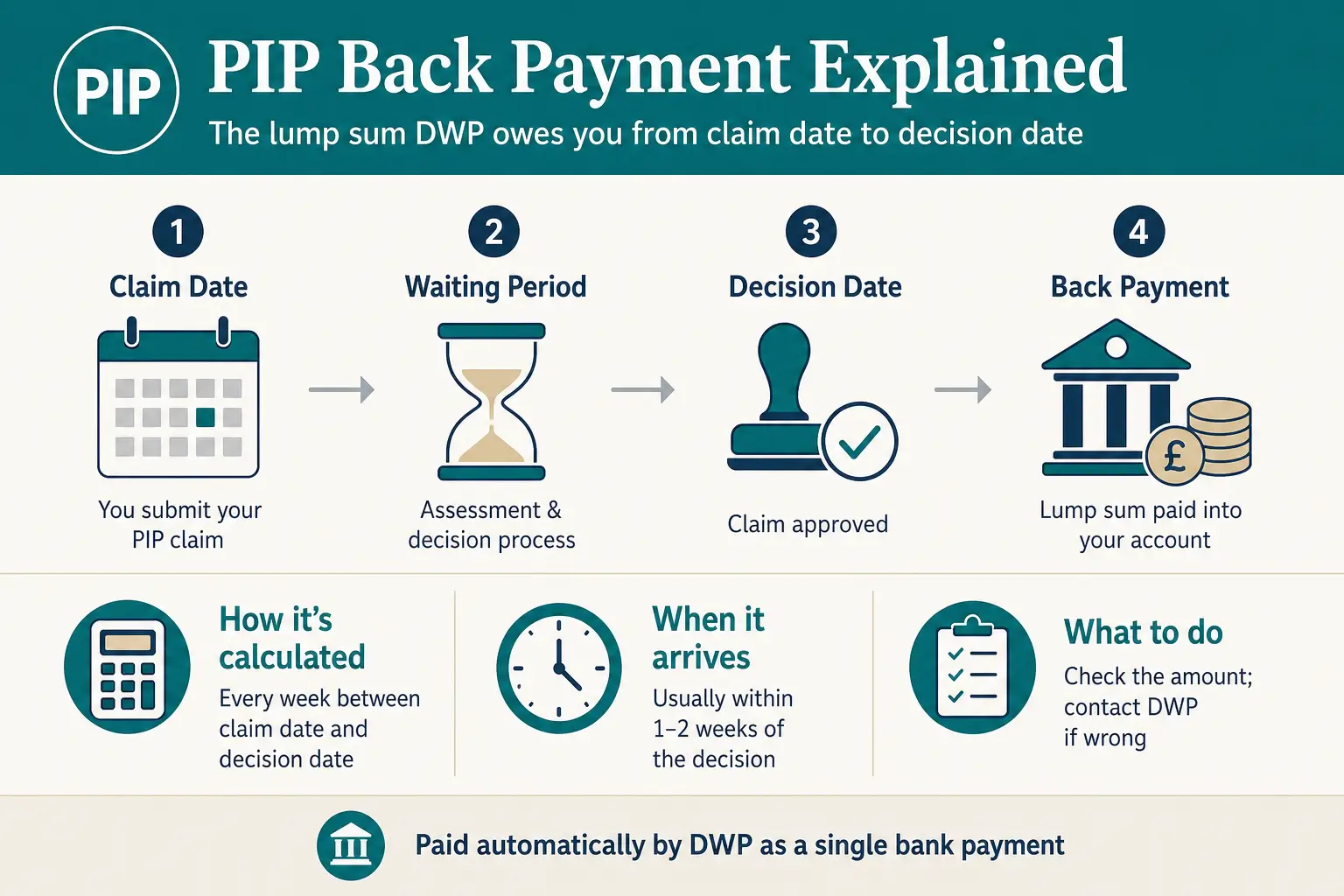
Personal Independence Payment (PIP) back payment is the lump sum the DWP owes you for every week between your claim date and your decision date. When your claim is approved, the DWP calculates it automatically and pays it as a single payment into your bank account — usually within 1–2 weeks of the decision.
If you’ve just been awarded PIP, are waiting for a decision, or want to check whether your back payment is correct, this guide answers every question about how much you’ll get, when the money arrives, and what to do if something goes wrong.
At a Glance: Key Facts About PIP Back Payment
| Fact | Detail |
|---|---|
| What it is | A one-off lump sum covering every week from your claim date to your decision date |
| Is it paid automatically? | Yes — no forms needed. The DWP calculates and pays it as part of your award |
| When does it arrive? | 1–2 weeks after your decision (sometimes before your letter arrives) |
| Is it paid separately? | It arrives together with your first regular PIP payment — one combined bank transfer |
| How much could you get? | Between £800 and £12,000+ depending on your rate and how long you waited |
| Does it affect Universal Credit? | No — PIP is tax-free and doesn’t count as income for UC or other means-tested benefits |
| Is it taxable? | No — PIP back payment is completely tax-free |
| Current maximum weekly rate | £194.60/week (Enhanced Daily Living + Enhanced Mobility, from April 2026) |
PIP Back Payment Calculator
Use our free calculator to estimate your back payment in seconds:
- Handles 3 scenarios: New Claim, Tribunal/MR, and Rate Change
- Day-accurate — no rounding errors
- Applies the correct DWP rate for each financial year automatically
- Download your estimate as a PDF
👉 Open the PIP Back Pay Calculator
Is PIP Back Pay Paid Separately From Your First Payment?
 This is one of the most common questions claimants ask. Here’s the clear answer:
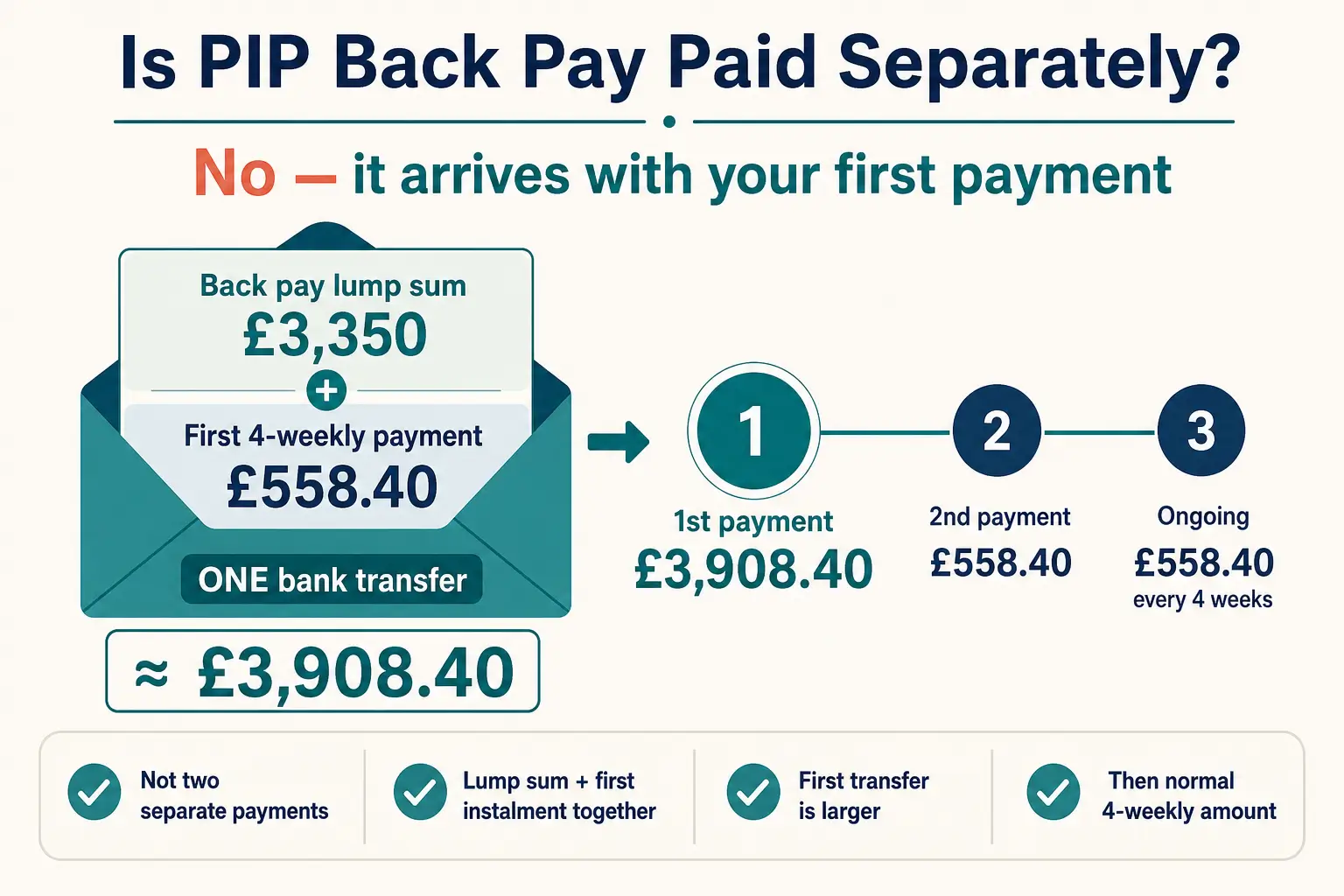
No — your back pay is not paid separately. It arrives as part of your first PIP payment, combined with your first 4-weekly instalment. You’ll see one bank transfer that is larger than your normal payments because it includes:
- Your back pay lump sum (arrears from claim date to decision date)
- Your first regular 4-weekly PIP payment
Example: If your back pay is £3,350 and your regular 4-weekly payment is £558.40, you’ll receive a single transfer of approximately £3,908.40 on your first payment date. After that, your payments return to the normal £558.40 every 4 weeks.
So to summarise:
- You do not receive two separate payments
- The lump sum and first regular payment arrive together
- Your first bank transfer will be noticeably larger than subsequent payments
- From the second payment onwards, you receive the normal 4-weekly amount
How Long After Being Awarded PIP Do You Get Back Pay?
This depends on how your award was reached. Here’s the timeline for every scenario:
After a New Claim Decision
| Stage | Typical Wait |
|---|---|
| DWP makes the decision | Day 0 |
| You receive the award text message | Usually same day or 1 day later |
| Back payment is processed | 1–2 weeks after decision |
| Decision letter arrives by post | Usually 3–10 working days |
| Money in your bank | Usually 7–14 days after the decision |
The median new PIP claim clearance time is currently 18 weeks from start to finish — gov.uk: PIP Official Statistics to April 2026. At standard combined rates, an 18-week wait produces a back payment of approximately £1,926.
After a Mandatory Reconsideration (MR)
| Stage | Typical Wait |
|---|---|
| DWP completes the MR | Day 0 |
| Additional back payment processed | 1–2 weeks after MR decision |
| Covers the difference between old and new rates | Backdated to your original decision date |
DWP MR clearance times in 2026 average 8–13 weeks. At a combined standard rate, a 10-week MR period produces an estimated additional back payment of approximately £1,070.
After Winning a Tribunal Appeal
| Stage | Typical Wait |
|---|---|
| Tribunal decides in your favour | Day 0 |
| DWP processes the new award | 2–4 weeks |
| Back payment arrives in your bank | 2–4 weeks after the tribunal decision |
Tribunal back pay covers the entire period from your original DWP decision date to the tribunal outcome — not just the tribunal waiting time. This means the longer the appeal took, the larger your lump sum.
PIP appeals currently take an average of 37 weeks from lodging to a hearing. At the maximum combined rate of £194.60/week, a 37-week appeal produces a lump sum of approximately £7,200.
64% of PIP appeals heard at tribunal between October and December 2025 were decided in the claimant’s favour — gov.uk: HMCTS Tribunal Statistics, October–December 2025.
After a DWP Review (MM Judgment or Other Review Exercise)
| Stage | Typical Wait |
|---|---|
| DWP identifies you and processes the review | Varies |
| Back payment paid | 2–6 weeks after review decision |
| Covers arrears going back to | 6 April 2016 (for MM judgment cases) |
The DWP contacts you automatically if you’re affected. You don’t need to do anything.
Summary Table: How Long Does PIP Back Pay Take?
| Scenario | Typical Wait for Back Pay | Estimated Lump Sum Range |
|---|---|---|
| New claim awarded | 1–2 weeks after decision | £800–£4,000 |
| Mandatory Reconsideration won | 1–2 weeks after MR decision | £500–£2,000 |
| Tribunal appeal won | 2–4 weeks after tribunal | £3,000–£12,000+ |
| DWP review exercise | 2–6 weeks after review | £5,000–£12,000+ |
If your payment hasn’t arrived after 3 weeks, call the PIP enquiry line on 0800 121 4433 (Monday–Friday, 9am–5pm). Have your National Insurance number ready.
“We’ve Awarded You PIP” — I Got a Text Message, When Will I Get Paid?
Many claimants first learn they’ve been awarded PIP through a text message from the DWP. The text typically says something like:
“We have awarded you PIP. We have sent you a decision letter explaining the award. Please allow 2 weeks to receive this. You only need to contact us if your circumstances change.”
Or:
“Your PIP review is complete. You should receive your decision letter in 2 weeks. Once you receive your letter, contact us if you have any questions.”
Here’s what happens next and when the money arrives:
Timeline After the Award Text Message
| Event | When |
|---|---|
| You receive the text message | Day 0 (today) |
| Decision letter posted to you | Within 1–3 working days |
| Letter arrives by Royal Mail | 3–10 working days |
| Back payment goes into your bank | Usually 7–14 days after the text |
| First regular 4-weekly payment | 4 weeks after the combined first payment |
Key points:
- Your payment usually arrives BEFORE the letter. Bank transfers process faster than Royal Mail delivers post. This is completely normal — don’t panic if money appears in your account before the brown envelope arrives.
- Don’t call the DWP before you receive the letter (as the text itself says). The DWP cannot tell you the decision details over the phone until the letter has been posted.
- Check your bank daily after about 5–7 days from the text message. DWP payments are processed via BACS and can take up to 3 working days to clear.
What to Do After Getting the Text
- Note the date of the text message — this helps you track your payment timeline
- Wait for the letter — it confirms your award level, rates, and payment dates
- Check your bank after 7 days
- Read the letter carefully — verify the start date matches when you first contacted the DWP
- Keep the letter safe — you’ll need it as proof for other benefits, council tax reduction, Blue Badge applications, and more
How Far Back Can PIP Be Backdated?
This is one of the most misunderstood parts of PIP. Here’s exactly how the backdating works:
The General Rule: Backdated to Your Claim Date
PIP is backdated to the date you first contacted the DWP to start your claim — not the date you sent the form, not the date of your assessment, and not the date of the decision. Your claim date is the day you:
- Called the PIP new claims line (0800 917 2222), OR
- Were sent the PIP1 form after your initial contact
This is the date your entitlement starts. Every week from that date to your decision date is covered by back pay.
The 3-Month Qualifying Period
For new claims, there’s an additional rule. Your back payment cannot start until your condition has affected you for at least 3 consecutive months (the “qualifying period”). This means:
- If you’ve had your condition for years before claiming: your back pay starts from your claim date
- If your condition started recently and you claimed immediately: your back pay starts from your claim date + 3 months
- The qualifying period is a waiting period, not a backdating limit
Example: You call the DWP on 1 January 2026 to claim PIP. You’ve had your condition for 2 years. The DWP awards you PIP on 1 May 2026. Your back pay covers 1 January to 1 May — that’s 17 weeks. The 3-month qualifying period is already satisfied because your condition existed long before you claimed.
Can PIP Be Backdated Before Your Claim Date?
Generally, no. PIP cannot be backdated to before you first contacted the DWP — even if your condition existed earlier or you were diagnosed years ago. This is different from some other benefits (like Universal Credit, which can be backdated up to 1 month on request).
However, there are exceptions:
| Situation | Can It Be Backdated Before Claim Date? | How Far Back? |
|---|---|---|
| New PIP claim | No — from claim date only | 0 months before claim |
| Mandatory Reconsideration | Yes — back to original decision date | To the date of the wrong decision |
| Tribunal appeal win | Yes — back to original DWP decision date | To the date of the original (incorrect) decision |
| DWP review exercise (MM judgment) | Yes — back to 6 April 2016 | Up to 10 years in some cases |
| Transferring from DLA to PIP | No — DLA continues until PIP starts | No separate back pay |
| Terminally ill (Special Rules) | Yes — from claim date, no qualifying period | 3-month wait is waived |
Can PIP Be Backdated 2 Years or 3 Years?
- For a standard new claim: No — it’s only backdated to your claim date, not years before.
- For a tribunal win or DWP review: Yes — if your original decision was 2 or 3 years ago and you won on appeal, or if you’re included in a DWP review exercise, arrears can go back that far.
- For the MM Supreme Court judgment review: Arrears go back to 6 April 2016 — potentially 10 years of backdated payments. Some claimants have received £5,000 to £12,000.
Common Myth: “PIP Is Automatically Backdated 3 Months Before You Claim”
This is wrong. Many people believe PIP is backdated three months before they claimed. That’s not how it works. The 3-month period is a waiting period after you claim, not a backdating period before you claim. PIP is only backdated to the date you first contacted the DWP — not before.
This is why it’s critical to claim as soon as you need help. Every day you delay is a day of PIP you lose.
When Exactly Does PIP Back Pay Go Into Your Bank?
Claimants often ask about the exact timing of the payment. Here’s what to know:
What Time Does the Money Arrive?
PIP payments are processed via BACS transfer. Most banks credit BACS payments:
- Between midnight and 6am on the payment date (most common)
- By 11:59pm on the payment date (some banks)
- Occasionally the next working day if processed late
You cannot choose what time the money goes in — it depends on your bank’s processing schedule. Most claimants find the money in their account first thing in the morning on the payment day.
Can PIP Back Pay Go In on a Weekend or Bank Holiday?
Yes. If your scheduled payment date falls on a weekend or bank holiday, the DWP usually moves the payment to the last working day before the weekend/holiday. So you may receive it on a Friday instead of a Monday.
| Payment Date | Actual Payment Day |
|---|---|
| Saturday 12 April | Friday 11 April |
| Sunday 13 April | Friday 11 April |
| Monday 18 August (Bank Holiday) | Friday 15 August |
| Tuesday–Friday (normal day) | That day as normal |
How Long Does It Take for the Payment to Clear?
Once the DWP sends the payment via BACS:
- Most banks: Cleared and available to spend within 1–3 working days
- Some banks: Available immediately on the payment date
- Credit unions: May take up to 3 working days
If the money hasn’t appeared after 3 working days past the expected date, contact your bank first, then call the PIP enquiry line on 0800 121 4433.
How Much Will Your PIP Back Payment Be?
Your back payment depends on two things:
- Which rate you’re awarded (Daily Living and/or Mobility component, Standard or Enhanced)
- How long you waited for a decision
The Formula
PIP Back Pay = (Your Weekly Rate) × (Number of Weeks from Claim Date to Decision Date)
If you were already receiving some PIP during the waiting period (for example, from a previous award), the DWP subtracts what you already got.
Current PIP Rates (2026/27)
From 6 April 2026, PIP rates increased by 3.8%:
| Component | Standard Rate | Enhanced Rate |
|---|---|---|
| Daily Living | £76.70 per week | £114.60 per week |
| Mobility | £30.30 per week | £80.00 per week |
| Combined Maximum | £107.00 per week | £194.60 per week |
If you’re awarded both enhanced rates from April 2026, that’s over £10,000 per year (£194.60 × 52 = £10,119.20).
Previous Rates (2025/26)
These rates applied from April 2025 to 5 April 2026:
| Component | Standard Rate | Enhanced Rate |
|---|---|---|
| Daily Living | £73.90 per week | £110.40 per week |
| Mobility | £29.20 per week | £77.05 per week |
| Combined Maximum | £103.10 per week | £187.45 per week |
Worked Example
Sarah from Manchester claimed PIP. Here’s what she received:
| Detail | Value |
|---|---|
| First contact date (claim date) | 1 January 2026 |
| Decision date | 1 May 2026 (17 weeks later) |
| Award | Enhanced Daily Living + Standard Mobility |
| Weekly rate | £114.60 + £30.30 = £144.90 |
| Total back payment | £144.90 × 17 = £2,463.30 |
Sarah received £2,463.30 as a lump sum with her first payment.
What Is the Maximum PIP Back Payment?
There is no fixed maximum — it depends entirely on your rate and how long you waited.
| Waiting Period | Enhanced Both (2026/27) | Standard Both (2026/27) |
|---|---|---|
| 15 weeks | £2,919.00 | £1,605.00 |
| 18 weeks (median claim) | £3,502.80 | £1,926.00 |
| 20 weeks | £3,892.00 | £2,140.00 |
| 26 weeks | £5,059.60 | £2,782.00 |
| 37 weeks (average tribunal) | £7,200.20 | £3,959.00 |
| 52 weeks (1 year) | £10,119.20 | £5,564.00 |
With tribunal waits of 37+ weeks at the maximum rate, some claimants receive £7,000 to £12,000+ in backdated payments.
Related Guide: PIP Lump Sum Back Payment from DWP: How Much Can You Receive?
How Is PIP Back Pay Calculated When Your Claim Spans Multiple Rate Years?
If your back-pay period crosses 6 April (the start of a new financial year), the DWP applies two different weekly rates — the old rate for weeks before April and the new rate for weeks after April. Your back payment is the sum of both portions.
Worked Example: Multi-Year Calculation
Your entitlement started 1 February 2025. Your decision date was 1 June 2025. Your award is Standard Daily Living + Standard Mobility.
| Period | Rate Year | Weekly Rate | Weeks | Amount |
|---|---|---|---|---|
| 1 Feb – 5 April 2025 | 2024/25 | £72.65 + £28.70 = £101.35 | 9 weeks | £912.15 |
| 6 April – 1 June 2025 | 2025/26 | £73.90 + £29.20 = £103.10 | 8 weeks | £824.80 |
| Total back payment | 17 weeks | £1,736.95 |
The calculator handles this multi-year calculation automatically. You don’t need to do this manually.
Who Is Eligible for PIP Back Payments?
Good news: if your PIP claim is successful, you’re automatically eligible for back payment. You don’t need to:
- Fill in extra forms
- Make a separate request
- Ask for backdating
The DWP calculates and pays your arrears as part of the normal award process.
Special Cases
| Situation | Back Pay Eligible? | Notes |
|---|---|---|
| New claim awarded | ✅ Yes | From claim date to decision date |
| Mandatory Reconsideration won | ✅ Yes | From original decision date |
| Tribunal appeal won | ✅ Yes | From original DWP decision date (covers entire appeal period) |
| DLA to PIP transfer | ❌ No separate back pay | DLA continues until PIP starts |
| Terminally ill (Special Rules) | ✅ Yes — from claim date, immediately | 3-month qualifying period is waived |
| DWP review exercise (MM judgment) | ✅ Yes — back to 6 April 2016 | DWP contacts you automatically |
Related Guide: Who Is Eligible for PIP Back Payments?
Terminally Ill Claimants (Special Rules for End of Life)
If you’re terminally ill, the normal rules are relaxed:
- The 3-month qualifying period is waived entirely
- Enhanced Daily Living rate is awarded automatically
- Back pay starts from your claim date immediately — no waiting period
- PIP is paid weekly instead of every 4 weeks
For more information: gov.uk: Claiming PIP if you’re nearing the end of life
DLA to PIP Transfer: No Back Pay
If you’re transferring from Disability Living Allowance to PIP, you do not receive separate back pay from your PIP claim date. DLA usually continues until the PIP decision is made, then PIP starts afterward. Back pay from the claim start date applies to entirely new PIP claims, not to DLA transfers.
Does PIP Back Payment Affect Universal Credit?
No. This is one of the most common worries, so let’s be very clear:
- PIP is not counted as income for Universal Credit or any means-tested benefit
- Your Universal Credit will not go down because you receive PIP
- In fact, receiving PIP can increase your UC — you may qualify for the LCWRA (Limited Capability for Work and Work-Related Activity) element or the disability element
Do I Need to Tell Universal Credit About My PIP?
Yes. You should tell the DWP that you’ve been awarded PIP, because it may increase your Universal Credit with additional disability elements. However:
- You must report the change in your UC journal
- Do not wait for the DWP to inform UC automatically — report it yourself to avoid delays
- Your UC may increase from the date you report it, or from the date of your PIP award, depending on timing
What About the Lump Sum — Does It Count as Savings?
Your backdated lump sum has special protection:
| Rule | What It Means |
|---|---|
| 12-month disregard | Your lump sum doesn’t count as savings for 12 months from the date you receive it |
| No benefit cap | PIP can lift the benefit cap from your household |
After 12 months, any remaining money from the lump sum may start counting as capital for UC purposes. The current UC capital limit is £16,000.
Other Benefits That May Increase
Receiving PIP can unlock or boost:
- Carer’s Allowance for someone who looks after you
- Housing Benefit premiums
- Council Tax reduction
- Blue Badge for parking
- Motability Scheme for vehicle leasing
- Disabled Persons Railcard
Lump Sum or Instalments: Which Should You Choose?
For large back payments, the DWP may contact you and offer a choice:
- Lump sum: Full amount paid at once
- Instalments: Spread over several payments
Most people should choose the lump sum. Here’s why:
- If you choose instalments that extend beyond 12 months, payments arriving after the first year may start counting as savings for UC purposes
- The lump sum avoids this issue entirely — it’s protected for the full 12-month disregard period
- The lump sum gives you immediate access to the full amount
Many people use their back payment to:
- Pay off debts
- Buy mobility aids
- Make home adaptations
- Cover extra care costs
- Save for emergencies
PIP Back Payment After Appeal or Review
What if you disagreed with your original decision and challenged it? Here’s how back payments work in those situations.
After Mandatory Reconsideration
If you asked for a Mandatory Reconsideration (MR) and the DWP increased your award:
- You receive additional arrears covering the difference between your old and new rates
- It’s backdated to your original decision date (not the MR request date)
- Payment arrives 1–2 weeks after the MR decision
In October to December 2025, approximately 60% of MRs resulted in a change to the award — gov.uk: HMCTS Tribunal Statistics. Don’t give up if your initial decision was wrong.
After Tribunal Appeal
If your MR failed and you appealed to an independent tribunal:
- 64% of PIP appeals heard at tribunal between October and December 2025 were decided in the claimant’s favour — gov.uk
- Additional back payment is calculated from your original DWP decision date (not the tribunal date)
- The entire appeal period is covered — so if you waited 37 weeks for the tribunal, you receive 37 weeks of back pay
- Allow 2–4 weeks for payment after a successful tribunal
The tribunal is run by HMCTS (His Majesty’s Courts and Tribunals Service), not the DWP. It’s independent.
Related Guide: How Long After Winning PIP Tribunal Will I Get Paid? — includes step-by-step tribunal payment timeline
After DWP Review (MM Judgment)
If you’re affected by the MM Supreme Court judgment review:
- The DWP identifies you automatically
- No action needed from you
- Arrears paid as a lump sum or instalments (your choice)
- Can go back to 6 April 2016
PIP Back Payment for Mental Health Conditions
The MM Supreme Court judgment specifically affects people with mental health conditions, such as:
- Anxiety
- Depression
- PTSD
- Bipolar disorder
- Schizophrenia
Read Details Here: PIP Back Payments for Mental Health Conditions
The ruling said the DWP must properly consider the support you need to engage with other people face-to-face. Before this ruling, many mental health claimants were underpaid or unfairly assessed.
If you claimed PIP since 6 April 2016 with a mental health condition, you may be included in the ongoing review. The DWP expects to complete this review by the end of 2026.
The Mobility component can also apply if psychological distress prevents you from making journeys. You don’t need a physical disability to qualify for Mobility.
Will You Get Payment Before Your Decision Letter?
Probably yes. The DWP processes payments electronically. Royal Mail delivers letters by post. Electronic payments are faster.
Many people see money in their bank account before the brown envelope arrives. This is completely normal. Don’t panic.
Read Detail Here: Will I Get PIP Back Payment Before My Decision Letter?
Your decision letter confirms:
- Your award level (Daily Living and Mobility components)
- Which rate you get (Standard or Enhanced)
- When your award starts
- When your award ends (if fixed-term)
- Your payment dates
- Your back payment breakdown
Keep this letter safe. You’ll need it as proof for other benefits and services.
What If Your Back Payment Is Wrong or Missing?
Errors happen. Here’s how to spot them and what to do.
Check Your Decision Letter
Look for these details:
- Start date — Should match when you first contacted the DWP
- Component rates — Correct Standard or Enhanced levels
- First payment amount — Should be larger than ongoing payments (includes arrears)
- 4-weekly cycle cut-off — The DWP calculates back pay to the start of the last complete 4-weekly payment cycle before your decision date, not to the exact decision date itself
If your letter says payments start from your decision date instead of your claim date, that’s wrong. You’re missing arrears.
Small Differences (Under £150) Are Usually Normal
The DWP calculates back pay to the start of the last 4-weekly cycle, not to the exact decision date. This can create a gap of £50–£150 between what you expected and what you received. This is not an error.
Example: Your daily rate is £20.70. A 3-day difference produces a gap of approximately £62.10. A 5-day difference produces a gap of approximately £103.50.
If the Amount Is Wrong (Gap Over £150)
Work through these common errors:
| Error | What to Check |
|---|---|
| Wrong start date | Should match when you first contacted DWP — not assessment date or decision date |
| Missing component | If you were awarded both Daily Living and Mobility, check both appear |
| Wrong rate across April | If your period crosses 6 April, two different rates should apply |
| Unexpected deductions | DWP may deduct UC adjustments or other benefit overpayments |
How to Challenge
You have one month from your decision letter to challenge it:
- Request a Mandatory Reconsideration in writing
- If the MR fails, appeal to an independent tribunal within one month
Call 0800 121 4433 and ask for an itemised breakdown of your back-pay calculation in writing.
Get free help from:
- Citizens Advice: 03444 111 444
- Turn2us: Free PIP helper tool online
- Scope: Disability advice forum
- Your local welfare rights service
Historical PIP Rates (2013/14 to 2026/27)
If your claim spans multiple years, your back payment is calculated using different rates for each financial year. Here’s the full history:
| Year | Daily Living Standard | Daily Living Enhanced | Mobility Standard | Mobility Enhanced |
|---|---|---|---|---|
| 2026/27 | £76.70 | £114.60 | £30.30 | £80.00 |
| 2025/26 | £73.90 | £110.40 | £29.20 | £77.05 |
| 2024/25 | £72.65 | £108.55 | £28.70 | £75.75 |
| 2023/24 | £68.10 | £101.75 | £26.90 | £71.00 |
| 2022/23 | £61.85 | £92.40 | £24.45 | £64.50 |
| 2021/22 | £60.00 | £89.60 | £23.70 | £62.55 |
| 2020/21 | £59.70 | £89.15 | £23.60 | £62.45 |
| 2019/20 | £58.70 | £87.65 | £23.25 | £61.65 |
| 2018/19 | £58.70 | £87.65 | £23.25 | £61.65 |
| 2017/18 | £57.30 | £85.60 | £23.20 | £61.20 |
| 2016/17 | £55.10 | £82.30 | £21.80 | £57.45 |
| 2015/16 | £55.10 | £82.30 | £21.80 | £57.45 |
| 2014/15 | £53.10 | £79.15 | £21.80 | £57.45 |
| 2013/14 | £51.40 | £76.45 | £21.08 | £55.25 |
2026/27 rates confirmed at gov.uk/pip/how-much-youll-get. Rates rose by 3.8% from 6 April 2026, in line with the September 2025 CPI figure.
What’s Changing in 2026?
PIP Rates Increased by 3.8%
From 6 April 2026, all PIP rates increased. This means larger back payments for anyone whose claim spans the rate change.
PIP Review Periods Extended (From 2 June 2026)
From 2 June 2026, new PIP claims for claimants aged 25 and over in England and Wales receive a minimum 3-year award before the first review (replacing the previous 9-month minimum). If entitlement continues at the first review, the next award can last up to 5 years. In practice, the DWP is reported to be awarding around 4 years then 6 years.
This change does not affect existing claimants and does not change back payment rules.
Related Guide: PIP Review Changes 2026: Awards Extended to 3–5 Years
Timms Review
The government is reviewing PIP eligibility rules. A review co-chaired by Sir Stephen Timms published its interim report on 9 July 2026, finding that PIP is “not fit for purpose.” Final recommendations are due in autumn 2026.
Key points about potential future changes:
- Existing claimants won’t be affected
- More face-to-face assessments expected (rising to around 30%)
- Assessments may be recorded
- No changes to eligibility yet — current rules remain in place
For now, if you think you’re eligible, it’s worth claiming as soon as possible. The current rules remain in place until any changes are announced.
Frequently Asked Questions
How long does PIP take to pay backdated money?
Most claimants receive their lump sum within 1–2 weeks of the decision. If it hasn’t arrived after 3 weeks, contact the PIP helpline on 0800 121 4433.
How much back pay do you get from PIP?
It depends on your weekly rate and waiting time. With an 18-week wait (the current median) and the combined standard rate of £107.00/week (2026/27), you’d receive around £1,926. At the maximum rate of £194.60/week, a 20-week wait produces approximately £3,892. Some tribunal claimants waiting a year have received over £10,000.
Do you get the PIP back payment before the letter?
Often yes. Bank transfers process faster than postal delivery. It’s normal to see money in your account before the brown envelope arrives.
Is PIP back pay paid separately from the first payment?
No. Your back pay lump sum arrives together with your first regular 4-weekly PIP payment as a single combined bank transfer. Your first payment will be noticeably larger than subsequent payments.
How far back can PIP be backdated?
PIP is backdated to the date you first contacted the DWP to start your claim. It cannot be backdated before that date for a standard new claim. However, tribunal wins and DWP review exercises can award arrears going back years — the MM judgment review covers claims back to 6 April 2016.
Does PIP back payment affect Universal Credit?
No. PIP is not counted as income for means-tested benefits. Your UC will not decrease. It may actually increase through disability elements. The lump sum is disregarded as capital for 12 months.
Does PIP back payment count as savings?
Your lump sum is disregarded for 12 months from the date you receive it. After that, any remaining money may count as capital for UC purposes. Keep bank evidence showing the payment was DWP arrears.
Can PIP be backdated more than the claim date?
Generally no for new claims. But DWP review exercises (like the MM judgment) can award arrears back to 6 April 2016 for affected claimants. Tribunal wins also back pay to the original decision date.
What is the maximum PIP back payment?
There’s no set maximum. It depends on your rate and how long you waited. At the maximum 2026/27 rate of £194.60/week, every 10 weeks of waiting = £1,946. Some claimants from review exercises have received £5,000 to £12,000+.
Is PIP back payment taxable?
No. PIP is completely tax-free. You don’t need to declare it on tax returns.
Why haven’t I received my PIP back payment?
Delays happen due to bank processing, verification checks, or DWP workload. If it’s been more than 3 weeks since your decision, call 0800 121 4433 with your National Insurance number ready.
Will I get more back pay if I win an appeal?
Yes. If your Mandatory Reconsideration or tribunal appeal increases your award, the DWP issues additional arrears covering the difference, backdated to your original decision date — not the appeal date.
How long after winning a PIP tribunal will I get paid?
Typically 2–4 weeks after the tribunal decision. The DWP must process the new award, calculate arrears from your original decision date, and issue payment. The back pay covers the entire period from the original wrong decision to the tribunal outcome.
I got the “we’ve awarded you PIP” text message — when will I get paid?
Usually within 7–14 days of the text message. The payment often arrives before the decision letter. Check your bank daily after about a week.
What time does PIP back pay go into my bank?
PIP payments are processed via BACS. Most banks credit the money between midnight and 6am on the payment date, or by end of that day. Exact timing depends on your bank.
Can PIP back pay go in on a weekend?
If your payment date falls on a weekend or bank holiday, the DWP usually moves it to the last working day before — typically the Friday.
Do I need to tell Universal Credit if I get PIP?
Yes — you should report your PIP award in your UC journal. PIP can increase your UC with disability elements. Don’t wait for the DWP to inform UC automatically.
How long does PIP back pay take after mandatory reconsideration?
Typically 1–2 weeks after the MR decision. The additional arrears cover the difference between old and new rates, backdated to your original decision date.
How is PIP back pay calculated?
PIP Back Pay = (Your Weekly Rate) × (Number of Weeks from Claim Date to Decision Date). If you were already receiving some PIP, the DWP subtracts what you already got. If your claim crosses 6 April, different rates apply for each financial year segment.
Is there a gov.uk PIP back pay calculator?
No. The DWP does not provide a public PIP back pay calculator. Our free calculator at pipbackpaycalculator.co.uk is an independent tool that uses official DWP rates.
Get Help and Support
Official Contacts
| Service | Number | Hours |
|---|---|---|
| PIP Enquiry Line | 0800 121 4433 | Mon–Fri, 9am–5pm |
| Textphone | 0800 121 4493 | Mon–Fri, 9am–5pm |
| Relay UK | 18001 then 0800 121 4433 | Mon–Fri, 9am–5pm |
| New Claims | 0800 917 2222 | Mon–Fri, 8am–5pm |
Free Advice Services
- Citizens Advice: 03444 111 444 or citizensadvice.org.uk
- Turn2us: Free online PIP helper and benefits calculator
- Scope: Disability advice and community forum
- Disability Rights UK: Guides and factsheets
Your MP Can Help
If the DWP is slow, not responding, or making errors, your Member of Parliament can chase them on your behalf. MPs work for everyone in their area — you don’t need to vote for their party.
Your Action Checklist
Use this checklist to make sure you receive the correct back payment:
- Record your first contact date — Check phone records or diary
- Return your PIP2 form on time — Within one month (ask for extension if needed)
- Attend your assessment — By phone, video, or in person
- Note the date of any award text message — This starts your payment timeline
- Check your bank after 7 days — Payment often arrives before the letter
- Check your decision letter — Verify start date matches first contact
- Check your first payment — Should be larger than regular payments (includes back pay lump sum)
- Contact DWP if wrong — Call 0800 121 4433
- Tell Universal Credit — Report your PIP award in your UC journal
- Challenge within one month — If you disagree with the decision or payment amount
- Keep your letter safe — You’ll need it for other services
Remember: PIP back payment is your money. It’s owed to you from the day you first contacted the DWP. Keep records, review your decision letter carefully, and don’t hesitate to challenge any errors. The system can be slow, but persistence pays off.
Reviewed by Jeremy Ogilvie-Harris, Public Law & Human Rights Barrister
Last reviewed: August 2026
Related PIP Calculators & Guides
- PIP Back Pay Calculator (Homepage)
- PIP Points Calculator
- PIP Rates 2026/27
- PIP Mandatory Reconsideration Guide
- PIP Review Changes 2026
- PIP Eligibility Guide
- PIP Back Payment Before Letter
- Who Is Eligible for PIP Back Payments?
- PIP Back Payments for Mental Health Conditions
- Explore All PIP Calculators